

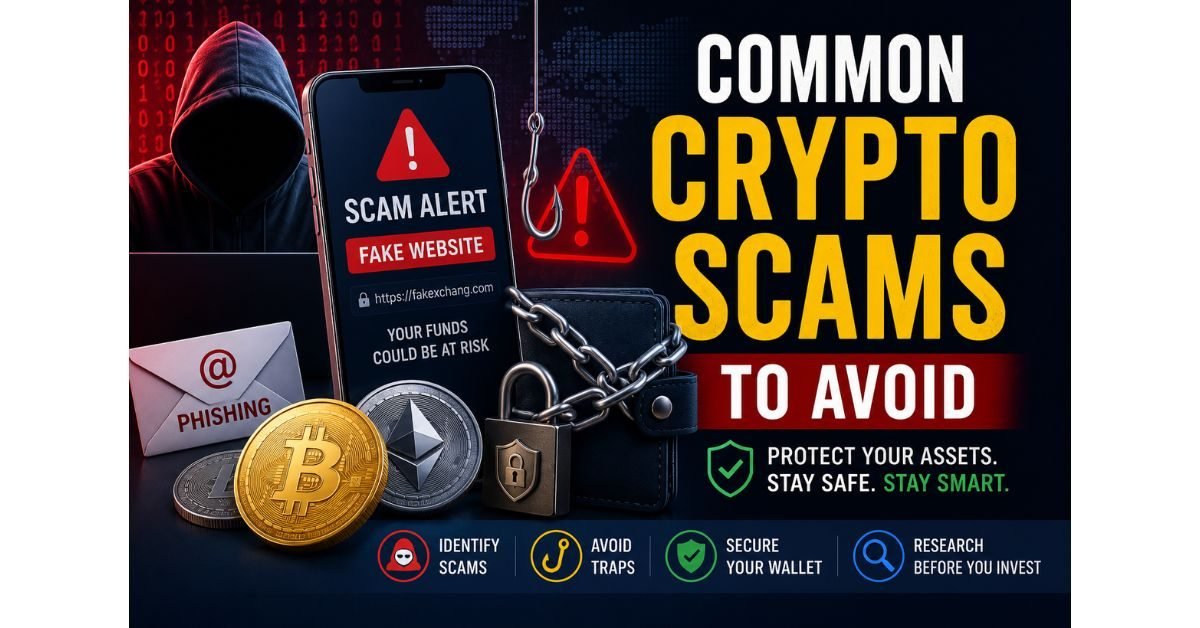
Common Crypto Scams to Avoid: Protect Your Cryptocurrency Investment
Introduction
The cryptocurrency market has created incredible opportunities for investors, but it has also become a target for scammers. Every year, thousands of people lose money because they fall victim to fake investment schemes, phishing attacks, fake crypto exchanges, and fraudulent giveaways.
Whether you’re investing in Bitcoin, Ethereum, or other cryptocurrencies, understanding common crypto scams is just as important as learning how to buy crypto. Knowing the warning signs can save you from financial loss and help you invest with confidence.
In this guide, you’ll learn the most common cryptocurrency scams, how they work, and practical steps to protect yourself.
What Are Common Crypto Scams? (Meaning)
Common crypto scams are fraudulent schemes designed to steal cryptocurrency, personal information, or private wallet credentials from investors.
Scammers often pretend to be trusted exchanges, investment companies, influencers, or technical support representatives to trick victims into transferring their digital assets.
Simply put,
A crypto scam is any deceptive activity intended to steal cryptocurrency or sensitive information from users.
Key Points
- Crypto transactions are usually irreversible.
- Never share your private keys or recovery phrase.
- Verify every website before investing.
- Avoid guaranteed profit schemes.
- Always use trusted exchanges and wallets.
- Stay updated with the latest scam techniques.
Visual Introduction
| Safe Investor | Scam Victim |
|---|---|
| Verifies websites | Clicks unknown links |
| Uses hardware wallet | Shares recovery phrase |
| Enables 2FA | Uses weak passwords |
| Researches projects | Invests blindly |
Features of Crypto Scams
- Fake promises of high returns
- Urgent investment requests
- Fake customer support
- Phishing websites
- Fake mobile applications
- Social media impersonation
- Giveaway fraud
- Ponzi or pyramid structures
Benefits of Learning About Crypto Scams
- Protect your investments
- Avoid financial losses
- Make smarter investment decisions
- Improve crypto security awareness
- Build confidence while investing
- Reduce the chances of account compromise
Quick Insights Table
| Scam Type | Risk Level | Prevention |
|---|---|---|
| Phishing Website | High | Verify URLs |
| Fake Exchange | High | Use official platforms |
| Giveaway Scam | High | Ignore “free crypto” offers |
| Rug Pull | High | Research projects |
| Ponzi Scheme | High | Avoid guaranteed returns |
| Fake Wallet App | Medium | Download only from official sources |
10 Common Crypto Scams to Avoid
1. Phishing Scams
Fraudsters create fake websites or emails that look identical to trusted exchanges and wallets.
Warning Sign
The website URL contains small spelling mistakes.
2. Fake Crypto Giveaways
Scammers pretend to be celebrities or crypto companies promising to double your cryptocurrency.
Remember:
Legitimate companies never ask you to send crypto first.
3. Ponzi and Pyramid Schemes
These scams pay early investors using money collected from new investors until the scheme collapses.
4. Rug Pull Scams
Developers launch a cryptocurrency project, attract investors, then suddenly withdraw all funds and disappear.
5. Fake Investment Platforms
These websites display fake profits but never allow withdrawals.
6. Romance Crypto Scams
Scammers build trust through online relationships before convincing victims to invest in fake cryptocurrency opportunities.
7. Fake Wallet Applications
Fraudulent apps steal your recovery phrase immediately after installation.
8. Social Media Impersonation
Scammers create fake profiles pretending to be famous crypto influencers or company representatives.
9. Pump-and-Dump Schemes
Groups artificially inflate a coin’s price before selling, leaving new investors with losses.
10. Technical Support Scams
Fraudsters claim to be customer support and request your wallet recovery phrase.
No genuine support team will ever ask for your private keys.
Small Case Study
Situation
A beginner investor received a message claiming to be from a popular exchange.
The message requested wallet verification through a provided link.
The investor entered the recovery phrase.
Within minutes, all cryptocurrency disappeared.
Lesson
Never enter your recovery phrase anywhere except during official wallet recovery.
Deep Explanation
Most crypto scams exploit emotions rather than technology.
Scammers create urgency using phrases like:
- Limited-time opportunity
- Guaranteed returns
- Double your Bitcoin
- Exclusive investment
- Secret crypto project
These tactics encourage investors to act quickly without proper research.
The safest investors always verify information before making financial decisions.
Real Example
Imagine Rahul discovers a Telegram group promising 5% guaranteed daily returns.
The group displays screenshots of huge profits.
Excited, Rahul transfers ₹50,000.
Initially, the website shows increasing profits.
When Rahul attempts to withdraw his funds, the platform demands additional “verification fees.”
Eventually, the website disappears.
This is a classic investment scam.
Risks of Crypto Scams
- Permanent financial loss
- Identity theft
- Wallet compromise
- Loss of private keys
- Malware infections
- Emotional stress
- Fake investment opportunities
Why Should You Learn About Crypto Scams?
Cryptocurrency transactions cannot usually be reversed.
Once scammers receive your cryptocurrency, recovering it is extremely difficult.
Learning scam prevention is one of the smartest investments you can make.
Current Trends
Crypto scams continue evolving with technology.
Recent trends include:
- AI-generated celebrity videos
- Deepfake investment promotions
- Fake Web3 applications
- Telegram trading groups
- QR code scams
- NFT fraud
- AI trading bot scams
Common Mistakes
- Trusting strangers online
- Ignoring website URLs
- Investing without research
- Sharing recovery phrases
- Clicking unknown links
- Downloading unofficial wallet apps
- Believing guaranteed profit claims
Pro Tips
- Enable Two-Factor Authentication.
- Store recovery phrases offline.
- Use hardware wallets for large investments.
- Research every crypto project before investing.
- Bookmark official exchange websites.
- Never rush investment decisions.
Expert Quote
“If an investment promises guaranteed returns with little or no risk, it’s almost certainly a scam.” — A widely accepted principle in financial and cryptocurrency investing.
Step-by-Step Guide to Stay Safe
Step 1
Research every cryptocurrency project.
Step 2
Verify official website URLs.
Step 3
Download wallets only from official sources.
Step 4
Enable Two-Factor Authentication.
Step 5
Never share your recovery phrase.
Step 6
Avoid investment schemes promising unrealistic profits.
Step 7
Stay informed about the latest cryptocurrency scams.
Future Outlook
As cryptocurrency adoption grows, scammers will continue developing more sophisticated fraud techniques, including AI-generated scams and advanced phishing attacks. At the same time, stronger blockchain security, improved wallet protections, and increased investor awareness will help reduce fraud. Staying educated and following cybersecurity best practices will remain the most effective defense.
Conclusion
Understanding common crypto scams is essential for anyone entering the cryptocurrency market. While blockchain technology is secure, scammers often target human mistakes rather than technical weaknesses. By researching projects, using trusted wallets and exchanges, enabling strong security measures, and avoiding offers that sound too good to be true, you can significantly reduce your risk and invest with greater confidence.
Remember, protecting your cryptocurrency starts with protecting yourself.
Frequently Asked Questions (FAQ)
1. What is the most common crypto scam?
Phishing scams are among the most common, where fake websites or emails trick users into revealing private keys or login credentials.
2. Can stolen cryptocurrency be recovered?
In most cases, cryptocurrency transactions are irreversible, making recovery very difficult.
3. How can I avoid crypto scams?
Use official platforms, verify website URLs, enable Two-Factor Authentication, and never share your recovery phrase.
4. Are crypto giveaways real?
Most “send crypto and receive more back” giveaways are scams. Always verify promotions through official company channels.
5. Is it safe to invest in cryptocurrency?
Yes, but investors should research thoroughly, use trusted platforms, and follow strong security practices.
Want to become a smarter crypto investor?
Explore more beginner-friendly guides, exchange reviews, wallet tutorials, blockchain insights, and cryptocurrency security tips on Acointrix. Our mission is to help you invest confidently with reliable, unbiased, and easy-to-understand crypto education.