
Introduction
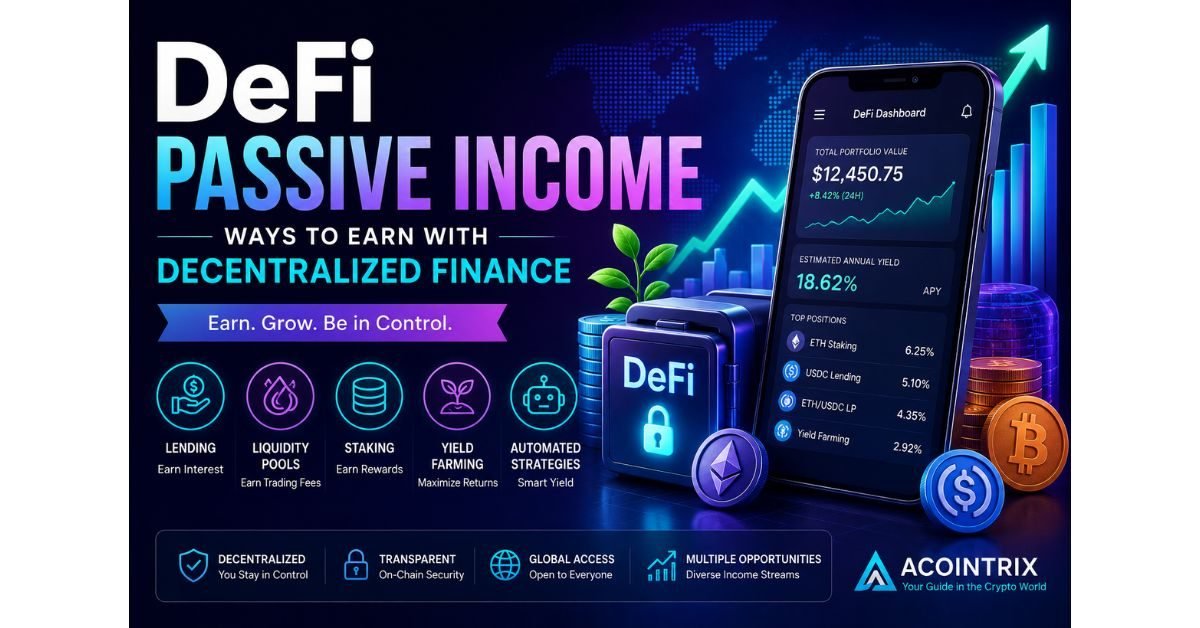
DeFi passive income has become one of the most discussed opportunities in the cryptocurrency and blockchain ecosystem.
Traditional financial services typically rely on banks, brokers, exchanges, and other intermediaries. Decentralized finance, or DeFi, uses blockchain networks and smart contracts to provide financial services such as lending, borrowing, trading, liquidity provision, and other forms of digital asset management.
Ethereum describes DeFi as an open financial system built for the internet, with applications that can allow users to borrow, lend, trade, save, and access other financial services through blockchain-based applications.
For crypto users, this creates several potential ways to generate returns from digital assets. These can include lending assets, providing liquidity to decentralized exchanges, staking, and participating in other protocol-based strategies.
But there is an important point to understand:
DeFi passive income is not guaranteed income.
Higher potential returns can come with higher risks, including smart-contract vulnerabilities, market volatility, impermanent loss, liquidation, protocol failure, and liquidity risk.
This guide explains what DeFi passive income means, how different strategies work, their potential benefits and risks, and how beginners can approach decentralized finance more responsibly.
Disclaimer: This article is for educational purposes only and is not financial, investment, tax, or legal advice. DeFi and cryptocurrency markets involve substantial risk, including possible loss of capital.
What Is DeFi Passive Income?
Meaning: What Is DeFi?
Decentralized Finance (DeFi) refers to blockchain-based financial applications that provide financial services without relying on traditional centralized intermediaries.
Instead of a bank managing a financial transaction, DeFi applications typically use smart contracts—programs deployed on a blockchain that execute predefined rules.
Ethereum explains that smart contracts can replace traditional intermediaries in certain financial transactions, while their code and transaction activity can be publicly inspected on the blockchain.
What Does DeFi Passive Income Mean?
DeFi passive income generally refers to potential returns generated by putting crypto assets to work within decentralized protocols rather than simply holding them.
Depending on the protocol, users may potentially earn:
- Lending interest
- Liquidity-provider fees
- Staking rewards
- Protocol incentives
- Yield from automated strategies
- Rewards associated with certain DeFi products
The important distinction is that these returns are generated through specific mechanisms and are not equivalent to guaranteed bank interest.
How Does DeFi Passive Income Work?
A simplified DeFi income model looks like this:
Crypto Assets → DeFi Protocol → Financial Activity → Potential Rewards
For example:
Lending
You supply crypto to a lending protocol.
↓
Borrowers use the available liquidity.
↓
You may receive interest according to the protocol’s rules.
Liquidity Providing
You supply assets to a liquidity pool.
↓
Traders use that liquidity.
↓
Liquidity providers may receive a share of applicable trading fees and, depending on the protocol, other incentives.
Staking
You commit eligible assets to a Proof-of-Stake network or staking mechanism.
↓
Your assets contribute to network operations.
↓
You may receive protocol-defined staking rewards.
The exact mechanics, risks, fees, and returns vary significantly between protocols.
Key Points About DeFi Passive Income
Before exploring individual strategies, remember these fundamentals:
- Returns are not guaranteed.
- Higher APY does not automatically mean a better opportunity.
- Crypto price movements can outweigh yield.
- Smart-contract risk is important.
- Fees can reduce your actual return.
- Some strategies require active monitoring.
- Liquidity can change quickly.
- Tax and regulatory treatment varies by jurisdiction.
The best DeFi strategy is not necessarily the one advertising the largest percentage.
It is the one whose mechanism and risks you actually understand.
Features of DeFi
1. Permissionless Access
Many DeFi applications can be accessed using a compatible crypto wallet without opening a traditional bank account.
2. Smart-Contract Based
Transactions and financial activities can be governed by blockchain-based smart contracts.
3. Transparent Transactions
Public blockchains can make transaction activity and protocol data visible for anyone to inspect.
4. Global Accessibility
DeFi applications can often be accessed across borders, subject to local laws and restrictions.
5. Programmability
Developers can combine different protocols and financial primitives to create new applications.
6. Composability
Different DeFi applications can sometimes interact with one another, creating what is often described as a financial “building block” ecosystem.
7 Ways to Earn With DeFi
1. DeFi Lending
One of the simplest DeFi income concepts is crypto lending.
Users supply digital assets to a lending protocol. Borrowers access liquidity by providing collateral under the protocol’s rules.
Aave, for example, describes its protocol as a non-custodial liquidity protocol where suppliers provide assets to markets and can earn interest, while borrowers generally provide collateral.
How It Works
Deposit assets → Protocol pools liquidity → Borrowers access funds → Supplier may earn interest
Potential Benefit
Lending can provide a way for holders of certain assets to potentially generate yield without selling those assets.
Key Risk
Rates can change, and protocol, smart-contract, liquidity, and asset risks remain.
2. Liquidity Providing
Decentralized exchanges need liquidity so users can trade assets.
Liquidity providers contribute assets to liquidity pools and can potentially receive a portion of trading fees according to the pool’s design.
Ethereum’s DeFi resources identify Uniswap as an automated liquidity protocol and Aave as a decentralized lending and borrowing protocol.
Simplified Example
Imagine a liquidity pool containing:
ETH + USDC
You contribute both assets according to the pool’s requirements.
Traders use the pool to swap between the assets.
You may receive a share of applicable trading fees.
Main Risk: Impermanent Loss
If the relative prices of the assets change significantly, the value of your liquidity position can differ from simply holding the assets separately.
This is commonly referred to as impermanent loss.
Therefore:
Trading fees earned ≠ guaranteed profit
You must evaluate both the fees and the potential changes in asset composition and value.
3. Staking
Staking is another way crypto users may potentially earn rewards.
Proof-of-Stake networks use validators and staked assets as part of their consensus mechanisms.
Ethereum, for example, uses Proof-of-Stake and allows participation through different staking approaches.
Basic Model
Stake eligible crypto → Participate in network security/consensus → Receive potential rewards
Staking can be attractive to someone who already intends to hold an eligible asset.
However, staking does not eliminate the underlying cryptocurrency’s market risk.
4. Liquid Staking
Liquid staking is designed to provide a representation of staked assets that may be usable within other applications, depending on the protocol.
This can potentially improve capital flexibility compared with traditional staking arrangements.
However, it introduces additional layers of risk.
Lido’s documentation highlights risks including smart-contract vulnerabilities, slashing, liquidity risks, and the possibility that liquid staking tokens can trade below their underlying value.
Important Lesson
Liquid staking can increase flexibility, but:
More flexibility can also mean more complexity.
Users should understand the underlying protocol before participating.
5. Yield Farming
Yield farming generally refers to moving or allocating crypto assets across DeFi protocols to seek potential returns.
Rewards can come from:
- Lending activity
- Trading fees
- Liquidity incentives
- Protocol token rewards
- Other DeFi mechanisms
Yield farming can be considerably more complex than basic lending or staking.
Why?
Because users may need to understand:
- Multiple protocols
- Smart contracts
- Token incentives
- Liquidity
- Price volatility
- Gas costs
- Impermanent loss
A high advertised APY should never be considered a guarantee of sustainable returns.
6. Stablecoin Yield Strategies
Some DeFi protocols allow users to supply stablecoins and potentially earn yield.
Stablecoins are designed to maintain a relatively stable value against another asset, often a fiat currency such as the U.S. dollar.
However, “stable” does not mean “risk-free.”
Users should consider:
- Stablecoin design
- Collateralization
- Depeg risk
- Protocol risk
- Liquidity
- Counterparty or issuer exposure where applicable
A stablecoin strategy can reduce some forms of price volatility compared with volatile crypto assets, but it does not eliminate DeFi risk.
7. Automated DeFi Strategies
Some protocols build automated strategies that attempt to manage deposits across different DeFi opportunities.
These strategies may automate:
- Yield allocation
- Rebalancing
- Compounding
- Liquidity management
- Portfolio strategies
Automation can make DeFi easier to use, but it also means users must understand the underlying contracts and strategy.
Automation does not remove risk.
It can simply make the strategy easier to execute.
Benefits of DeFi Passive Income
Potential Benefit 1: Put Idle Crypto to Work
Instead of simply holding eligible assets, users may explore ways to potentially generate additional returns.
Potential Benefit 2: Access to Global Financial Applications
DeFi can provide access to blockchain-based financial products through internet-connected wallets, subject to network and jurisdictional limitations.
Potential Benefit 3: Transparency
Blockchain transactions and many protocol mechanisms can be publicly inspected.
Potential Benefit 4: Programmability
Users can potentially combine different financial applications.
Potential Benefit 5: Multiple Income Strategies
DeFi offers several different mechanisms rather than a single yield model.
Quick Insights Table
| DeFi Strategy | Potential Income Source | Complexity | Major Risk |
|---|---|---|---|
| Lending | Borrower interest | Low–Medium | Protocol & market risk |
| Liquidity Providing | Trading fees | Medium | Impermanent loss |
| Staking | Network rewards | Low–Medium | Market & validator risk |
| Liquid Staking | Staking rewards | Medium | Smart-contract & liquidity risk |
| Yield Farming | Fees + incentives | High | Strategy & protocol risk |
| Stablecoin Strategies | Lending/protocol yield | Medium | Depeg & protocol risk |
| Automated Strategies | Strategy-generated yield | Medium–High | Smart-contract & strategy risk |
Note: Complexity and risk vary by protocol. This table is a general educational comparison, not a ranking.
Small Case Study: A Simple DeFi Lending Example
Imagine a user supplies $5,000 worth of a stablecoin to a hypothetical lending protocol.
Assume the displayed annual rate is:
5%
A simplified calculation would be:
$5,000 × 5% = $250
The theoretical gross reward would be approximately $250 over one year if the rate stayed constant.
But real-world results may differ because:
- Interest rates can change.
- Fees may apply.
- The protocol may experience an incident.
- The asset may lose its intended peg.
- The user may withdraw at a different time.
- Tax obligations may apply.
Therefore:
Displayed APY ≠ Guaranteed Annual Profit
Deep Explanation: Why APY Can Be Misleading
Suppose one DeFi protocol advertises:
8% APY
and another advertises:
15% APY
It may seem obvious that 15% is better.
But you need to ask:
Where does the yield come from?
Is it generated by:
- Borrowing demand?
- Trading fees?
- Token incentives?
- Inflationary token emissions?
- A temporary promotional program?
Is the rate sustainable?
A high reward funded primarily by newly issued tokens may not have the same economic characteristics as yield generated from genuine protocol activity.
What risks are involved?
The higher-yield strategy may expose you to:
- Greater volatility
- Smart-contract risk
- Liquidity risk
- Impermanent loss
- Token price decline
This is why experienced DeFi users often evaluate yield quality, not just yield quantity.
Real Example: Aave Lending
Aave provides an example of how decentralized lending works.
Aave’s documentation explains that users can supply assets to liquidity markets and earn interest while those assets contribute to available liquidity. Borrowers generally access liquidity against collateral.
Importantly, Aave also explains that borrowing rates can change dynamically based on utilization and governance parameters.
This demonstrates a broader DeFi principle:
The yield you see today may not be the yield you receive indefinitely.
DeFi Passive Income Risks
DeFi can create new financial opportunities, but it also introduces significant risks.
1. Smart-Contract Risk
A bug or vulnerability in a smart contract can potentially result in loss of funds.
Even audited protocols cannot guarantee that every vulnerability has been discovered.
Lido’s risk documentation explicitly identifies smart-contract vulnerabilities as a risk for liquid staking applications.
2. Market Risk
The value of cryptocurrencies can move significantly.
A yield of 10% does not protect against a 30% decline in the underlying asset.
3. Impermanent Loss
Liquidity providers can experience impermanent loss when the relative prices of assets in a pool change.
4. Liquidation Risk
Some DeFi strategies involve borrowing against collateral.
If collateral falls sufficiently, a position can potentially be liquidated.
Aave’s documentation explains that borrowers must maintain sufficient collateral and that falling below required collateralization levels can lead to liquidation.
5. Liquidity Risk
You may not always be able to exit a position at the price or speed you expect.
This can become particularly important during periods of market stress.
6. Stablecoin Depeg Risk
A stablecoin can trade away from its intended reference value.
That can affect strategies that appear less volatile.
7. Validator and Slashing Risk
Some staking systems involve validator penalties.
Lido’s documentation notes that validator performance, slashing, fees, and network conditions can affect staking outcomes.
8. Regulatory Risk
The legal and regulatory treatment of DeFi and digital assets varies by jurisdiction and continues to evolve.
Lido’s current risk disclosure also emphasizes regulatory variability and uncertainty around digital assets, staking, and liquid staking.
Responsible DeFi: How to Approach It Safely
Responsible participation starts with understanding what you are actually doing.
Before Depositing Funds
Ask:
What generates this yield?
What happens if the asset price falls?
Can I withdraw immediately?
What fees will I pay?
Has the smart contract been audited?
What are the protocol’s known risks?
Who controls the contract?
What happens during an exploit?
What happens if liquidity disappears?
These questions can be more important than the advertised APY.
Why Do People Use DeFi for Potential Passive Income?
There are several reasons.
1. Direct Access
Users can interact directly with blockchain applications through compatible wallets.
2. Multiple Financial Opportunities
DeFi can support lending, trading, liquidity provision, staking, and other financial activities.
3. Potential Yield
Certain activities can generate rewards or fees.
4. Financial Experimentation
Developers and users can combine blockchain-based financial primitives in ways that are difficult to replicate in traditional financial systems.
5. Portfolio Utility
Some holders may prefer to explore ways of generating potential returns from assets they already intend to hold.
Trends Shaping DeFi
1. Liquid Staking
Liquid staking continues to develop as an alternative approach to traditional staking, offering potential flexibility while introducing additional risks.
2. Real-World Assets
DeFi is increasingly interacting with tokenized real-world assets and traditional financial instruments.
3. Layer-2 Networks
Lower-cost blockchain networks can make certain DeFi transactions more accessible.
4. Automated Strategies
Protocol automation can simplify complex yield strategies.
5. Better Risk Transparency
As the DeFi ecosystem matures, users are paying greater attention to audits, risk disclosures, protocol design, liquidity, and sustainability.
Common DeFi Mistakes
Mistake 1: Chasing the Highest APY
A very high APY can attract attention, but it may come with significantly higher risk.
Better Approach:
Understand how the yield is generated.
Mistake 2: Ignoring Gas Fees
Small positions can be heavily affected by transaction costs.
Better Approach:
Calculate expected net returns after fees.
Mistake 3: Not Understanding Impermanent Loss
Liquidity pools can behave differently from simply holding two assets.
Better Approach:
Understand the pool’s mechanics before depositing.
Mistake 4: Using Borrowing Without Understanding Liquidation
Borrowing against volatile collateral can create significant downside risk.
Better Approach:
Understand LTV, liquidation thresholds, health factors, and liquidation mechanics.
Mistake 5: Trusting Anonymous Links
Scammers can create websites that look like legitimate DeFi applications.
Better Approach:
Access protocols through verified official sources and carefully check URLs.
Mistake 6: Putting Everything Into One Protocol
Concentration creates additional risk.
Better Approach:
Consider whether your overall exposure is appropriate for your circumstances.
Pro Tips for DeFi Beginners
Tip 1: Start Small
Learn the mechanics with an amount you can afford to lose.
Tip 2: Read Official Documentation
Understand the protocol before connecting your wallet.
Tip 3: Check Contract Addresses
Do not interact with random contract addresses shared through social media.
Tip 4: Understand Fees
Calculate gas and protocol fees before executing transactions.
Tip 5: Don’t Trust Guaranteed Returns
DeFi cannot magically eliminate financial risk.
Tip 6: Track Your Transactions
Maintain records of deposits, withdrawals, rewards, swaps, and other transactions.
Tip 7: Protect Your Wallet
Never share your seed phrase or private keys.
Tip 8: Research Before You Deposit
A few minutes of research can help you identify obvious warning signs.
Step-by-Step Guide: How to Explore DeFi Passive Income
Step 1: Learn the Basics
Understand:
- Blockchain
- Wallets
- Smart contracts
- Gas fees
- Tokens
- Stablecoins
- DeFi protocols
Step 2: Decide What You Want to Do
Are you interested in:
- Lending?
- Staking?
- Liquidity providing?
- Stablecoin strategies?
Don’t begin with a complicated yield-farming strategy if you don’t understand basic DeFi.
Step 3: Research the Protocol
Check:
- Official website
- Documentation
- Smart-contract information
- Audit history
- Security incidents
- Governance
- Liquidity
- Risk disclosures
Step 4: Understand the Yield
Find out:
Where does the return come from?
This is one of the most important questions in DeFi.
Step 5: Calculate the Economics
Estimate:
Gross Yield − Fees − Potential Losses = Potential Net Result
This is only an analytical framework—not a guarantee.
Step 6: Connect Your Wallet Carefully
Verify that you are interacting with the legitimate protocol website.
Step 7: Start With a Small Amount
Learn how deposits, withdrawals, rewards, and fees actually work.
Step 8: Monitor Your Position
Watch:
- APY changes
- Asset prices
- Liquidity
- Protocol announcements
- Smart-contract risks
- Your exposure
Step 9: Review Regularly
DeFi strategies can change rapidly.
Don’t assume a strategy that made sense six months ago is still suitable today.
Expert Perspective
A useful principle for evaluating DeFi yield is:
“High yield should always lead to a better question: where is the yield coming from?”
This is not a promise of returns. It is a risk-analysis mindset.
The strongest DeFi users don’t simply search for the highest percentage.
They investigate:
Yield source + sustainability + liquidity + fees + technical risk + market risk.
That approach can help separate a potentially understandable strategy from one that simply looks attractive on a dashboard.
DeFi vs Traditional Passive Income
| Factor | Traditional Finance | DeFi |
|---|---|---|
| Intermediary | Usually present | Often reduced or replaced by smart contracts |
| Access | Account/application often required | Wallet-based access for many protocols |
| Operating Hours | Often institution-dependent | Blockchain networks can operate continuously |
| Transparency | Institution-controlled | Many blockchain transactions are publicly visible |
| Custody | Often third-party | Can be self-custodial |
| Yield | Usually defined by financial product | Depends on protocol mechanics |
| Risk | Market/institutional risk | Market + smart-contract + protocol risks |
| Technical Knowledge | Generally lower | Can be significantly higher |
This is a general comparison; individual products can differ considerably.
FAQ: DeFi Passive Income
What is DeFi passive income?
DeFi passive income refers to potential returns generated by using crypto assets in decentralized financial protocols, such as lending, staking, liquidity provision, or other yield strategies.
Is DeFi passive income guaranteed?
No. DeFi returns are not guaranteed. Rates can change, and users can lose money because of market movements, smart-contract vulnerabilities, liquidity problems, or other risks.
What is the easiest DeFi passive income strategy for beginners?
There is no universally best strategy. Lending or basic staking can be easier to understand than complex yield farming, but each has its own risks.
Can you make money with DeFi?
It is possible to earn rewards or fees through certain DeFi activities, but losses are also possible. Profit depends on the strategy, asset prices, fees, protocol performance, and other factors.
What is the difference between DeFi lending and liquidity providing?
DeFi lending generally involves supplying assets to a lending market where borrowers pay interest. Liquidity providing involves supplying assets to a trading pool and potentially earning applicable trading fees.
What is yield farming?
Yield farming generally describes strategies where users allocate assets across DeFi protocols to seek potential returns from fees, incentives, or other sources.
Is a higher DeFi APY better?
Not necessarily. A higher APY may come with higher market, smart-contract, liquidity, or token-incentive risk.
What is impermanent loss?
Impermanent loss is a potential loss in relative value experienced by liquidity providers when the prices of assets in a liquidity pool change compared with simply holding those assets.
Can I lose all my money in DeFi?
Yes. Depending on the strategy and failure scenario, users can potentially lose a substantial portion or all of their deposited funds.
Is DeFi safe?
No financial system is completely risk-free. DeFi has unique risks involving smart contracts, wallets, protocols, liquidity, market volatility, and governance.
Do I have to pay fees when using DeFi?
Blockchain transactions generally require network fees, and individual protocols may have additional fees. These costs should be considered when calculating potential returns.
Is DeFi legal?
The legal and regulatory treatment of DeFi varies by jurisdiction and can change over time. Users should understand the rules applicable where they live.
Future Outlook for DeFi Passive Income
The DeFi ecosystem is continuing to evolve.
Future developments may focus on:
- More efficient blockchain infrastructure
- Lower transaction costs
- Improved smart-contract security
- Better risk disclosures
- Tokenized real-world assets
- More sophisticated lending markets
- Liquid staking
- Automated portfolio strategies
- Cross-chain applications
- Greater institutional participation
However, growth does not mean risk disappears.
As the DeFi ecosystem becomes more sophisticated, users may need to become more sophisticated as well.
The future of DeFi passive income will likely be less about simply finding the highest APY and more about understanding where yield comes from, how sustainable it is, and what risks are attached to it.
Conclusion
DeFi passive income offers several ways for crypto users to potentially generate returns from digital assets.
The most common approaches include:
- DeFi lending
- Liquidity providing
- Staking
- Liquid staking
- Yield farming
- Stablecoin strategies
- Automated DeFi strategies
But potential returns always come with potential risks.
A 15% APY does not automatically make a strategy better than a 5% APY strategy.
The real questions are:
Where does the yield come from?
What risks are involved?
What fees will I pay?
Can I access my funds when I need them?
What happens if the market moves against me?
Understanding these questions is more valuable than chasing a headline percentage.
DeFi is an innovative financial ecosystem, but innovation requires responsible participation.
Learn first. Start small. Understand the risks. Never invest more than you can afford to lose.
Explore the World of DeFi With Acointrix
The DeFi ecosystem is changing quickly—and understanding the technology is the first step toward making informed decisions.
At Acointrix, we simplify complex topics across cryptocurrency, blockchain, DeFi, staking, Web3, and digital assets so readers can understand how the ecosystem works.
Want to understand crypto beyond the headlines?
Explore more educational crypto guides and blockchain insights on Acointrix.com.
Learn. Research. Understand. Navigate Crypto Smarter.