
Introduction
Cryptocurrency is known for price volatility, but one category of digital assets is designed to provide something very different: stability.
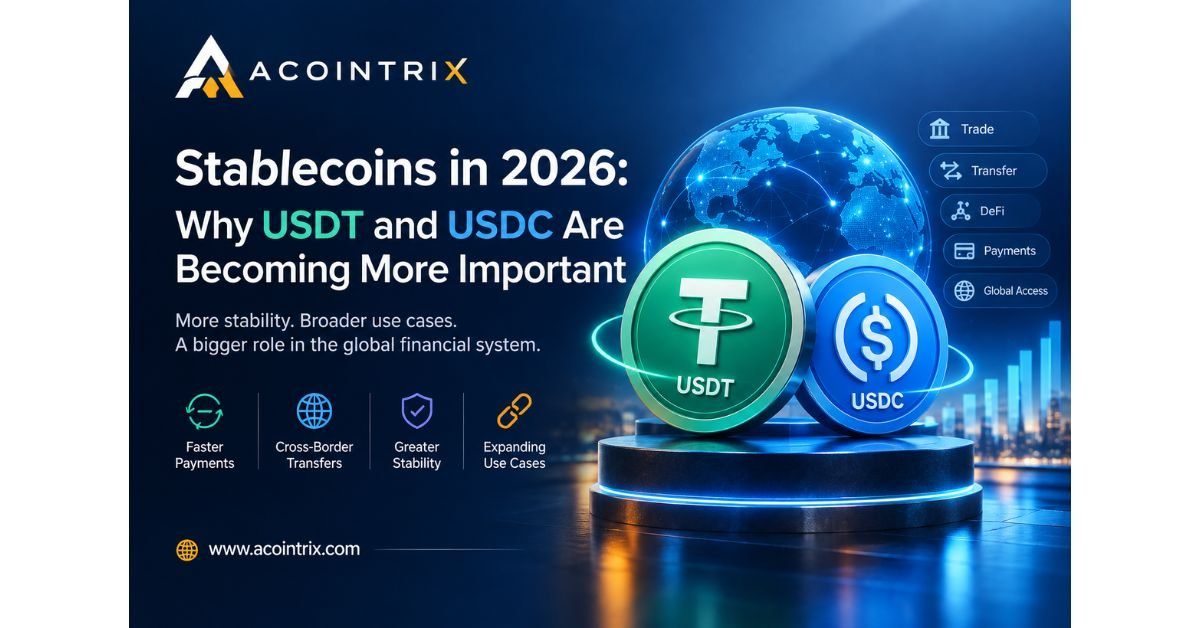
Stablecoins in 2026 are becoming increasingly important because they connect traditional fiat currencies with blockchain-based financial systems. Instead of moving directly between volatile assets such as Bitcoin and Ethereum, users can use dollar-pegged stablecoins to trade, transfer value, settle transactions and access digital financial services.
Two names dominate this conversation: USDT and USDC.
Tether’s USDT remains the largest stablecoin by supply, while Circle’s USDC has built a strong position around reserve transparency, regulatory alignment and institutional adoption. The IMF reported that USDT and USDC together represented more than 80% of stablecoin market capitalization in its 2026 research.
The broader stablecoin market has also grown substantially. BIS estimated global stablecoin market capitalization at approximately $315 billion in early April 2026, while IMF research reported that the market had reached about $300 billion by the end of 2025.
So why are stablecoins becoming more important in 2026?
The answer goes beyond crypto trading.
Stablecoins are increasingly being discussed as infrastructure for payments, cross-border transfers, digital commerce, tokenized assets and global dollar access.
What Are Stablecoins?
A stablecoin is a type of cryptocurrency designed to maintain a relatively stable value against another asset, most commonly the U.S. dollar.
Unlike Bitcoin or many other cryptocurrencies, stablecoins are generally designed to minimize price fluctuations.
For example:
- 1 USDT is designed to represent approximately 1 U.S. dollar.
- 1 USDC is designed to represent approximately 1 U.S. dollar.
This makes stablecoins useful as a digital representation of dollar value on blockchain networks.
Stablecoins can generally be categorized into several types:
- Fiat-backed stablecoins
- Crypto-backed stablecoins
- Commodity-backed stablecoins
- Algorithmic stablecoins
USDT and USDC belong to the fiat-backed category.
The important distinction is that a stablecoin is not the same thing as holding a U.S. dollar in a bank account. Its stability depends on the issuer, reserve assets, redemption mechanisms, market liquidity, regulation and operational infrastructure.
Key Points About Stablecoins in 2026
Before going deeper, here are the major developments investors and crypto users should understand.
- USDT remains the largest stablecoin by supply.
- USDC has strengthened its position among regulated and institutional users.
- Stablecoin market capitalization is now measured in hundreds of billions of dollars.
- Stablecoins are expanding beyond crypto trading.
- Cross-border payments are one of the biggest potential use cases.
- Regulatory frameworks are becoming more important.
- Reserve transparency is increasingly influencing user trust.
- Stablecoins are becoming part of the discussion around tokenized finance.
- USDT and USDC serve somewhat different market needs.
- Stablecoins still carry issuer, reserve, regulatory, liquidity and technology risks.
Visual Introduction: How Stablecoins Connect Traditional Finance With Crypto
Think of a stablecoin as a bridge:
Traditional Money
↓
Stablecoin Issuer & Reserves
↓
Blockchain Network
↓
Crypto Exchanges / DeFi / Payments / Businesses
↓
Global Users
This structure allows dollar-denominated value to move through blockchain networks without requiring users to directly transfer traditional bank money for every on-chain transaction.
That is one reason stablecoins in 2026 are receiving attention from both crypto companies and traditional financial institutions.
USDT in 2026: Why Tether Remains Important
Tether (USDT) remains the dominant stablecoin by circulating supply.
Tether’s transparency page provides information about the circulation of its tokens, while the company has continued publishing reserve information.
USDT has a particularly strong presence across global cryptocurrency markets and multiple blockchain networks.
Its major advantages include:
- Deep market liquidity
- Wide exchange availability
- Large global user base
- Extensive blockchain support
- Strong presence in crypto trading
- Significant use in emerging markets
- Large role in cross-border digital value transfers
USDT’s importance is therefore not simply related to its market capitalization.
Liquidity itself is extremely important.
A stablecoin that is available on many exchanges and blockchain networks can become easier to use for traders, businesses and other crypto applications.
USDC in 2026: Why Circle Is Gaining Attention
USD Coin (USDC) has taken a different approach to the stablecoin market.
Circle emphasizes reserve transparency, regulatory compliance and institutional integration.
Circle currently states that USDC is backed 100% by highly liquid cash and cash-equivalent assets, with reserves equal to or greater than USDC in circulation. Circle also publishes monthly reserve attestations from a Big Four accounting firm.
Circle reported approximately $74.3 billion USDC in circulation as of September 7, 2026.
This transparency-focused model has become increasingly relevant as stablecoin regulation develops.
For institutions, payment companies and financial businesses, questions about reserves, redemption and regulatory compliance can be just as important as transaction speed.
USDT vs USDC: What Is the Difference?
| Feature | USDT | USDC |
|---|---|---|
| Issuer | Tether | Circle |
| Peg | U.S. dollar | U.S. dollar |
| Primary role | Trading, liquidity and global transfers | Payments, DeFi and institutional use |
| Market position | Largest stablecoin by supply | Major second-largest stablecoin |
| Transparency focus | Reserve reporting and attestations | Strong reserve disclosure and attestations |
| Blockchain availability | Broad multi-chain presence | Broad multi-chain presence |
| Global liquidity | Extremely high | High |
| Institutional focus | Increasing | Strong |
| Regulatory focus | Increasing | Strong emphasis |
| Main consideration | Liquidity, availability and issuer risk | Regulation, reserves and issuer risk |
The comparison does not mean one stablecoin is universally better than the other.
The appropriate choice depends on the user’s purpose, jurisdiction, platform support, liquidity requirements and risk tolerance.
Features of Stablecoins in 2026
1. Dollar-Based Stability
Most major stablecoins are designed to maintain a value close to one U.S. dollar.
This makes them easier to understand than highly volatile crypto assets.
2. Blockchain-Based Transfers
Stablecoins can move across blockchain networks rather than relying exclusively on traditional banking rails.
3. 24/7 Availability
Blockchain networks can operate continuously, allowing stablecoin transfers outside conventional banking hours.
4. Global Accessibility
Stablecoins can provide digital access to dollar-denominated value in markets where access to traditional dollar banking services may be limited.
5. Programmability
Smart contracts can integrate stablecoins into decentralized applications, payment systems and automated financial processes.
6. Exchange Liquidity
USDT and USDC are widely integrated into cryptocurrency exchanges and decentralized applications.
7. Growing Regulatory Frameworks
Stablecoin regulation is becoming an increasingly important part of the financial system.
Benefits of Stablecoins in 2026
Faster Cross-Border Transfers
Traditional international transfers can involve multiple intermediaries, banking hours and settlement processes.
Stablecoins can potentially simplify the movement of digital dollar value across borders.
However, actual speed and cost depend on the blockchain network, exchange, wallet and conversion process.
Lower Friction for Crypto Trading
Stablecoins provide traders with a dollar-denominated asset without requiring them to immediately convert their crypto holdings into traditional bank currency.
Easier Settlement
Businesses and financial institutions can potentially use stablecoins for digital settlement and treasury operations.
Access to Dollar-Denominated Value
In countries with currency instability or limited access to U.S. dollar banking products, dollar-backed stablecoins can be attractive.
The IMF has highlighted emerging markets and cross-border money movement as important potential areas for stablecoin adoption.
Integration With DeFi
Stablecoins are foundational assets across decentralized finance.
They can be used for:
- Lending
- Borrowing
- Liquidity pools
- Decentralized exchanges
- Payments
- Settlement
Support for Tokenized Finance
As financial assets increasingly move onto blockchain networks, stablecoins can provide the settlement currency for tokenized assets.
Quick Insights Table
| Metric / Development | 2026 Insight |
|---|---|
| Global stablecoin market | Hundreds of billions of dollars |
| Market leaders | USDT and USDC |
| USDT | Largest stablecoin by supply |
| USDC | Major institutional and regulated-market competitor |
| Main denomination | U.S. dollar |
| Major use cases | Trading, settlement, payments and DeFi |
| Regulation | Becoming increasingly important |
| Major opportunity | Cross-border and digital payments |
| Major concern | Reserve, liquidity, regulatory and systemic risk |
BIS estimated stablecoin market capitalization at about $315 billion in early April 2026.
Why Are Stablecoins Becoming More Important in 2026?
There are several reasons.
1. Crypto Markets Need Stable Settlement Assets
Cryptocurrency markets operate globally and continuously.
Traders need assets that can move between exchanges and blockchain applications without exposing every transaction to Bitcoin- or altcoin-level volatility.
Stablecoins fill this role.
2. Payments Are Becoming a Bigger Focus
Stablecoins are increasingly being explored for cross-border payments, business settlements and digital commerce.
The Federal Reserve has noted that payment stablecoins are designed to maintain a stable one-to-one relationship with the U.S. dollar under the applicable regulatory framework.
3. Regulation Is Creating More Clarity
The U.S. GENIUS Act, enacted in July 2025, created a federal framework for payment stablecoins.
Regulatory developments are important because financial institutions generally need greater clarity before integrating new financial infrastructure at scale.
4. Traditional Finance Is Paying Attention
Banks, payment companies, asset managers and fintech businesses are increasingly exploring blockchain-based settlement.
This could expand stablecoin usage beyond cryptocurrency exchanges.
5. Tokenization Is Growing
Tokenized bonds, funds, equities and other real-world assets need settlement mechanisms.
Stablecoins can potentially provide the digital dollar component of these transactions.
Deep Explanation: Why USDT and USDC Are So Important
The importance of USDT and USDC comes from their network effects.
Imagine a crypto ecosystem where millions of users, exchanges, wallets and applications already understand the same digital dollar.
That creates a powerful effect.
More users create more liquidity.
More liquidity attracts more businesses.
More businesses create more applications.
More applications create additional demand.
This can create a cycle where stablecoins become financial infrastructure rather than simply another category of cryptocurrency.
However, this does not mean stablecoins are risk-free.
The stability of a stablecoin depends on its underlying structure.
What Makes a Stablecoin Stable?
A stablecoin’s stability can depend on:
Reserve assets
What assets back the stablecoin?
Redemption
Can holders redeem tokens under the issuer’s applicable terms?
Liquidity
Is there enough market liquidity to support trading?
Issuer
Who controls the stablecoin?
Regulation
What rules apply to the issuer and token?
Technology
Which blockchain supports the stablecoin?
Market confidence
What happens if users suddenly want to redeem large amounts?
These questions are becoming more important as stablecoins become larger.
Risks of Stablecoins in 2026
Stablecoins are not risk-free digital dollars.
1. Depegging Risk
A stablecoin can temporarily trade above or below its intended value.
Extreme market conditions can increase this risk.
2. Reserve Risk
Users depend on the quality, liquidity and management of reserve assets.
3. Issuer Risk
A stablecoin is connected to the company or organization responsible for issuing and managing it.
4. Regulatory Risk
Rules can differ between countries and may change over time.
5. Blockchain Risk
A stablecoin can inherit risks associated with the blockchain on which it operates.
6. Smart Contract Risk
Certain applications that use stablecoins can contain coding vulnerabilities.
7. Counterparty Risk
Users may interact with exchanges, custodians, wallets or payment providers in addition to the stablecoin issuer.
8. Centralization Risk
Some major stablecoins depend heavily on centralized issuers and compliance systems.
9. Systemic Risk
As stablecoins become more connected to traditional financial markets, problems in one part of the ecosystem could potentially affect others.
Recent research from the New York Fed has highlighted the growing interconnectedness between stablecoins and traditional financial markets.
Responsible Stablecoin Use
Anyone using stablecoins should approach them as financial infrastructure rather than automatically assuming they are equivalent to cash.
A responsible approach includes:
- Verify the issuer.
- Understand the reserve model.
- Check the blockchain network before sending funds.
- Verify wallet addresses carefully.
- Understand transaction fees.
- Review redemption and withdrawal conditions.
- Avoid unknown yield platforms.
- Use reputable exchanges and wallets.
- Understand local tax and regulatory requirements.
- Never invest money you cannot afford to lose.
Stablecoins reduce some types of volatility, but they do not eliminate financial risk.
Small Case Study: USDC and Institutional Settlement
Consider a hypothetical international business that needs to settle a digital transaction with a partner in another country.
Using traditional banking infrastructure may involve:
Business A
→ Bank
→ Correspondent Bank
→ International Settlement
→ Bank
→ Business B
A blockchain-based stablecoin model could potentially simplify the digital settlement layer:
Business A
→ USDC
→ Blockchain
→ USDC
→ Business B
The actual process can still involve exchanges, banks, compliance checks and conversion to local currency.
The important difference is that blockchain can provide a programmable settlement layer.
This is one reason USDC’s institutional positioning matters.
Circle’s current model emphasizes reserve transparency and integration with regulated financial infrastructure.
Real Example: USDT and Global Crypto Liquidity
USDT demonstrates another side of the stablecoin story.
Rather than focusing only on institutional settlement, USDT has become deeply integrated into global cryptocurrency trading and liquidity.
Its large supply, exchange availability and multi-chain presence make it an important quote and settlement asset throughout the crypto ecosystem.
Research and industry analysis in 2026 continues to show that USDT and USDC serve somewhat different roles across payments, DeFi and trading.
This illustrates an important point:
Stablecoin adoption is not one single trend.
Different stablecoins can become important for different use cases.
Stablecoin Trends to Watch in 2026
1. Stablecoin Payments
Payment companies are exploring blockchain-based settlement and stablecoin infrastructure.
2. Cross-Border Transfers
Stablecoins may become increasingly relevant for international business payments and remittances.
3. Institutional Adoption
Banks and financial institutions are exploring digital asset infrastructure.
4. Tokenized Assets
Stablecoins could become the settlement layer for tokenized financial assets.
5. Regulatory Competition
Countries and regions are developing different approaches to stablecoin regulation.
6. Multi-Chain Stablecoins
Stablecoins are increasingly available across different blockchain networks.
7. Greater Transparency
Reserve reporting, attestations and eventually more comprehensive audits are becoming increasingly important.
Tether announced in August 2026 that KPMG U.S. had conducted a full independent audit of its 2025 financial statements, although the audit itself had not been made public at the time of the Reuters report.
8. Competition Beyond USDT and USDC
New stablecoin models and entrants are likely to compete for payment, institutional and crypto-market use cases.
Common Mistakes When Using Stablecoins
Mistake 1: Assuming Every Stablecoin Is Identical
Different stablecoins have different issuers, reserves, regulations and risks.
Mistake 2: Ignoring the Network
Sending USDT or USDC through the wrong blockchain network can cause serious problems.
Mistake 3: Looking Only at Market Capitalization
Market cap does not tell the complete story.
Liquidity, transaction activity, geographical usage and institutional adoption also matter.
Mistake 4: Assuming Stable Means Risk-Free
A stablecoin is designed for price stability, not guaranteed safety.
Mistake 5: Chasing High Yield
A platform offering unusually high stablecoin returns may carry significant additional risks.
Mistake 6: Ignoring Regulation
Stablecoin rules can differ substantially between countries.
Pro Tips for Using Stablecoins
Tip 1: Check the issuer before using a stablecoin.
Tip 2: Verify the exact blockchain network before transferring.
Tip 3: Compare transaction fees.
Tip 4: Understand the reserve and redemption model.
Tip 5: Keep your wallet security strong.
Tip 6: Use reputable platforms.
Tip 7: Monitor regulatory developments in your country.
Tip 8: Don’t confuse a stablecoin with a bank deposit.
Tip 9: Keep records of transactions for accounting and tax purposes.
Tip 10: Diversify operational risk rather than assuming one stablecoin will always remain dominant.
Step-by-Step Guide: How to Evaluate a Stablecoin
Step 1: Identify the Issuer
Find out which company or organization issues the token.
Step 2: Understand the Peg
Check whether the token is designed to track USD, another currency or another asset.
Step 3: Review Reserves
Look for current reserve disclosures and independent attestations where available.
Step 4: Check Regulation
Understand which jurisdictions and regulatory frameworks apply.
Step 5: Check Blockchain Support
Confirm which networks support the stablecoin.
Step 6: Check Liquidity
Look at exchange liquidity and trading availability.
Step 7: Understand Redemption
Review how holders can redeem or convert the stablecoin.
Step 8: Assess Your Purpose
Are you using it for trading, payments, DeFi, remittances or holding dollar-denominated digital value?
Step 9: Review Fees
Consider blockchain transaction fees, exchange fees and conversion costs.
Step 10: Make a Risk-Aware Decision
Do not choose a stablecoin simply because it has the largest market capitalization.
Expert Perspectives on Stablecoins
The growing importance of stablecoins does not mean experts agree that they are automatically the future of payments.
The IMF has highlighted the rapid growth of stablecoins and their increasing role in cross-border payments and tokenized financial services.
The Federal Reserve has also noted that stablecoins can facilitate payment activity, while emphasizing the importance of their regulatory structure.
At the same time, BIS officials have raised concerns about interoperability, financial stability and monetary-system implications if stablecoins become widely used.
One important takeaway from these different perspectives is:
Stablecoin growth creates opportunities, but adoption does not remove the need for regulation, risk management and strong financial infrastructure.
This balanced view is important for anyone researching stablecoins in 2026.
Frequently Asked Questions
What are stablecoins in 2026?
Stablecoins in 2026 are blockchain-based digital assets designed to maintain a relatively stable value, usually against the U.S. dollar. They are increasingly used for crypto trading, settlement, DeFi and emerging payment applications.
What is USDT?
USDT, issued by Tether, is the largest stablecoin by circulating supply and is designed to maintain a value close to one U.S. dollar.
What is USDC?
USDC is a dollar-backed stablecoin issued by Circle. Circle emphasizes reserve transparency, regulatory compliance and institutional use.
Is USDT better than USDC?
Neither is universally better. USDT has exceptional global liquidity and exchange adoption, while USDC has strong positioning around transparency and regulated financial integration. The right choice depends on the use case and jurisdiction.
Are stablecoins safe?
Stablecoins can reduce exposure to crypto price volatility, but they are not risk-free. Users should consider issuer, reserve, regulatory, liquidity, blockchain and custody risks.
Can stablecoins be used for payments?
Yes. Stablecoins can be used for certain digital and cross-border payments, although adoption, merchant acceptance, regulation and infrastructure vary by market.
Are stablecoins regulated?
Regulation depends on the country and type of stablecoin. In the United States, the GENIUS Act created a federal framework for payment stablecoins, with further implementation and regulatory work continuing.
Why are USDT and USDC important?
They have large user bases, substantial liquidity and extensive integration across crypto markets and blockchain applications. Together they represent a significant share of the global stablecoin ecosystem.
Can stablecoins lose their dollar peg?
Yes. Stablecoins can temporarily trade above or below their intended value, particularly during periods of market stress or liquidity disruption.
Will stablecoins replace banks?
There is currently no basis for saying stablecoins will simply replace banks. Instead, they may become another layer of digital financial infrastructure that interacts with banks, payment companies and blockchain networks.
Future Outlook for Stablecoins
The future of stablecoins will probably be determined by more than crypto speculation.
The biggest question is whether stablecoins can move from being primarily crypto-market infrastructure toward broader financial infrastructure.
Several developments could influence that transition:
- Clearer regulation
- Greater institutional adoption
- Improved blockchain interoperability
- Better payment infrastructure
- Stronger reserve transparency
- More merchant acceptance
- Tokenized financial markets
- Cross-border business payments
- Competition among stablecoin issuers
The market is already large enough to attract serious attention from regulators and financial institutions.
However, there is an important reality check.
BIS research found that although stablecoin transaction volumes are very large, their real-economy payment use remains much smaller, with crypto trading still representing a major part of activity.
That means the next phase of stablecoin growth will depend on whether the technology can demonstrate sustainable real-world utility.
USDT may continue to dominate global crypto liquidity, while USDC may continue strengthening its position in regulated and institutional markets.
At the same time, new stablecoins could emerge with different models, currencies and use cases.
Conclusion
Stablecoins in 2026 are becoming more important because they provide a bridge between traditional money and blockchain-based finance.
USDT and USDC are leading this transformation, but they are not identical.
USDT’s strength comes from its enormous liquidity, global exchange presence and extensive crypto-market adoption.
USDC’s strength comes from its emphasis on reserve transparency, regulatory alignment and institutional integration.
The broader stablecoin market is now large enough to influence discussions around payments, tokenization, digital dollars and financial infrastructure.
But stablecoins should not be treated as risk-free assets.
Users need to consider reserves, issuer credibility, regulation, liquidity, blockchain technology and custody before using them.
For crypto investors, businesses and financial professionals, understanding USDT, USDC and the broader stablecoin ecosystem will be increasingly important as blockchain moves closer to mainstream financial infrastructure.
Acointrix: Stay Ahead of Crypto Trends
The crypto market is changing quickly, and understanding new developments is essential before making financial decisions.
At Acointrix, we cover cryptocurrency trends, blockchain technology, market developments, stablecoins, DeFi, regulations and emerging digital assets.
Follow Acointrix for practical crypto insights, market education and the latest developments shaping the digital asset industry.
Acointrix — Understand Crypto. Stay Informed.