
Introduction
Choosing a cryptocurrency exchange is one of the first major decisions an Indian crypto user makes.
Two names that frequently appear in this discussion are Binance and CoinDCX.
But Binance vs CoinDCX is not simply a question of which platform has more features. Indian users also need to consider INR access, KYC requirements, trading fees, available products, security controls, regulatory compliance, tax reporting, crypto withdrawals, liquidity, and ease of use.
Binance registered as a reporting entity with India’s Financial Intelligence Unit (FIU-IND) in August 2024 and subsequently made its platform available to Indian users.
CoinDCX, meanwhile, operates an India-focused exchange with INR trading, spot and derivatives products, VIP fee tiers, security programs, and compliance-focused processes. Its current fee structure is based on 30-day trading volume and VIP levels.
So, which one should you use?
The answer depends on what you actually need from a crypto exchange.
This guide breaks down the two platforms without relying on hype, and explains the differences that matter to Indian beginners, investors, and active traders.
What Is a Crypto Exchange?
A crypto exchange is an online platform that allows users to buy, sell, trade, and sometimes store cryptocurrencies.
Depending on the platform, users may get access to:
- Bitcoin and Ethereum
- Stablecoins
- Altcoins
- INR trading pairs
- Spot trading
- Futures and margin products
- Earn or staking products
- Crypto deposits and withdrawals
- Advanced trading charts
- Trading APIs
- Recurring investment tools
However, not every exchange provides the same combination of services.
That is why comparing Binance vs CoinDCX requires looking beyond the headline trading fee.
Binance vs CoinDCX: Key Points at a Glance
| Factor | Binance | CoinDCX |
|---|---|---|
| Indian users | Available | India-focused |
| FIU registration | Registered with FIU-IND | FIU-registered entity |
| INR-focused experience | Available options vary by product/region | Strong INR-oriented ecosystem |
| Spot trading | Yes | Yes |
| Futures | Yes, subject to applicable availability | Yes |
| Advanced trading | Extensive | Advanced/Pro-style features |
| Trading fees | Volume-based/VIP structure | Volume-based/VIP structure |
| Security fund | SAFU | Crypto Investor Protection Fund |
| Proof of reserves | Yes | Transparency/PoR disclosures |
| KYC | Required | Required |
| Crypto deposits | Available | Available, subject to compliance checks |
| Beginner experience | Feature-rich but can feel complex | More India-focused |
| Global ecosystem | Very broad | More India-centric |
| Best suited to | Users seeking broad crypto-market tools | Users prioritizing an India-focused experience |
Important: Fees, products, payment methods, and availability can change. Always verify the live fee schedule and product availability before trading.
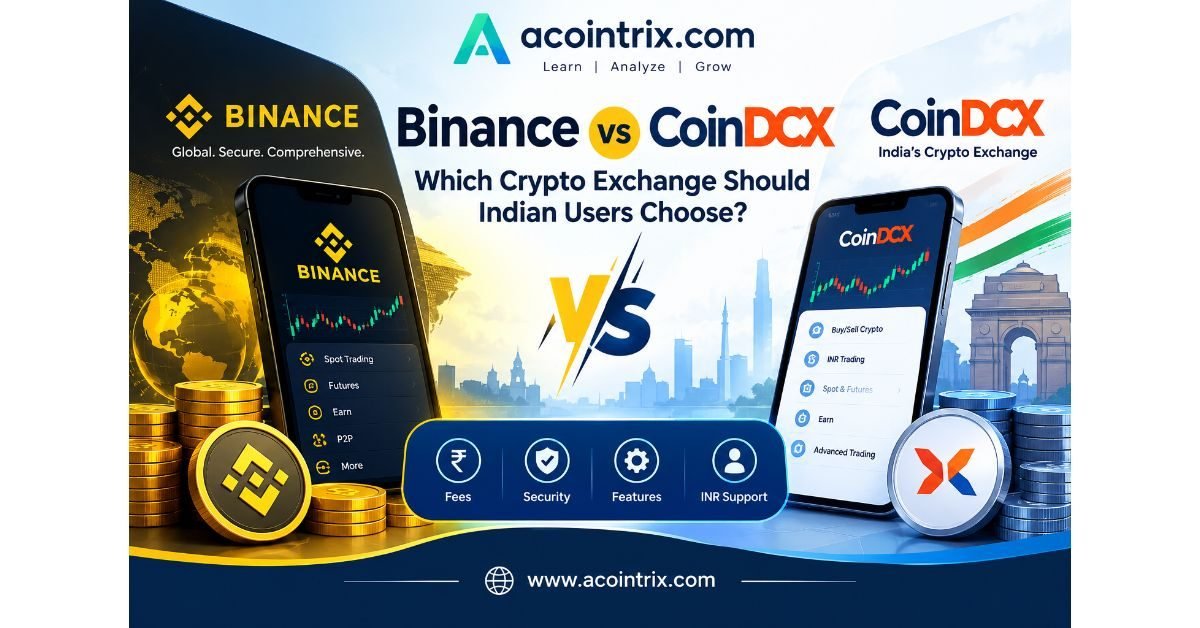
Visual Introduction: Binance vs CoinDCX
Think of the comparison this way:
Binance
🌎 Global ecosystem
📊 Extensive trading tools
💧 Broad market access
⚙️ Advanced products
🛡️ SAFU + security tools
CoinDCX
🇮🇳 India-focused experience
₹ INR-oriented trading
📱 Beginner-friendly products
📊 Advanced trading modes
🛡️ CIPF + security infrastructure
The important question isn’t simply “Which exchange is bigger?”
It is:
Which platform fits your trading method, risk tolerance, tax requirements, and preferred way of moving money?
Binance: Features Indian Users Should Know
Binance provides a broad range of crypto products, including spot trading, futures, P2P, Earn products and other trading tools. Its India website also highlights access to hundreds of crypto-related products and services.
1. Spot Trading
Spot trading lets users buy and sell cryptocurrencies directly.
Binance’s current standard spot fee schedule lists 0.10% maker and 0.10% taker fees for regular users, with lower rates possible through applicable BNB discounts and VIP tiers.
2. Futures
Binance provides crypto futures products, although users should always check whether a particular product is available to them based on jurisdiction and current rules.
Futures are substantially more complex than spot trading because leverage can magnify both gains and losses.
3. Binance Earn
Binance Earn provides various products that can offer rewards on supported crypto assets. Current products include flexible and locked products, ETH staking, SOL staking and advanced earning products.
Rewards are not equivalent to guaranteed bank interest. Product-specific risks and conditions apply.
4. P2P
Binance also offers peer-to-peer trading.
P2P users should verify counterparties, payment information, transaction status and platform instructions carefully. Binance specifically recommends using verified buyers or sellers and keeping communication and payments within its P2P system.
CoinDCX: Features Indian Users Should Know
CoinDCX has developed a product ecosystem specifically around the Indian crypto market.
Its platform includes:
- Insta trading
- Spot trading
- Futures
- Margin products
- Earn
- API services
- Advanced trading tools
- Crypto deposits
- INR-based products
CoinDCX has also integrated advanced trading functionality into its main application rather than requiring users to maintain a separate Pro app.
1. INR Trading
For Indian beginners, INR access can be an important consideration.
CoinDCX’s published fee structure includes specific INR spot pricing and volume-based tiers. Its current fee page lists regular INR spot fees of 0.50% for the lowest volume tier, falling as users reach higher tiers.
2. Advanced Trading
CoinDCX offers advanced trading functionality, including charting and trading tools designed for more experienced users.
3. Crypto Deposits
CoinDCX introduced crypto deposits from external exchanges and wallets, with compliance checks designed around AML/CFT requirements. The exchange says deposits can be subject to due-diligence checks and may take time depending on compliance verification.
4. VIP Fee Structure
CoinDCX uses trading-volume-based VIP levels.
Its current published structure shows lower fees as the user’s 30-day trading volume increases.
Binance vs CoinDCX: Fees Comparison
Fees are one of the biggest reasons users search for Binance vs CoinDCX.
But comparing only the headline percentage can be misleading.
Current published spot-fee comparison
| Fee Factor | Binance | CoinDCX |
|---|---|---|
| Regular spot fee | 0.10% maker / 0.10% taker | Starts at 0.50% INR spot |
| Higher-volume discounts | Yes | Yes |
| VIP program | Yes | Yes |
| BNB fee discount | Yes | Not applicable |
| GST | Depends on applicable transaction/service treatment | 18% GST on listed fees |
| Withdrawal cost | Depends on asset/network | Depends on asset/product |
| Fees can change | Yes | Yes |
Binance currently publishes a regular-user spot fee of 0.10% maker/taker, while CoinDCX’s current published table lists 0.50% for Regular 1 INR spot trading, 0.42% for Regular 2, and lower rates at higher VIP levels.
Why the fee percentage isn’t the whole story
Your actual cost can include:
Trading fee + GST + spread + network fee + withdrawal cost + payment-related cost
Therefore, don’t compare exchanges using trading fees alone.
For a large trade, liquidity and execution quality can matter as much as the advertised fee.
Benefits of Binance
1. Broad crypto ecosystem
Binance offers a large range of products, markets and trading tools.
2. Competitive standard spot fees
The current standard spot rate is 0.10% maker/taker before applicable discounts or taxes.
3. Advanced trading
Experienced traders can access sophisticated order types, charts, derivatives and other tools.
4. Proof of Reserves
Binance provides a Proof of Reserves system using cryptographic verification methods such as Merkle Trees.
5. SAFU
Binance maintains the Secure Asset Fund for Users, an emergency protection mechanism. Binance reported the SAFU fund at approximately $1 billion in USDC in January 2026.
Benefits of CoinDCX
1. India-focused experience
CoinDCX is designed around the needs of Indian crypto users.
2. INR ecosystem
INR-based products can make the platform easier to understand for users who primarily think in rupees.
3. Multiple trading modes
Users can access simpler and more advanced trading experiences within the platform.
4. Volume-based fee structure
Active traders can move through VIP levels as their 30-day trading volume increases.
5. Crypto Investor Protection Fund
CoinDCX reports maintaining a Crypto Investor Protection Fund. Its August 2026 transparency report listed the CIPF corpus at ₹51.53 crore.
Security: Binance vs CoinDCX
Security deserves its own section because crypto exchange security is never simply about a logo or reputation.
Binance Security
Binance highlights:
- Proof of Reserves
- SAFU
- Two-factor authentication
- Account-security controls
- Withdrawal protection
- Risk monitoring
Its Proof of Reserves system allows users to verify that their balances are included in the reported reserve structure. Binance also acknowledges that Proof of Reserves is a point-in-time framework and has limitations.
CoinDCX Security
CoinDCX reports using:
- Cold storage
- Multi-layer security
- Multi-party computation
- Two-factor authentication
- Proof of Reserves
- Crypto Investor Protection Fund
An important security case study
In July 2025, CoinDCX disclosed a security incident involving an operational hot wallet on a partner exchange. The company stated that the affected account was separate from customer wallets and that the loss was absorbed from company reserves. CoinDCX also reported that customer assets were held separately in cold wallets.
That incident is worth mentioning because responsible exchange research should consider actual incident history, not just marketing claims.
Regulation and Compliance in India
Regulatory status is another important part of the Binance vs CoinDCX comparison.
Binance registered as a reporting entity with FIU-IND in 2024.
However, there is an important historical detail that users should understand.
India’s FIU issued a June 2024 order concerning Binance and imposed a ₹18.82 crore penalty for violations relating to PMLA obligations at that time.
Binance subsequently stated that it had registered with FIU-IND and was complying with Indian AML requirements.
The lesson for users: regulatory registration is important, but it should not be treated as the same thing as a government guarantee of investment performance or protection from market losses.
Crypto Taxes for Indian Users
Choosing an exchange does not remove your tax responsibilities.
The Income Tax Department states that income from transfer of Virtual Digital Assets is subject to a 30% tax under Section 115BBH, along with applicable surcharge and cess. The tax department also provides a separate Schedule VDA for reporting VDA transactions.
Indian users should maintain records of:
- Purchase price
- Sale price
- Transaction date
- Quantity
- Exchange fees
- TDS deducted
- Wallet transfers
- Transaction IDs
- INR value
- Realized gains/losses
Tax rules can change, so readers should verify the rules applicable to their financial year and consult a qualified tax professional for personal advice.
Risk: What Can Go Wrong?
Neither Binance nor CoinDCX eliminates crypto risk.
1. Market Risk
Bitcoin, Ethereum and altcoins can experience significant price volatility.
2. Liquidity Risk
A low-liquidity market can result in greater slippage.
3. Platform Risk
An exchange can experience:
- Technical outages
- Withdrawal delays
- Cybersecurity incidents
- Regulatory restrictions
- Product changes
4. Custody Risk
Keeping crypto on an exchange means depending on a third party to provide custody.
5. Leverage Risk
Futures and margin products can produce losses much faster than ordinary spot trading.
6. Tax Risk
Incorrect transaction records can create tax-reporting problems.
7. Phishing Risk
Even a secure exchange account can be compromised if a user gives attackers their password, OTP or recovery credentials.
Responsible Crypto Trading
Acointrix recommends treating exchange selection as part of a broader risk-management process.
Follow these principles:
- Complete KYC only through the official platform.
- Enable 2FA or passkeys where available.
- Use a unique password.
- Never share OTPs.
- Verify URLs before logging in.
- Avoid keeping unnecessary funds on an exchange.
- Don’t use leverage until you understand liquidation.
- Keep detailed transaction records.
- Review withdrawal networks before transferring crypto.
- Never invest money you cannot afford to lose.
Binance itself emphasizes that users remain an important part of the security process, while CoinDCX similarly provides security and compliance guidance.
Why Indian Users Compare Binance and CoinDCX
The comparison has become increasingly relevant because Indian users want a combination of:
- INR convenience
- Crypto variety
- Lower trading costs
- Strong liquidity
- Advanced charts
- Security
- Regulatory compliance
- Tax transparency
- Easy withdrawals
- Beginner-friendly interfaces
However, these priorities do not always point toward the same platform.
A beginner who values a straightforward INR-focused experience may evaluate CoinDCX differently from an experienced trader who wants access to a broader global ecosystem.
Quick Insights
Choose based on your priority, not popularity.
| Your Priority | What to Examine |
|---|---|
| Beginner trading | Interface + INR experience |
| Active spot trading | Fees + liquidity + spreads |
| Advanced trading | Order types + charts + derivatives |
| INR users | Deposit/withdrawal options |
| Long-term holding | Custody + security + withdrawal options |
| Frequent trading | VIP structure + execution |
| Tax compliance | Transaction reports + TDS records |
| Security | 2FA + PoR + custody + incident history |
| Crypto transfers | Supported networks + withdrawal rules |
| Advanced investors | Liquidity + product availability + risk controls |
Small Case Study: A ₹1 Lakh Trader
Consider two hypothetical Indian traders.
Trader A: The Beginner
They have ₹1,00,000 and want to:
- Buy Bitcoin
- Hold for several months
- Use INR
- Avoid leverage
- Keep trading simple
Their priority should be ease of INR access, transparent costs, security controls and straightforward reporting.
Trader B: The Active Trader
Another user has ₹1,00,000 and trades frequently.
They care more about:
- Maker/taker fees
- Liquidity
- Advanced order types
- Trading pairs
- Execution
- API access
- Futures availability
For this user, the broader product and fee structure becomes much more important.
The same exchange does not necessarily fit both traders equally well.
Real Example: Why Security History Matters
The July 2025 CoinDCX incident provides a useful lesson.
According to CoinDCX’s own incident report, an internal operational account used for liquidity provisioning on a partner exchange was compromised. CoinDCX said approximately $44 million in crypto was exposed, while customer assets were held separately in cold wallets and the company absorbed the exposure through its reserves.
This demonstrates an important point:
Exchange security should be evaluated at multiple levels: customer custody, operational wallets, account security, reserves, incident response and transparency.
A platform can have strong security systems and still face operational or cyber incidents.
Deep Explanation: What Should You Actually Compare?
1. Fees
Don’t look only at the advertised trading fee.
Calculate:
Total trading cost = trading fee + GST + spread + slippage + network/withdrawal costs
2. Liquidity
Higher liquidity can make it easier to enter and exit larger positions without significant price impact.
3. INR Experience
Indian beginners may care more about INR deposits and withdrawals than international trading features.
4. Asset Selection
If you frequently trade smaller altcoins, check whether the exact assets and trading pairs you need are available.
5. Security
Look for:
- 2FA
- Cold storage
- Proof of Reserves
- Withdrawal controls
- Account monitoring
- Incident-response procedures
6. Compliance
Check whether the platform’s current services align with applicable Indian requirements.
7. Reporting
Good transaction reports make tax filing and portfolio tracking easier.
Common Mistakes Indian Crypto Users Make
1: Choosing only based on fees
The cheapest advertised fee doesn’t necessarily mean the lowest total trading cost.
2: Ignoring spread
A wider spread can cost more than a small difference in trading fees.
3: Using leverage too early
Leverage can magnify losses and trigger liquidation.
4: Keeping everything on an exchange
Exchange custody introduces counterparty and platform risks.
5: Forgetting tax records
Don’t wait until tax-filing season to reconstruct hundreds of trades.
6: Sending crypto over the wrong network
Always confirm the receiving network before transferring funds. Binance specifically warns that using the wrong network can permanently result in loss of funds.
7: Trusting fake customer support
Never share passwords, OTPs, seed phrases or private keys with someone claiming to be support.
Pro Tips for Choosing a Crypto Exchange in India
1: Compare the exact trading pair
BTC/INR, BTC/USDT and other pairs can have different liquidity and spreads.
2: Calculate the complete cost
Don’t stop at the trading fee.
3: Test with a small amount
Before transferring significant funds, understand the deposit and withdrawal process.
4: Enable security features immediately
Don’t wait until something goes wrong.
5: Keep your own records
Download transaction statements regularly.
6: Review withdrawal rules
Exchange policies can change.
7: Separate investing from trading
Long-term holding and high-frequency trading require different approaches to risk management.
Expert Quotes & Industry Lessons
Binance on security
Binance has emphasized that users are an important part of the security system and should use available security tools alongside platform-level protections.
CoinDCX on security
During its July 2025 incident response, CoinDCX leadership emphasized containment and the separation of the affected operational wallet from customer cold wallets.
A key lesson from Proof of Reserves
Binance’s own educational material explains that Proof of Reserves is a point-in-time snapshot, meaning it should be viewed as one security/transparency signal rather than a complete guarantee against every type of platform risk.
Step-by-Step Guide: How to Choose Between Binance and CoinDCX
Step 1: Define your objective
Are you:
- Investing?
- Spot trading?
- Day trading?
- Learning?
- Using futures?
- Buying crypto periodically?
Step 2: Check INR support
Confirm the current deposit and withdrawal methods available to your account.
Step 3: Compare your actual trading pair
Don’t compare generic BTC fees if you plan to trade another asset.
Step 4: Calculate total cost
Include:
- Trading fee
- GST
- Spread
- Slippage
- Withdrawal fee
- Network fee
Step 5: Review security
Check:
- 2FA
- Passkeys
- Withdrawal controls
- Proof of Reserves
- Custody arrangements
- Protection funds
Step 6: Review tax reporting
Make sure you can download or access the transaction information you need.
Step 7: Start small
Test the platform before committing a large amount.
Step 8: Review regularly
The best exchange for you today may not be the best fit after fees, products, regulations or your trading strategy change.
Trends: What Is Changing in India’s Crypto Market?
Several trends are becoming increasingly important.
1. Compliance is becoming a core exchange feature
Indian users increasingly need to consider AML/KYC processes, reporting and tax documentation.
2. Transparency is becoming more important
Proof of Reserves, transparency reports and protection funds are becoming more visible parts of exchange competition.
CoinDCX’s monthly transparency reporting, for example, publishes figures covering its protection fund, compliance and user base.
3. Advanced products are moving into unified apps
Platforms are increasingly combining beginner and professional trading experiences in one application.
4. Security is becoming a differentiator
Cyber incidents have demonstrated that operational security matters alongside customer-wallet protection.
5. Users are becoming more cost-conscious
With trading fees, GST and spreads all affecting returns, users are increasingly looking at total cost of ownership, not just headline fees.
Binance vs CoinDCX: Who Might Prefer Which?
Instead of declaring one universal winner, consider this framework.
Binance may appeal to users who prioritize:
- A broad global crypto ecosystem
- Extensive trading products
- Competitive standard spot fees
- Advanced trading functionality
- P2P and global market access
- Binance Earn
- Large-scale crypto infrastructure
CoinDCX may appeal to users who prioritize:
- An India-focused experience
- INR-oriented trading
- Integrated beginner and advanced modes
- Indian market-focused products
- Volume-based VIP pricing
- Indian compliance and reporting infrastructure
- A dedicated Crypto Investor Protection Fund
This doesn’t mean one platform is universally better. Your trading style should determine which features matter most.
Future Outlook
The future of crypto exchanges in India is likely to focus increasingly on four areas:
1. Compliance
Exchanges will need to adapt as Indian financial and tax requirements evolve.
2. Transparency
Proof of Reserves, transparency reports and clearer transaction records are likely to become increasingly important.
3. Security
Exchange users will increasingly evaluate custody, operational wallets, account protection and incident response.
4. User Experience
Indian users will likely expect both simple INR investing and sophisticated trading tools within the same ecosystem.
The competition between global and India-focused exchanges will therefore extend beyond fees.
It will be about trust, usability, liquidity, compliance, security and product depth.
Conclusion
The Binance vs CoinDCX comparison does not have one universal answer for every Indian crypto user.
Binance offers a broad global ecosystem, extensive trading products, competitive published spot fees, Proof of Reserves, SAFU and advanced tools.
CoinDCX offers an India-focused ecosystem with INR-oriented products, advanced trading modes, volume-based pricing, crypto deposits, transparency reporting and a Crypto Investor Protection Fund.
For beginners, simplicity, INR access, security and reporting may matter most.
For active traders, fees, liquidity, trading pairs, execution and advanced tools may become more important.
For long-term holders, custody, withdrawal options, security and transparency deserve particular attention.
The smartest approach is therefore not to choose an exchange simply because it is popular. Compare the exact features you need, calculate your total costs, understand the risks, and verify the latest platform rules before depositing money.
Make Smarter Crypto Decisions with Acointrix
Crypto investing becomes easier when you understand the market before you act.
At Acointrix, we simplify complex crypto topics into practical guides covering:
- Crypto exchanges
- Bitcoin and Ethereum
- Technical analysis
- Chart patterns
- Trading strategies
- Crypto security
- Market education
- Risk management
- Blockchain trends
Acointrix — Learn. Analyze. Understand the Crypto Market.
FAQ: Binance vs CoinDCX
Is Binance available to Indian users?
Yes. Binance announced its registration as a reporting entity with FIU-IND in 2024 and stated that its website and application were available to Indian users.
Is CoinDCX available in India?
Yes. CoinDCX operates an India-focused crypto platform offering INR and crypto trading products.
Which has lower trading fees, Binance or CoinDCX?
The answer depends on the product, trading volume, fee tier and applicable charges. Binance currently lists 0.10% maker/taker for regular spot users, while CoinDCX’s published INR spot structure starts at 0.50% for Regular 1 and decreases at higher volume tiers.
Is Binance safe for Indian users?
Binance provides security measures including Proof of Reserves, SAFU and account-level security tools. However, no crypto exchange can eliminate every market, custody, regulatory or cybersecurity risk.
Is CoinDCX safe?
CoinDCX says it uses cold storage, security controls, MPC, 2FA and a Crypto Investor Protection Fund. It also experienced an operational-wallet security incident in July 2025 and stated that customer assets were segregated from the affected wallet.
Does India tax crypto profits?
Yes. The Income Tax Department states that income from transfer of Virtual Digital Assets is taxed at 30% under Section 115BBH, along with applicable surcharge and cess.
Should beginners use crypto futures?
Beginners should understand spot trading, volatility, position sizing and risk management before considering leveraged derivatives. Futures can magnify both gains and losses.
Can I transfer crypto between Binance and CoinDCX?
Crypto transfers may be possible for supported assets and networks, subject to the platforms’ current deposit/withdrawal rules and compliance checks. Always confirm the exact network before sending funds.
Does Proof of Reserves guarantee my money is safe?
No. Proof of Reserves is useful for demonstrating reported asset backing, but it is generally a point-in-time transparency mechanism and does not eliminate every custody, operational, regulatory or market risk.
What should I check before choosing an exchange?
Check:
- Current fees
- INR deposit/withdrawal options
- Trading pairs
- Liquidity
- Security
- Proof of Reserves
- Compliance
- Tax reports
- Crypto withdrawal support
- Customer support