

Introduction:
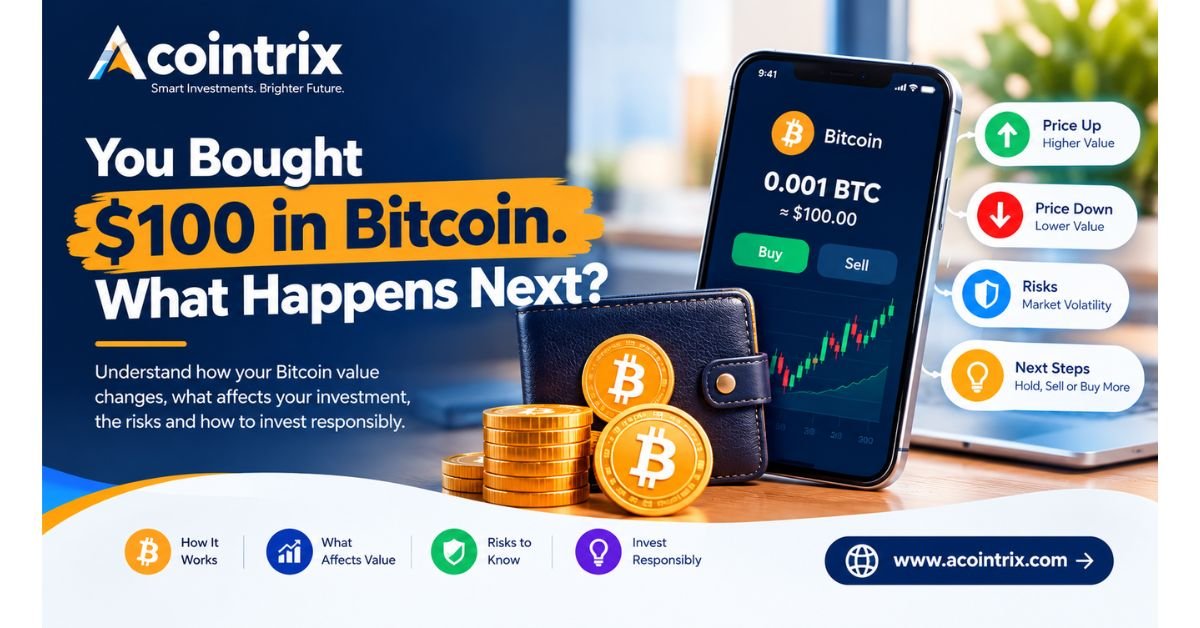
Imagine opening a cryptocurrency exchange, purchasing $100 worth of Bitcoin, and seeing a small amount of BTC appear in your account.
You have completed your first Bitcoin purchase. But what happens next?
Does your Bitcoin automatically increase in value? Can you lose part of your $100? Where is your Bitcoin stored? And what happens if Bitcoin’s market price doubles or falls by 50%?
These are important questions for anyone exploring cryptocurrency for the first time.
Bitcoin operates differently from money held in a traditional savings account. Its market price changes according to supply, demand, investor activity, market conditions, and other factors. Your investment can increase or decrease in value even when you do nothing.
In this guide, Acointrix explains what happens when you buy $100 in Bitcoin, how to calculate your potential returns and losses, what risks to understand, and how to approach cryptocurrency responsibly.
The key takeaway: Buying Bitcoin gives you exposure to its changing market price. It does not guarantee a profit or protect your original investment.
What Does It Mean to Buy $100 in Bitcoin?
Buying $100 in Bitcoin means exchanging $100 worth of your local currency for a corresponding amount of Bitcoin, minus any applicable transaction fees and other charges.
You do not need to purchase one entire Bitcoin. Bitcoin is divisible into much smaller units, allowing people to purchase fractions of a BTC.
The smallest unit of Bitcoin is called a satoshi.
One Bitcoin equals 100 million satoshis. This divisibility makes it possible to purchase a small amount of Bitcoin even when the market price of one whole BTC is very high.
How Is Your Bitcoin Amount Calculated?
Your BTC quantity depends on Bitcoin’s purchase price and the amount actually invested after applicable fees.
For example, suppose Bitcoin is trading at $100,000 per BTC.
If you invest $100 and ignore transaction fees for this illustration:
$100 ÷ $100,000 = 0.001 BTC
You would receive 0.001 BTC.
If Bitcoin’s market price changes later, the dollar value of your 0.001 BTC changes as well. Your quantity generally stays the same unless you buy, sell, or transfer Bitcoin in a way that changes the amount you own or controls associated with it.
Actual exchange quotes may differ because of spreads, fees and price movements during execution.
Key Points: What Happens After Your Bitcoin Purchase?
After buying Bitcoin, several things happen.
- Your order is executed: The exchange or service processes your purchase at the applicable price.
- Your BTC quantity is determined: The amount you receive depends on the executed price and applicable charges.
- Your holdings are recorded: If you purchase through a custodial exchange, your account displays your Bitcoin balance. The platform typically controls the private keys. With a self-custody wallet, you control the keys.
- The market continues moving: Bitcoin’s market price can rise or fall after your purchase.
- Your investment value changes: The market value of your holdings changes as the BTC price changes.
- You decide what to do next: Depending on your circumstances, you may hold, sell, or transfer your Bitcoin, subject to fees, platform rules, and applicable laws.
Importantly, your displayed balance and the amount you would receive from selling may differ because of trading fees, spreads, withdrawal costs, and market movements.
Visual Introduction: Follow Your $100 Bitcoin Purchase
Think of your Bitcoin purchase as a simple journey.
Step 1: Purchase
You exchange $100 for a fraction of Bitcoin.
↓
Step 2: Hold
Your BTC remains in your exchange account or wallet.
↓
Step 3: Market movement
Bitcoin’s market price changes over time.
↓
Step 4: Value changes
Your holdings may be worth more or less than your original purchase amount.
↓
Step 5: Decide
You evaluate your goals, risk tolerance, and financial situation before deciding whether to continue holding or sell.
This process illustrates an important distinction: the number of BTC you own and the market value of that BTC are two different things.
Features of Bitcoin That Matter to Beginners
1. Divisibility
Bitcoin can be divided into smaller units. You can buy a fraction of a BTC rather than purchasing a complete coin.
2. Blockchain-Based Transactions
Bitcoin transactions are recorded on a distributed public ledger called the Bitcoin blockchain. This ledger allows network participants to verify transactions according to the system’s rules.
3. Limited Supply
Bitcoin’s protocol sets a maximum supply of 21 million BTC. Its limited issuance is one factor that investors consider when analysing Bitcoin’s long-term economic characteristics.
However, limited supply does not guarantee that demand will rise or that the price will increase.
4. A Continuously Changing Market Price
Bitcoin trades on cryptocurrency markets where buyers and sellers influence its price. The market operates around the clock, including weekends and holidays.
5. Different Storage Options
Bitcoin can be held through a custodial service or in a self-custody wallet.
With custodial storage, a service provider manages the private keys. With self-custody, you are responsible for safeguarding the keys or recovery information that gives access to your funds.
Each option has different operational and security risks.
Benefits of Understanding a Small Bitcoin Purchase
Starting with a small amount can help a beginner learn how cryptocurrency works without immediately committing a large sum.
Potential educational benefits include:
- Learning market mechanics: Understanding how cryptocurrency prices and order execution work.
- Understanding fractional ownership: Seeing how small BTC quantities correspond to market prices.
- Practising wallet security: Learning how custodial and self-custody storage differ.
- Tracking price movements: Observing how volatility affects an investment’s value.
- Understanding transaction costs: Learning how fees and spreads affect the final purchase amount.
- Building financial awareness: Recognising the difference between an unrealised gain or loss and a completed sale.
These are learning benefits, not guarantees of financial returns. Even a small investment can lose value.
Quick Insights Table: What Could Your $100 in Bitcoin Become?
The following table illustrates what happens if Bitcoin’s price changes after you buy it.
Assume you initially purchase $100 worth of BTC, and ignore fees, taxes, and other charges for simplicity.
| Change in Bitcoin price | Value of your BTC | Gain or loss |
|---|---|---|
| +100% | $200 | +$100 |
| +50% | $150 | +$50 |
| +20% | $120 | +$20 |
| 0% | $100 | $0 |
| -20% | $80 | -$20 |
| -50% | $50 | -$50 |
| -80% | $20 | -$80 |
These are hypothetical scenarios, not predictions of Bitcoin’s future performance.
Notice how a 50% increase produces a $50 gain on the original $100, while a 50% decrease leaves only $50 in market value. The same percentage movement can have a very different effect on your financial decisions depending on your goals and circumstances.
Also remember that the table represents market value, not guaranteed cash proceeds from a sale.
Deep Explanation: What Actually Happens to Your Money?
1. Your Dollars Are Exchanged for Bitcoin
When you place an order, the platform processes the transaction using its supported trading mechanism.
Your purchase amount is converted into a quantity of BTC at the executed price, with applicable fees or spreads affecting the final quantity.
For instance, if the price changes between the time you view a quote and the time your order executes, the final amount of Bitcoin may be slightly different from your initial estimate.
2. Your Investment Becomes Exposed to Market Risk
After purchasing Bitcoin, your holdings are exposed to market movements.
If the BTC price increases, the market value of your holdings generally increases. If the BTC price decreases, the market value generally decreases.
Your Bitcoin does not automatically earn interest merely because you hold it. Any separate yield or lending arrangement would involve additional terms and risks.
3. Your Balance May Stay the Same While Its Value Changes
Suppose you own 0.001 BTC.
If Bitcoin’s price is $100,000, your holding is worth $100 before fees.
If the market price moves to $120,000, that same amount becomes worth $120.
If the price falls to $80,000, it becomes worth $80.
Your BTC quantity remains 0.001 BTC in all three examples, but the market value changes.
4. Your Gain Is Not the Same as Money in Your Bank Account
If the market value of your holdings increases, you may have an unrealised gain.
An unrealised gain means the asset is currently worth more than its purchase cost, but you have not sold it to realise that gain.
If you sell your Bitcoin, the transaction converts your BTC into the currency or asset you receive, minus applicable fees and charges. The resulting amount may differ from the value displayed immediately before the sale.
Real Example: Three Possible Outcomes for a $100 Bitcoin Purchase
Consider an illustrative investor who buys $100 worth of Bitcoin when the price is $100,000 per BTC.
Ignoring fees, the investor receives 0.001 BTC.
Scenario A: Bitcoin’s Price Rises
Bitcoin’s price increases to $130,000.
The investor’s holdings are now worth:
0.001 × $130,000 = $130
The unrealised gain is $30, equivalent to a 30% increase over the original $100.
Scenario B: Bitcoin’s Price Falls
Bitcoin’s price decreases to $70,000.
The holdings are now worth:
0.001 × $70,000 = $70
The unrealised loss is $30, equivalent to a 30% decrease.
Scenario C: Bitcoin’s Price Remains Unchanged
Bitcoin remains at $100,000.
The holding is still worth $100 before fees, spreads, and taxes.
What does this example teach us?
The outcome depends on the market price after your purchase. A small investment does not automatically grow, and a price decline can reduce the value of your holdings.
This is a hypothetical example designed to explain the calculation. It does not represent an actual investor’s results or predict future prices.
Risks of Buying $100 in Bitcoin
Before buying Bitcoin, it is important to understand the risks involved.
1. Price Volatility
Bitcoin’s price can fluctuate significantly over short periods. You may see a gain one day and a loss the next.
2. Loss of Capital
You could lose a substantial portion of your investment. You should not assume that Bitcoin will recover to your purchase price within a particular period.
3. Transaction Fees and Spreads
Buying, selling, and transferring Bitcoin can involve costs. These costs may have a proportionally greater effect on small purchases.
4. Custody and Security
If you use a custodial exchange, you depend on the provider’s security, operations, and withdrawal processes. If you use self-custody, losing your recovery information or exposing your private keys can put your Bitcoin at risk.
5. Emotional Decisions
Rapid price movements may encourage impulsive buying or selling. Decisions made out of fear or excitement can conflict with your original financial plan.
6. Regulatory and Tax Considerations
Cryptocurrency rules differ by jurisdiction and can change. Your tax obligations may depend on where you live, the nature of your transaction, and the laws that apply.
7. Liquidity and Platform Risk
The price displayed on a platform does not guarantee execution at that exact price. Platform outages, withdrawal restrictions, and market liquidity can affect your ability to transact.
For these reasons, Bitcoin should be approached as a volatile asset rather than a guaranteed store of short-term value.
Responsible Bitcoin Investing: What Should Beginners Do?
Responsible cryptocurrency participation starts with understanding your financial position before making a purchase.
Consider these principles:
- Use only money you can afford to lose without compromising essential expenses.
- Maintain an emergency fund and prioritise high-interest debt before taking speculative investment risks.
- Understand the platform’s fees, withdrawal policies, and security features.
- Protect account access with strong, unique passwords and two-factor authentication.
- If using self-custody, protect your recovery phrase and never share it with anyone.
- Avoid borrowing money to speculate on volatile assets.
- Keep accurate records of purchases, sales, transfers, and fees.
- Understand the tax rules that apply in your country.
- Do not rely on social media predictions as a substitute for independent research.
For beginners in India, the Income Tax Department provides official guidance on virtual digital asset taxation. Under the rules described in its current guidance, income from transfers of qualifying virtual digital assets is generally subject to a special 30% tax rate, plus applicable surcharge and cess. Section 194S also provides for 1% TDS on qualifying transfers, subject to applicable conditions and thresholds. These rules are more detailed than a simple flat calculation, so verify your circumstances with official guidance or a qualified tax professional.
Official references:
- Income Tax Department: Taxation of Virtual Digital Assets
- Income Tax Department: TDS on Virtual Digital Asset Transfers
These are general educational points, not individual financial or tax advice.
Why Do People Buy Bitcoin?
People explore Bitcoin for different reasons. Understanding those motivations helps explain why buyers may behave differently during changing market conditions.
Long-Term Investment Interest
Some people believe Bitcoin may have a role in a diversified portfolio and choose to hold it for an extended period. Its future performance, however, remains uncertain.
Interest in Blockchain Technology
Bitcoin provides an opportunity to learn about decentralised networks, digital signatures, public ledgers, and peer-to-peer transactions.
Portfolio Diversification
Some investors consider exposure to alternative assets. However, Bitcoin can be highly volatile, and diversification does not eliminate the risk of loss.
Learning Through Small Purchases
A modest purchase can help someone understand the practical steps involved in buying, holding, and selling cryptocurrency.
The important distinction is that understanding why people buy Bitcoin does not establish that buying it is appropriate for every individual.
Step-by-Step Guide: What to Do After Buying $100 in Bitcoin
If you have already made your first Bitcoin purchase, follow this simple checklist.
Step 1: Verify Your Transaction
Check your order history, executed price, BTC quantity, and transaction charges. Make sure the details match your expectations.
Step 2: Understand Where Your Bitcoin Is Stored
Determine whether your BTC is held by a custodial service or in a wallet for which you control the private keys.
Step 3: Secure Your Account
Enable two-factor authentication where available, use a unique password, and watch for suspicious login activity.
Step 4: Record Your Purchase
Save the date, quantity, purchase value, fees, and transaction reference. These records may help with portfolio tracking and tax reporting.
Step 5: Set Your Financial Boundaries
Decide how much volatility you can tolerate and what portion of your finances you can reasonably expose to risk. Do not commit money needed for bills or emergencies.
Step 6: Review the Market Without Overreacting
Understand that prices can rise and fall. You do not need to make a new trading decision every time the price changes.
Step 7: Review Your Investment Periodically
Evaluate your original reasons for buying Bitcoin, your financial circumstances, and any relevant regulatory changes.
This checklist is an educational framework, not a recommendation to buy, hold, or sell Bitcoin.
Common Mistakes Beginners Make After Buying Bitcoin
Mistake 1: Expecting Immediate Profits
Bitcoin can decline immediately after a purchase. There is no guaranteed timeline for gains.
Better approach: Understand the risks before investing and avoid relying on a specific return expectation.
Mistake 2: Ignoring Small Transaction Costs
Even small fees can reduce the value of a modest investment.
Better approach: Review the actual purchase quote and fee schedule before confirming an order.
Mistake 3: Confusing BTC Quantity With Its Dollar Value
Owning a fraction of a Bitcoin does not mean that fraction is worth a fixed amount.
Better approach: Learn how the BTC quantity and market price combine to determine the value of your holdings.
Mistake 4: Checking the Price Constantly
Frequent price checking can encourage emotional decisions without improving your understanding of the asset.
Better approach: Choose a review routine appropriate to your goals and avoid reacting automatically to every movement.
Mistake 5: Neglecting Security
Weak passwords, fake wallet applications, and exposed recovery phrases can put funds at risk.
Better approach: Use verified services, secure your account, and never disclose private keys or recovery phrases.
Mistake 6: Forgetting Tax Records
A cryptocurrency transaction may create reporting obligations even when the amount is small.
Better approach: Maintain accurate transaction records and check the applicable rules.
Pro Tips for Understanding Your First Bitcoin Investment
Tip 1: Learn the percentage calculation.
If your investment rises from $100 to $110, it has increased by 10% before costs. If it falls to $90, it has decreased by 10%.
Tip 2: Understand the difference between price and value.
A Bitcoin price quotation refers to one BTC. Your investment value depends on the fraction of BTC you own.
Tip 3: Compare the total purchase cost.
Check the execution price, fees, spread, and any applicable charges instead of looking only at the advertised price.
Tip 4: Keep a transaction record.
A simple spreadsheet containing the date, amount, BTC quantity, fees, and transaction ID can help you track your holdings.
Tip 5: Separate education from speculation.
Use reliable resources to understand Bitcoin’s design and risks. Do not treat a price forecast as a fact.
Tip 6: Protect your financial stability first.
Your essential expenses, emergency savings, and existing financial obligations should take priority over speculative investments.
An Acointrix Expert Insight
“The most useful first step in Bitcoin is not predicting tomorrow’s price. It is understanding what you own, what can change its value, and what risks you are accepting.”
This editorial principle captures the purpose of beginner cryptocurrency education: informed decisions matter more than confident predictions.
Bitcoin Trends: What Could Shape Its Future?
Bitcoin’s market behaviour can be influenced by several developments.
Institutional Participation
Participation by larger financial firms and investment products can influence market access and trading activity. It does not guarantee that demand or prices will continue rising.
Regulation and Tax Policy
Government rules can affect trading access, reporting requirements, custody services, and the costs of participating in cryptocurrency markets.
Technology and Network Development
Changes in wallet software, network infrastructure, security practices, and supporting services can affect the user experience and ecosystem.
Global Economic Conditions
Interest rates, liquidity, investor risk appetite, and broader economic developments can influence demand for volatile assets.
Market Sentiment
News, trading activity, expectations, and investor behaviour can cause rapid price changes. Sentiment can shift in either direction.
These factors may affect Bitcoin, but their combined influence is uncertain. No single trend provides a reliable way to predict future prices.
Future Outlook: What Happens to Your $100 in Bitcoin Over Time?
Your $100 Bitcoin investment has no predetermined future value.
If the market price rises, the value of your BTC may increase. If the price falls, your investment may decline. Over time, the result will depend on market movements, your holding quantity, transaction costs, any decisions you make, and applicable taxes.
Bitcoin’s long-term role in financial markets will depend on adoption, technology, regulation, market demand, and other factors that remain uncertain.
For a beginner, the most useful approach is to understand the asset’s mechanics, establish sensible financial limits, protect account access, and evaluate decisions using reliable information rather than promises or predictions.
A small Bitcoin purchase can be a starting point for learning about cryptocurrency. It should not be treated as a guaranteed route to financial growth.
Frequently Asked Questions (FAQ)
1. What happens when you buy $100 in Bitcoin?
You exchange $100 worth of currency for a fraction of BTC. Your final quantity depends on the executed price and applicable fees. The value of your BTC then changes with Bitcoin’s market price.
2. Can $100 in Bitcoin become $200?
Yes, if the value of your BTC doubles before costs and taxes. However, there is no guarantee that this will happen, and the investment could also lose value.
3. Can I lose money by buying $100 in Bitcoin?
Yes. If Bitcoin’s market price falls, the value of your holdings can decrease. You could lose a substantial portion or, in extreme circumstances, all of the amount invested.
4. How much Bitcoin can I buy with $100?
The quantity depends on Bitcoin’s price at the time your order executes. For example, at a BTC price of $100,000, a $100 purchase would equal 0.001 BTC before fees.
5. Does Bitcoin automatically generate income after I buy it?
No. Simply holding Bitcoin does not automatically produce interest or income. Your market value changes as the BTC price moves. Separate yield arrangements involve additional risks and conditions.
6. Should I sell Bitcoin when its price falls?
There is no universal answer. The decision depends on your financial situation, risk tolerance, investment objectives, and the reasons you purchased it. Avoid making decisions solely because of short-term price movements.
7. Is buying a small amount of Bitcoin safer than buying a large amount?
A smaller purchase limits the absolute amount you initially expose to market risk, assuming all other factors are equal. It does not make Bitcoin itself less volatile or guarantee that you will not lose money.
8. Do I need a Bitcoin wallet to buy Bitcoin?
Not necessarily. Some cryptocurrency services hold Bitcoin on behalf of customers. A self-custody wallet is another option, but it requires you to manage the relevant private keys and recovery information securely.
9. What fees apply when buying Bitcoin?
Depending on the platform and transaction, costs can include trading fees, spreads, deposit charges, and withdrawal or network fees. Review the provider’s current fee schedule before transacting.
10. Is Bitcoin taxed in India?
Qualifying virtual digital asset transactions are subject to specific Indian tax provisions. The rules include a special tax regime for income from transfers and TDS provisions in applicable cases. Verify current requirements with the Income Tax Department or a qualified tax professional.
11. Can I buy a fraction of Bitcoin?
Yes. Bitcoin is divisible into smaller units, so you can buy a fraction of a BTC rather than a whole Bitcoin, subject to the platform’s minimum purchase requirements.
12. Is Bitcoin suitable for every beginner?
No. Bitcoin’s volatility, custody requirements, and regulatory and tax considerations mean it may not suit every financial situation. Understanding these factors is essential before deciding whether to participate.
Conclusion: Your First $100 in Bitcoin Is a Lesson in Risk and Value
Buying $100 in Bitcoin is a relatively simple transaction, but understanding what happens afterward requires a little more knowledge.
Your purchase converts money into a fraction of BTC. The quantity you own and its market value are different things. As Bitcoin’s price changes, the value of your holdings can rise or fall.
Transaction fees, security practices, market conditions, and applicable tax rules can also affect the overall outcome.
The most important lesson is to approach Bitcoin with realistic expectations. Learn how it works, protect your assets, maintain accurate records, and never risk money you cannot afford to lose.
At Acointrix, our goal is to make cryptocurrency concepts easier to understand so readers can make better-informed decisions.
Explore more cryptocurrency and blockchain educational resources at Acointrix.com.
Understand the technology. Evaluate the risks. Make informed decisions.