
Introduction
Imagine paying for coffee, shopping online, or sending money to a friend using cryptocurrency without worrying about private keys, complicated wallet addresses, or blockchain network fees. You simply open an app, scan a QR code, verify the payment, and confirm the transaction. This is the kind of experience that could make cryptocurrency accessible to everyday users.
Digital payment applications such as Google Pay have trained people to expect payments to be quick, familiar, and easy to understand. Cryptocurrency wallets, however, often require users to understand concepts that are unfamiliar to the average consumer.
The question is not simply whether crypto wallets can become easier to use. It is whether they can deliver the convenience people expect from digital payments while preserving the security, transparency, and user control associated with blockchain technology.
Developments in smart wallets, account abstraction, passkeys, and stablecoin infrastructure are helping developers address this challenge. However, significant questions remain about security, recovery, transaction costs, regulation, and merchant acceptance.
What Are Crypto Wallets?
A crypto wallet is a tool that allows users to manage cryptocurrency and interact with blockchain networks. Unlike a traditional payment app, a crypto wallet manages cryptographic keys that authorize transactions.
Wallets can be custodial, where a provider manages the keys, or non-custodial, where users control them. This distinction affects convenience, security, and recovery options.
Key Features Making Crypto Wallets Easier
- Smart wallets: Programmable wallets can simplify transactions and automate certain actions.
- Passkey authentication: Supported wallets can use device-based authentication instead of relying entirely on traditional recovery phrases.
- Sponsored transaction fees: Some blockchain applications can cover network fees for users.
- Stablecoin payments: Stablecoins aim to maintain a relatively stable value against a reference asset, such as the US dollar.
- QR code payments: Scanning a code can make entering wallet addresses easier.
These features can reduce friction, although availability varies by wallet and blockchain.
Benefits of Easier Crypto Wallets
More accessible wallets could produce meaningful benefits:
Lower learning barriers: New users would need less technical knowledge to understand basic payments.
Better security through design: Clear warnings, spending limits, and secure recovery options could reduce certain user errors.
Simplified digital commerce: Compatible applications could integrate blockchain payments into familiar checkout processes.
More flexible global transactions: Some blockchain-based payment arrangements may provide alternative cross-border settlement options, depending on their costs, regulations, and accessibility.
Improved application integration: Developers could create services in which payments, digital assets, and blockchain-based applications work together with fewer manual steps.
These benefits depend on real-world implementation. A simpler interface does not automatically make a wallet safer, cheaper, or more widely accepted.
Crypto Wallets vs Google Pay: Quick Comparison
| Feature | Google Pay | Crypto Wallets |
|---|---|---|
| Setup | Generally simple | Varies by wallet |
| Payments | Supported payment methods | Supported blockchain assets |
| Fees | Depend on payment method | Network and service fees may apply |
| Recovery | Account recovery options | Depends on custody and wallet design |
| Transactions | Usually familiar and straightforward | May require network selection and confirmation |
| Acceptance | Supported merchants and services | Depends on asset, network, and merchant |
Google Pay’s exact features and availability vary by country and payment method. Crypto wallets also differ considerably in their design and capabilities.
Small Case Study: A QR Code Payment
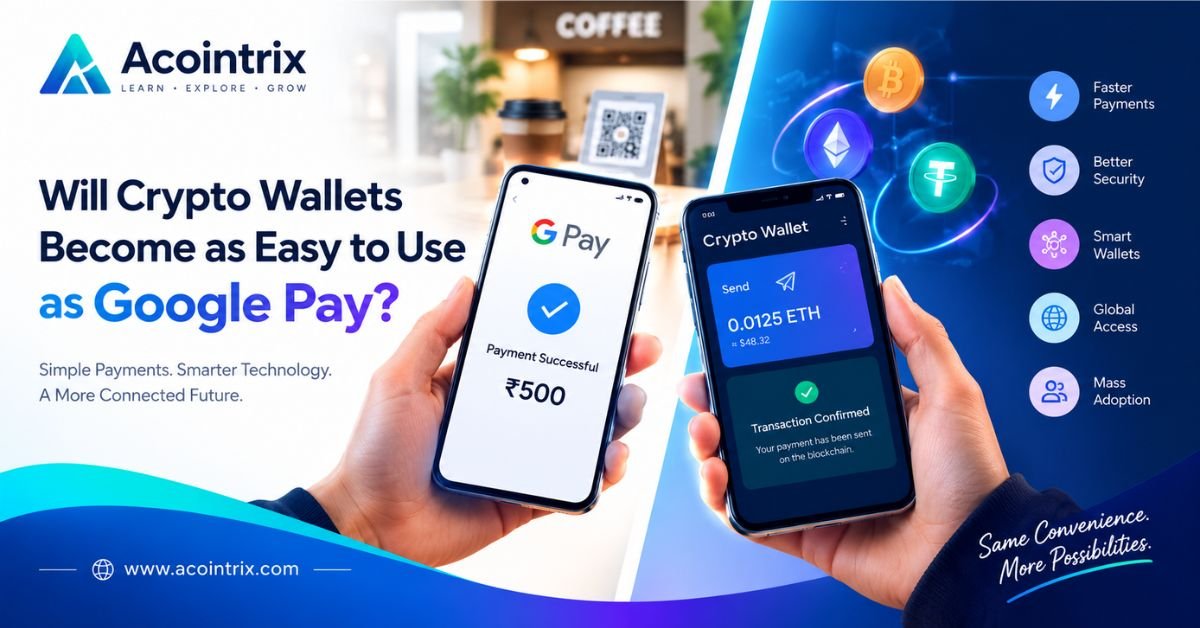
Imagine a customer paying at a café. With a familiar payment app, the customer scans a QR code, checks the recipient, and confirms the payment.
A crypto wallet could offer a similar experience by displaying a payment QR code, selecting an appropriate asset, and confirming the transaction. Behind the scenes, the blockchain still processes the payment.
The lesson is simple: a crypto payment can feel familiar without removing the technical complexity underneath. This is an illustrative example, not a claim about a specific company’s product.
Risks and Common Mistakes
Making crypto wallets easier to use does not eliminate their risks. Users should watch out for:
- Scams and fake apps: Download wallets from verified sources.
- Wrong network selection: Sending assets through an unsupported network can cause loss.
- Lost recovery credentials: Non-custodial wallet recovery may be difficult or impossible without the required credentials.
- Misleading fee claims: Transactions may still involve network or service charges.
- Assuming stablecoins are risk-free: Stablecoins carry issuer, reserve, regulatory, and depegging risks.
Never share a private key or recovery phrase with someone claiming to provide customer support.
Step-by-Step Guide to Easier Crypto Payments
- Choose a reputable wallet that supports your intended cryptocurrency.
- Understand whether the wallet is custodial or non-custodial.
- Secure your account using available security features.
- Verify the recipient address, asset, and network before paying.
- Check all fees and transaction details.
- Start with a small test transaction when appropriate.
- Keep recovery information secure and private.
Future Outlook: Will Crypto Match Google Pay’s Simplicity?
The future of crypto payments may include simpler onboarding, passkey-based authentication, smart wallets, and more familiar checkout experiences. Stablecoins could also expand certain payment options where regulations and merchant support permit.
However, ease of use alone will not guarantee widespread adoption. Consumer protection, reliable recovery, regulatory clarity, transaction costs, and merchant acceptance will all matter.
Conclusion
Will crypto wallets become as easy to use as Google Pay? They could become much easier as wallet technology improves and blockchain complexity becomes less visible to users. Yet, achieving the same familiar experience requires more than a simple interface. Security, recovery, affordability, and real-world acceptance must improve together.
For anyone exploring digital assets, understanding wallet technology today can help prepare for the next generation of digital payments.
Explore Acointrix for more educational insights into cryptocurrency, blockchain technology, and digital asset trends.
Frequently Asked Questions
1. Can crypto wallets become as simple as Google Pay?
Yes, potentially. Smart wallets, passkeys, and improved interfaces can simplify many steps, although experiences vary between providers.
2. Are crypto wallets safer than Google Pay?
Neither is universally safer. Risks depend on the provider, wallet design, security practices, and transaction type.
3. Can I pay with crypto using a QR code?
Yes. Compatible wallets can generate or scan payment QR codes, but the recipient, cryptocurrency, and network must be supported.
4. Will stablecoins make crypto payments easier?
Stablecoins may reduce exposure to some price fluctuations compared with volatile cryptocurrencies, but they still carry risks and may incur transaction fees.
5. What is the biggest barrier to crypto wallet adoption?
Key barriers include usability, recovery difficulties, scams, fees, regulatory uncertainty, and limited merchant acceptance.