
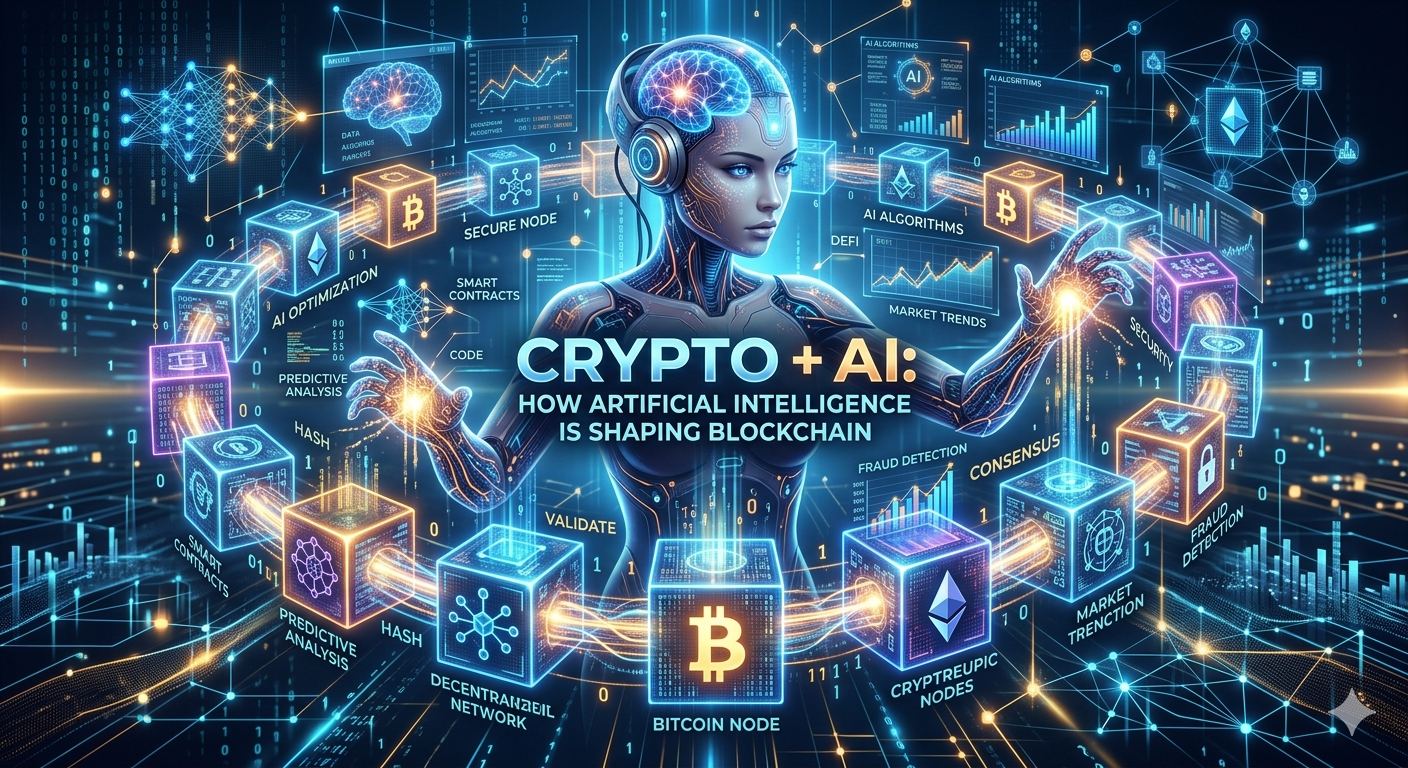
Two of the most transformative technologies today — artificial intelligence (AI) and blockchain — are increasingly intersecting to redefine how digital systems operate. While blockchain provides transparency, security, and decentralization, AI brings data intelligence, automation, and predictive capabilities.
The combination of these technologies is not just a trend; it represents a shift toward more efficient, data-driven ecosystems. From smarter trading systems to enhanced security and decentralized intelligence, AI is playing a growing role in shaping the future of blockchain.
Understanding the Basics
Before exploring their intersection, it’s important to understand their individual roles.
- Blockchain is a decentralized ledger that records transactions securely and transparently. Cryptocurrencies like Bitcoin and Ethereum are built on this technology.
- Artificial Intelligence (AI) refers to systems capable of analyzing data, learning patterns, and making decisions with minimal human intervention.
When combined, these technologies create systems that are both trustless (blockchain) and intelligent (AI).
How AI is Transforming Blockchain
1. Smarter Data Analysis
Blockchain networks generate vast amounts of data, including transaction histories and network activity. AI can process this data to identify patterns, anomalies, and trends.
For example, AI models can analyze activity on networks like Ethereum to detect unusual behavior or optimize performance.
2. Enhanced Security and Fraud Detection
Security is a key advantage of blockchain, but AI adds another layer by identifying suspicious patterns in real time.
AI-driven systems can:
- Detect unusual transaction activity
- Identify potential vulnerabilities
- Support faster response to security risks
This is particularly relevant in decentralized finance (DeFi) ecosystems.
3. Intelligent Smart Contracts
Smart contracts are self-executing programs on blockchain platforms. AI can enhance these contracts by making them more adaptive and responsive to real-world data.
This enables:
- Dynamic decision-making
- Automated adjustments based on external inputs
- Improved efficiency in contract execution
4. AI-Powered Trading and Market Analysis
AI is increasingly used to analyze cryptocurrency markets, helping interpret price trends, trading volumes, and sentiment data.
Assets such as Bitcoin are often analyzed using AI models that process:
- Historical price data
- Market sentiment
- Global financial indicators
These insights can support structured decision-making, although outcomes still depend on market conditions.
5. Decentralized AI Networks
Blockchain is enabling the development of decentralized AI platforms where:
- Data is shared securely
- Models are trained collaboratively
- Control is distributed rather than centralized
This reduces dependency on large centralized systems and promotes transparency.
Real-World Use Cases
Supply Chain Optimization
AI combined with blockchain can improve tracking, forecasting, and transparency across supply chains.
Financial Services
From fraud detection to automated compliance, AI enhances blockchain-based financial systems.
Healthcare Data Management
Blockchain ensures secure data storage, while AI helps analyze medical data for better insights.
Digital Identity Verification
AI can process identity data, while blockchain ensures it remains secure and tamper-proof.
Key Benefits of Crypto + AI Integration
- Improved efficiency through automation
- Better decision-making with data-driven insights
- Enhanced security with real-time monitoring
- Greater transparency through decentralized systems
Challenges and Considerations
While the integration offers significant potential, there are important challenges:
Data Privacy
AI requires large datasets, which must be managed carefully within decentralized systems.
Scalability
Both AI and blockchain technologies face scalability limitations that need to be addressed.
Regulatory Environment
As with cryptocurrencies, regulations in regions like India are still evolving, impacting adoption and implementation.
Technical Complexity
Combining AI and blockchain requires advanced infrastructure and expertise.
Future Outlook
The convergence of AI and blockchain is expected to expand across industries. Some emerging directions include:
- Autonomous financial systems powered by AI
- Decentralized data marketplaces
- AI-enhanced governance in blockchain networks
- Integration with emerging technologies like IoT
As both technologies mature, their combined applications are likely to become more practical and widely adopted.
Conclusion
The integration of artificial intelligence and blockchain represents a significant step toward more intelligent and decentralized digital ecosystems. While still evolving, this combination has the potential to enhance efficiency, security, and transparency across multiple industries.
A balanced understanding of both the opportunities and challenges is essential for navigating this space as it continues to develop.