

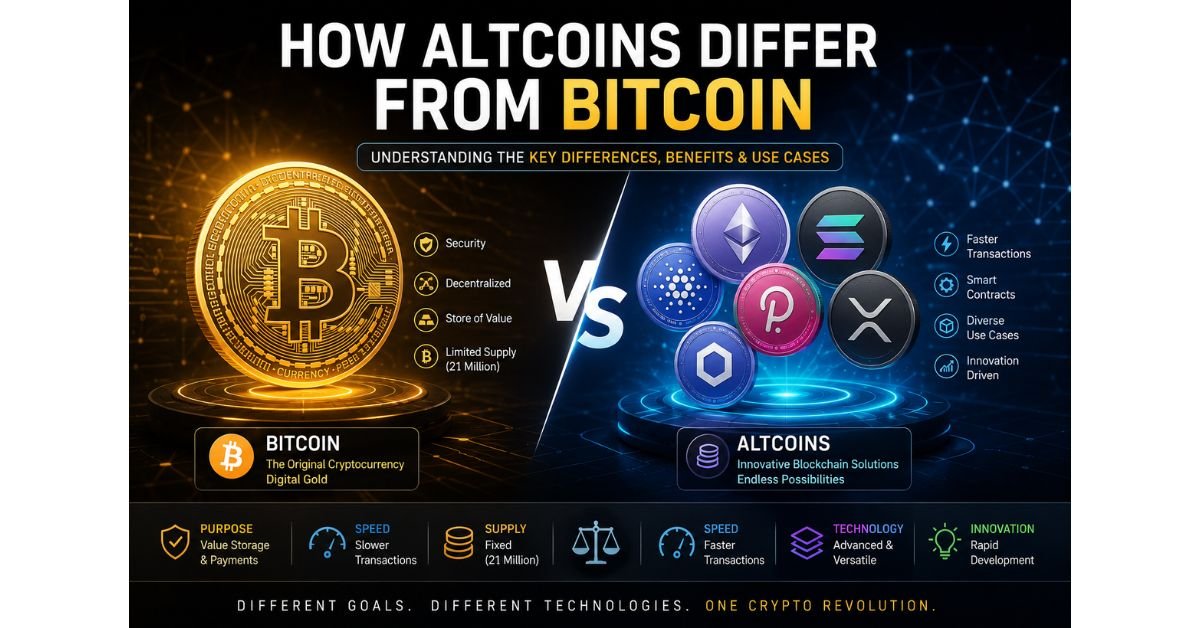
When most people hear the word “cryptocurrency,” the first thing that comes to mind is Bitcoin. But today’s crypto ecosystem is much bigger than just Bitcoin. Thousands of alternative cryptocurrencies — known as altcoins — are transforming industries through smart contracts, decentralized finance, NFTs, gaming, and blockchain innovation.
So, how exactly do altcoins differ from Bitcoin?
While Bitcoin was created primarily as a decentralized digital currency and store of value, altcoins aim to solve broader technological and financial challenges. Understanding these differences is essential for anyone exploring the world of cryptocurrency and blockchain technology.
Bitcoin is often hailed as “digital gold,” but altcoins are the laboratories of crypto innovation. While Bitcoin set the foundation for decentralized finance, altcoins have diversified the ecosystem with speed, scalability, and specialized applications. The question is: How exactly do altcoins differ from Bitcoin, and what does this mean for investors, businesses, and the future of blockchain?
Meaning
What is Bitcoin?
Bitcoin is the world’s first decentralized cryptocurrency, launched in 2009 by the mysterious creator known as Satoshi Nakamoto.
Bitcoin was designed to:
- Enable peer-to-peer digital payments
- Operate without banks or intermediaries
- Serve as a decentralized store of value
Bitcoin is often called “digital gold” because of its limited supply and long-term value proposition.
What are Altcoins?
Altcoins simply mean “alternative coins.” These are cryptocurrencies created after Bitcoin that attempt to improve, modify, or expand blockchain technology.
Popular altcoins include:
- Ethereum
- Solana
- Cardano
- Polygon
- Ripple
Many altcoins focus on:
- Faster transactions
- Lower fees
- Smart contracts
- Decentralized applications
- Blockchain scalability
Key Points
- Bitcoin was the first cryptocurrency.
- Altcoins are cryptocurrencies developed after Bitcoin.
- Bitcoin mainly focuses on value storage and payments.
- Altcoins often provide additional blockchain functionalities.
- Ethereum introduced smart contracts.
- Altcoins usually innovate faster than Bitcoin.
- Bitcoin remains the most dominant cryptocurrency by market capitalization.
Visual Introduction
| Feature | Bitcoin | Altcoins |
| Launch Year | 2009 | After 2009 |
| Main Purpose | Digital currency & store of value | Various blockchain solutions |
| Supply | Limited to 21 million | Varies by project |
| Smart Contracts | Limited | Widely supported |
| Transaction Speed | Slower | Usually faster |
| Market Dominance | Highest | Lower individually |
| Innovation Speed | Conservative | Rapid innovation |
Features of Bitcoin
- Decentralized digital currency
- Strong network security
- Limited supply
- High global recognition
- Long-term store of value
Features of Altcoins
- Smart contract functionality
- Faster blockchain processing
- Lower transaction fees
- DeFi and NFT ecosystems
- Advanced scalability solutions
Benefits of Bitcoin
1. Strong Brand Trust
Bitcoin is the most recognized cryptocurrency globally.
2. Decentralization
No central authority controls Bitcoin.
3. Scarcity
Bitcoin’s limited supply increases long-term value perception.
4. Institutional Adoption
Many institutions now hold Bitcoin as a digital asset.
Benefits of Altcoins
1. Technological Innovation
Altcoins introduce advanced blockchain features.
2. Diverse Use Cases
Many altcoins support gaming, DeFi, NFTs, and enterprise solutions.
3. Faster Transactions
Several altcoins process transactions more quickly than Bitcoin.
4. Lower Network Costs
Altcoins often provide cheaper transaction fees.
Case Study: Ethereum’s Rise Beyond Bitcoin
Bitcoin introduced decentralized digital money.
However, Ethereum expanded blockchain functionality through smart contracts.
Results:
- Enabled decentralized finance (DeFi)
- Powered NFT marketplaces
- Supported blockchain gaming ecosystems
- Created thousands of decentralized applications
Ethereum demonstrated that blockchain technology could be used beyond simple transactions.
Explanation
Why Bitcoin is Different
Bitcoin prioritizes:
- Security
- Stability
- Decentralization
- Store of value
Its blockchain changes slowly because developers focus heavily on maintaining network security and trust.
Bitcoin’s main goal is financial independence and digital scarcity.
Why Altcoins Exist
Altcoins were developed to overcome Bitcoin’s limitations, such as:
- Slow transaction speeds
- Limited programmability
- Scalability issues
Different altcoins solve different problems.
Real Example / Case Study
Real-World Example: Blockchain Payments
A global business uses:
- Bitcoin for long-term treasury reserves
- Stablecoins for daily transactions
- Ethereum for smart contract automation
This shows how different cryptocurrencies serve different purposes within the same ecosystem.
Expert Quotes
“Bitcoin is digital gold; altcoins are digital experiments.” – Andreas Antonopoulos
“Diversification is key: Bitcoin for stability, altcoins for growth.” – Vitalik Buterin
Major Crypto Trends in 2026
1. Layer-2 Scaling Solutions
Altcoins are focusing on scalability improvements.
2. Institutional Bitcoin Adoption
Large companies continue adding Bitcoin to reserves.
3. AI and Blockchain Integration
Altcoins are exploring AI-powered ecosystems.
4. DeFi Expansion
Altcoins dominate decentralized finance innovation.
5. Tokenized Real-World Assets
Blockchain platforms are tokenizing traditional assets.
Common Mistakes
Mistakes Investors Make
1. Assuming All Cryptocurrencies Are the Same
Each project serves different purposes.
2. Ignoring Blockchain Utility
Technology matters more than hype.
3. Chasing Trends Without Research
Not all altcoins survive long term.
4. Overlooking Security
Wallet security is essential in crypto investing.
Pro Tips
Research blockchain use cases before investing.
Focus on long-term utility rather than short-term hype.
Diversify between Bitcoin and strong altcoin projects.
Track developer activity and ecosystem growth.
Understand tokenomics before evaluating a project.
Future Outlook
The future of cryptocurrency will likely involve:
- Bitcoin as digital gold
- Altcoins powering decentralized applications
- Greater institutional blockchain adoption
- Expansion of tokenized economies
- Improved blockchain scalability and efficiency
As blockchain technology evolves, both Bitcoin and altcoins will continue shaping the future of digital finance.
Conclusion
Bitcoin and altcoins both play important roles in the cryptocurrency ecosystem.
Bitcoin remains the dominant digital asset because of its:
- Security
- Scarcity
- Institutional trust
Meanwhile, altcoins continue driving blockchain innovation through:
- Smart contracts
- Decentralized applications
- Faster transaction systems
- Scalable ecosystems
Instead of competing directly, Bitcoin and altcoins often complement each other within the broader digital economy.
As blockchain adoption increases globally, understanding these differences will become increasingly important for businesses, investors, and technology enthusiasts.