
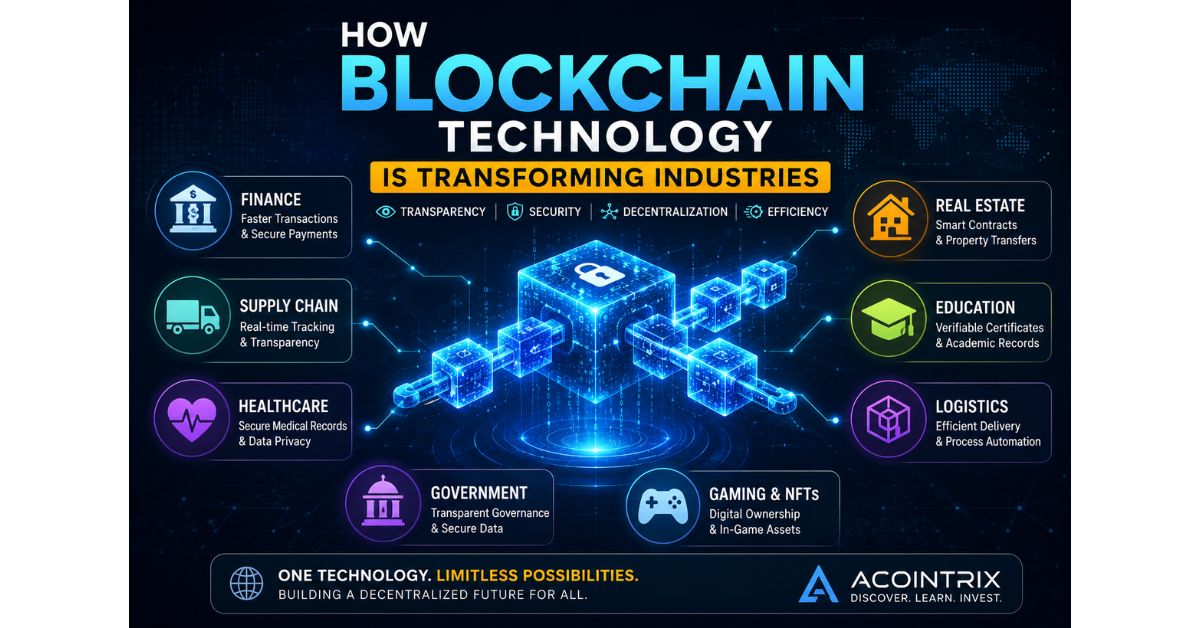
From banking and healthcare to logistics and digital identity, blockchain technology is rapidly transforming how industries operate worldwide. What started as the technology behind Bitcoin has now evolved into one of the most revolutionary innovations of the digital era.
Businesses are increasingly exploring blockchain because it offers:
-
- Better transparency
-
- Improved security
-
- Faster transactions
-
- Reduced operational costs
-
- Decentralized trust systems
But how exactly is blockchain changing industries?
In this comprehensive guide by Acointrix, we’ll explore how blockchain technology works, its real-world applications, benefits, challenges, and the future impact across multiple industries.
Blockchain is no longer just about Bitcoin. From healthcare to logistics, industries worldwide are embracing blockchain to enhance transparency, security, and efficiency. The question is not if blockchain will transform industries, but how fast and to what extent.
What is Blockchain Technology?
Blockchain is a decentralized digital ledger that records transactions securely across multiple computers.
Instead of storing data in one central location, blockchain distributes records across a network, making the system:
-
- Transparent
-
- Secure
-
- Tamper-resistant
-
- Decentralized
Each transaction is stored inside a “block,” and blocks are linked together chronologically to form a “chain.”
Key Points
-
- Blockchain eliminates the need for central intermediaries.
-
- Industries use blockchain for transparency and security.
-
- Smart contracts automate digital agreements.
-
- Blockchain reduces fraud and operational costs.
-
- Supply chains, healthcare, and finance are major adopters.
-
- Decentralized systems improve trust between parties.
Visual Introduction
| Industry | Blockchain Impact |
| Finance | Faster transactions & DeFi |
| Healthcare | Secure medical records |
| Supply Chain | Product traceability |
| Real Estate | Smart property contracts |
| Education | Digital certificates |
| Logistics | Transparent tracking |
| Gaming | NFT ownership systems |
| Banking | Reduced transaction costs |
Key Features of Blockchain Technology
1. Decentralization
No single authority controls the network.
2. Transparency
Transactions can be verified publicly.
3. Security
Cryptographic protection makes data highly secure.
4. Immutability
Once recorded, data cannot easily be altered.
5. Smart Contracts
Automated agreements execute without intermediaries.
Benefits of Blockchain Across Industries
1. Enhanced Security
Blockchain reduces the risk of fraud and unauthorized changes.
2. Improved Transparency
Businesses can track every transaction in real time.
3. Lower Costs
Automation reduces operational expenses.
4. Faster Transactions
Blockchain speeds up payment and verification systems.
5. Better Data Integrity
Tamper-proof records improve trust.
Quick Insights Table
| Feature | Traditional Systems | Blockchain Systems |
| Data Control | Centralized | Decentralized |
| Security | Moderate | High |
| Transparency | Limited | Strong |
| Speed | Slower | Faster |
| Trust Model | Third-party dependent | Distributed trust |
| Fraud Risk | Higher | Lower |
Case Study: Supply Chain Transparency
A food distribution company implemented blockchain tracking for product shipments.
Results:
-
- Faster inventory verification
-
- Reduced counterfeit risks
-
- Improved delivery tracking
-
- Better customer trust
Consumers could scan QR codes to trace products from origin to delivery.
How Blockchain is Transforming Major Industries
1. Finance and Banking
Blockchain is revolutionizing financial services through:
-
- Faster international payments
-
- Decentralized finance (DeFi)
-
- Reduced banking fees
-
- Transparent auditing systems
Banks are exploring blockchain to improve efficiency and reduce settlement times.
2. Healthcare
Healthcare providers use blockchain for:
-
- Secure patient records
-
- Medical data sharing
-
- Drug supply verification
-
- Fraud prevention
Blockchain improves data privacy while allowing authorized access.
3. Supply Chain Management
Blockchain helps businesses:
-
- Track products in real time
-
- Verify authenticity
-
- Reduce counterfeiting
-
- Improve logistics transparency
This is especially important in food, pharmaceuticals, and luxury goods industries.
4. Real Estate
Smart contracts simplify:
-
- Property transfers
-
- Legal agreements
-
- Ownership verification
-
- Payment processing
Blockchain reduces paperwork and middleman involvement.
5. Education
Educational institutions use blockchain for:
-
- Digital certificates
-
- Degree verification
-
- Fraud prevention
-
- Academic record storage
Blockchain-based credentials are difficult to fake.
Real-World Example: Blockchain in Global Payments
Many financial companies now use blockchain networks to process international payments faster than traditional banking systems.
Benefits:
-
- Reduced transfer delays
-
- Lower transaction fees
-
- Improved transparency
-
- Faster settlement times
This demonstrates blockchain’s real-world efficiency improvements.
Blockchain Trends in 2026
1. Enterprise Blockchain Adoption
Large corporations are integrating blockchain into operations.
2. AI + Blockchain Integration
Artificial intelligence is being combined with decentralized systems.
3. Tokenized Real-World Assets
Assets like real estate and stocks are being tokenized.
4. Green Blockchain Solutions
Eco-friendly blockchain networks are gaining attention.
5. Expansion of Decentralized Finance
DeFi platforms continue growing rapidly.
Common Mistakes
1. Assuming Blockchain Equals Cryptocurrency
Blockchain has applications beyond crypto.
2. Ignoring Scalability Challenges
Not all blockchains process transactions efficiently.
3. Underestimating Regulation
Compliance remains important for adoption.
4. Believing Blockchain Solves Every Problem
Some industries may not require decentralization.
Pro Tips
-
- Focus on blockchain utility, not hype.
-
- Research real-world adoption cases.
-
- Understand the difference between public and private blockchains.
-
- Monitor industry-specific blockchain innovations.
-
- Evaluate scalability and security together.
How Businesses Can Adopt Blockchain Technology
Step 1: Identify Operational Challenges
Find areas where transparency or automation is lacking.
Step 2: Choose the Right Blockchain Model
Select public, private, or hybrid blockchain solutions.
Step 3: Integrate Smart Contracts
Automate repetitive workflows securely.
Step 4: Train Teams
Educate employees about blockchain processes.
Step 5: Monitor Performance
Track efficiency improvements and cost reductions.
Expert Quotes
“Blockchain is not just a technology shift — it is a trust revolution.”
“Industries adopting blockchain today are preparing for tomorrow’s digital economy.”
“Decentralization has the power to redefine global business operations.”
Future Outlook
The future of blockchain technology may include:
-
- Widespread enterprise integration
-
- AI-powered decentralized ecosystems
-
- Expansion of Web3 applications
-
- Tokenized digital economies
-
- Advanced blockchain interoperability
As industries continue digitizing operations, blockchain is expected to become a critical infrastructure layer of the modern internet economy.
Conclusion
Blockchain technology is no longer limited to cryptocurrency. It is becoming a foundational technology that is reshaping industries across the world.
From improving healthcare data security to revolutionizing financial systems and supply chains, blockchain is creating:
-
- Greater transparency
-
- Stronger security
-
- Faster digital operations
-
- Decentralized innovation
While challenges such as scalability and regulation remain, the long-term potential of blockchain technology continues to attract businesses, governments, and investors globally.
Industries that adopt blockchain strategically may gain a significant competitive advantage in the digital economy of the future.