
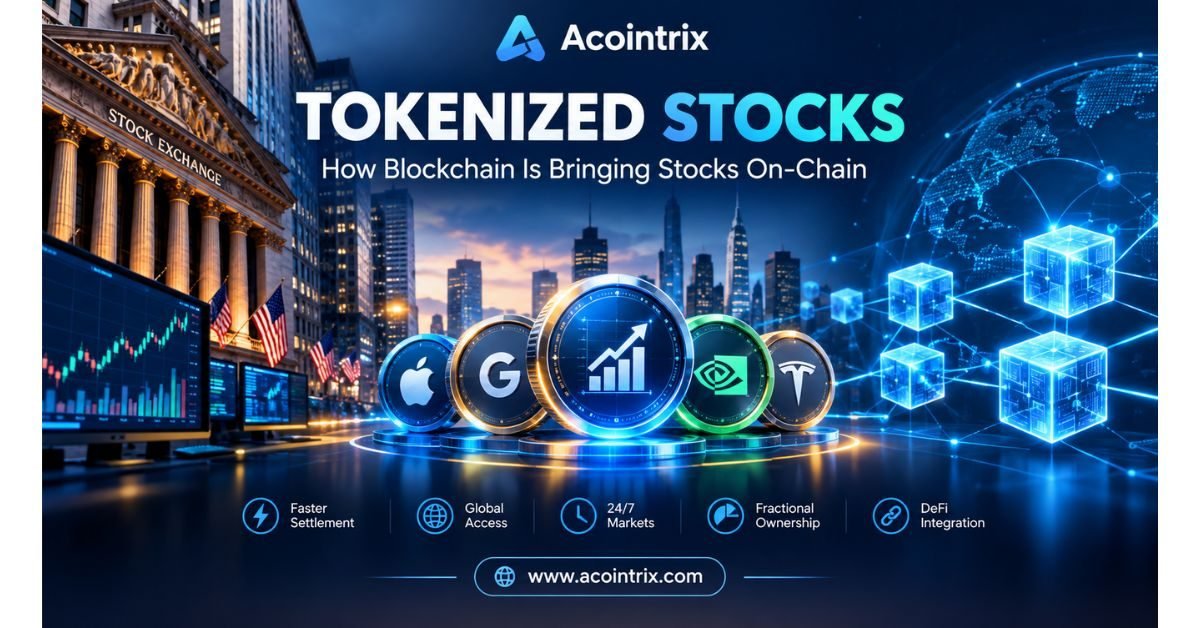
Introduction
Imagine buying exposure to a major company, transferring that position on a blockchain and potentially using it within a digital financial ecosystem.
That is the idea behind tokenized stocks.
Stock markets traditionally operate through brokers, exchanges, custodians, clearing systems and other financial intermediaries. Tokenization introduces a different infrastructure: representing securities as digital tokens recorded on a blockchain or similar distributed ledger.
In 2026, this idea is moving beyond experimentation.
Nasdaq announced in September 2026 that it had agreed to invest $100 million in Payward, the parent company of Kraken, while continuing work on infrastructure for tokenized equities and always-on markets.
The U.S. Securities and Exchange Commission has also provided a framework for understanding tokenized securities. Its January 2026 statement explains that a tokenized security can be a security represented as a crypto asset where ownership records are maintained partly or entirely through crypto networks.
This does not mean every stock token automatically represents direct ownership of the underlying shares.
That distinction is extremely important.
Some tokenized products can represent actual securities, while others may provide synthetic exposure or another legal structure linked to a stock.
So, what exactly are tokenized stocks?
How do they work?
What are the benefits and risks?
And could stocks eventually become a major part of on-chain finance?
Let’s explore.
What Are Tokenized Stocks?
Tokenized stocks are digital tokens that represent or provide exposure to shares of publicly traded companies through blockchain-based infrastructure.
The exact legal structure can vary.
In an issuer-sponsored model, a company or its authorized agent issues the security directly on a blockchain.
In a custodial model, the underlying shares may be held with a custodian while tokens represent the holder’s interest in those securities.
In a synthetic model, a third party can create a token or financial product that tracks the price of an underlying stock without giving the holder direct ownership of that company’s shares.
The SEC and Investor.gov specifically distinguish between issuer-sponsored, custodial and synthetic tokenized securities because the rights attached to each structure can be different.
This leads to one of the most important rules for understanding tokenized stocks:
A token that tracks the price of a stock is not necessarily the same thing as owning the stock itself.
Investors must understand the legal rights attached to the specific token.
Key Points About Tokenized Stocks
Before going deeper, here are the most important points:
- Tokenization puts securities or economic exposure onto blockchain infrastructure.
- Tokenized stocks can potentially trade and settle using blockchain-based systems.
- Not every stock token provides traditional shareholder rights.
- Some models use custodians to hold underlying shares.
- Some products provide synthetic exposure instead.
- Tokenized stocks can support fractional ownership structures.
- Blockchain can enable programmable transfers and settlement.
- 24/7 markets are one potential advantage.
- Regulation remains critical.
- Tokenized equities are still small compared with traditional stock markets.
Visual Introduction: How Stock Tokenization Works
A traditional stock transaction can look like:
Investor
↓
Broker
↓
Stock Exchange
↓
Clearing & Settlement
↓
Custodian
↓
Investor’s Account
A tokenized model can introduce blockchain into the ownership and settlement process:
Investor
↓
Tokenized Stock
↓
Blockchain
↓
Custody / Issuer / Regulated Infrastructure
↓
Underlying Security or Economic Exposure
The exact structure depends on the token and platform.
The blockchain becomes a digital infrastructure layer for recording, transferring and potentially settling the asset.
Why Are Stocks Being Tokenized?
The traditional financial system already works at enormous scale.
So why change it?
The argument for tokenization is not necessarily that traditional stock markets are broken.
Instead, blockchain can potentially improve certain parts of the financial lifecycle.
These include:
- Settlement
- Transferability
- Market accessibility
- Programmability
- Transparency
- Fractionalization
- Automation
- Cross-border infrastructure
- Integration with digital assets
Tokenization attempts to combine the legal and economic characteristics of traditional securities with the technological capabilities of blockchain.
Nasdaq has described tokenization as representing securities on blockchain-based distributed ledgers instead of conventional electronic book-entry systems.
Features of Tokenized Stocks
1. Blockchain-Based Ownership Records
Instead of relying exclusively on traditional databases, ownership or associated rights can be represented through blockchain infrastructure.
2. Programmability
Smart contracts can potentially automate certain processes associated with transfers, compliance and corporate actions.
3. Fractionalization
Some tokenized structures can make it easier to divide exposure into smaller units.
However, fractional ownership depends on the product’s legal and operational structure.
4. Potential 24/7 Trading
Blockchain networks can operate continuously, unlike traditional equity markets that generally follow defined trading hours.
Some tokenized stock platforms are already exploring around-the-clock access.
5. Faster Settlement
Blockchain-based settlement can potentially reduce settlement time.
Some models aim for near-instant or atomic settlement.
6. Global Accessibility
Subject to local laws and platform restrictions, tokenized securities could make certain markets more accessible to international users.
7. Composability
Tokenized assets can potentially interact with other blockchain-based financial applications.
For example, a tokenized asset could potentially be integrated into digital lending, collateral or settlement infrastructure where legally permitted.
Benefits of Tokenized Stocks
1. Potentially Faster Settlement
Traditional securities settlement involves multiple systems and intermediaries.
Blockchain-based settlement can potentially reduce the number of steps involved.
2. 24/7 Market Infrastructure
Traditional stock exchanges generally have defined trading sessions.
Blockchain markets can operate continuously.
This could eventually support a more flexible global market structure.
3. Fractional Access
Tokenization can support smaller units of ownership or exposure.
This could potentially lower minimum transaction sizes for certain products.
4. Greater Programmability
Smart contracts can automate certain financial processes.
For example:
Trade
→ Verification
→ Settlement
→ Asset Transfer
can potentially occur through programmable infrastructure.
5. Global Settlement
Blockchain networks operate across borders.
This creates potential for more efficient international settlement, subject to regulations and financial controls.
6. Transparency
Depending on the blockchain and product design, transactions can be recorded on a transparent ledger.
7. Integration With Digital Finance
Tokenized stocks could eventually interact with stablecoins, tokenized bonds, funds and other digital assets.
This could contribute to a broader on-chain financial ecosystem.
Quick Insights Table
| Feature | Traditional Stocks | Tokenized Stocks |
|---|---|---|
| Ownership record | Traditional financial infrastructure | Blockchain or hybrid infrastructure |
| Trading hours | Usually defined market hours | Potentially 24/7 |
| Settlement | Traditional clearing and settlement | Potentially blockchain-based |
| Transfer | Broker/custodian infrastructure | Blockchain-enabled transfer where permitted |
| Fractionalization | Available through certain products | Can be built into token structures |
| Programmability | Limited | Potentially high |
| Transparency | Regulated market records | Potentially on-chain plus regulated records |
| Global access | Depends on broker and jurisdiction | Depends on regulation and platform |
| Shareholder rights | Generally defined by share class | Depends on token structure |
| Main risk | Market and operational risks | Market, technology, legal, custody and regulatory risks |
Tokenized Stocks vs Traditional Stocks
The two should not automatically be treated as competing assets.
Tokenization can be viewed as a new technological representation of securities.
For example, a traditional share might be represented through:
Brokerage Account → Central Securities Infrastructure
A tokenized security might use:
Digital Wallet → Blockchain → Custody / Issuer Infrastructure
But the legal rights can vary significantly.
Investor.gov explains that issuer-sponsored tokenized securities can carry rights such as voting and dividends, while synthetic tokenized securities can provide price exposure without giving investors claims or rights against the company whose stock is being referenced.
Therefore, investors should always ask:
What exactly does this token represent?
Deep Explanation: How Stock Tokenization Works
A simplified tokenization process can involve several stages.
Step 1: Select the Underlying Security
A company or financial provider identifies the stock to be tokenized.
For example:
- Apple
- Tesla
- Nvidia
- Alphabet
The actual availability depends on the platform, jurisdiction and product.
Step 2: Establish the Legal Structure
The issuer determines whether the token will represent:
- Direct ownership
- Custodial ownership
- A security entitlement
- Synthetic exposure
- Another financial structure
This is one of the most important stages.
Step 3: Custody the Underlying Asset
In some structures, actual shares are held by a qualified custodian.
Step 4: Mint the Token
A blockchain token is created according to the product’s structure.
Step 5: Distribute the Token
Eligible users may be able to purchase or receive the token through a supported platform.
Step 6: Trade or Transfer
Depending on the rules, users may be able to transfer or trade the token.
Step 7: Corporate Actions
Dividends, splits and other corporate actions need to be handled according to the legal structure of the token.
This is an area where issuer-sponsored tokenization can be particularly important.
Nasdaq has said its equity-token design aims to preserve issuer control and modernize areas such as corporate actions, proxy voting and shareholder engagement.
Real Example: Nasdaq and Tokenized Equities
One of the strongest signals that stock tokenization is becoming a mainstream financial-market topic is the involvement of Nasdaq.
In March 2026, Nasdaq announced an equity-token design intended to put public companies at the center of ownership rights, investor experience, transparency and governance.
In September 2026, Nasdaq announced an agreement to invest $100 million in Payward, the parent company of Kraken, while expanding their collaboration around tokenized equities and always-on market infrastructure.
This is significant because the development is not coming exclusively from crypto-native companies.
A major traditional market operator is actively exploring how blockchain infrastructure can fit into regulated capital markets.
That could be an important signal for the future of tokenized securities.
Small Case Study: Tokenized Stock Market Growth
The market remains small compared with traditional equities, but its growth has been rapid.
CoinGecko’s 2026 RWA report found that tokenized stocks reached approximately $486.69 million in market capitalization by March 31, 2026, up from about $2.09 million in June 2025. It also reported approximately $15.1 billion in tokenized-stock spot trading volume during Q1 2026.
The report identified technology companies among the leading tokenized equities, including Circle, Tesla, Nvidia and Alphabet.
However, CoinGecko also noted that trading volumes for leading tokenized equities remained less than 1% of their traditional stock-market counterparts.
This gives us a balanced picture:
Growth is strong, but tokenized stocks are still a small part of global equity markets.
Tokenized Stocks and DeFi
One of the most interesting differences between tokenized stocks and traditional shares is the possibility of integration with decentralized finance.
In theory, tokenized securities could become building blocks for:
- Digital collateral
- Lending
- Structured products
- Portfolio management
- Automated settlement
- Cross-border finance
However, this does not mean every tokenized stock can automatically be deposited into any DeFi protocol.
Legal restrictions, smart-contract compatibility, custody arrangements and platform rules all matter.
The future may depend on creating compliant ways for traditional securities to interact with blockchain-based financial applications.
Risks of Tokenized Stocks
Tokenized stocks offer opportunities, but investors should understand the risks.
1. Legal Structure Risk
The biggest question is often:
What legal rights does the token actually provide?
Two tokens referencing the same stock may provide very different rights.
2. Regulatory Risk
Securities laws vary across jurisdictions.
A product legally available in one country may not be available in another.
3. Custody Risk
If the token depends on underlying shares held by a custodian, the custody arrangement becomes an important part of the risk structure.
4. Smart Contract Risk
Blockchain-based products can depend on smart contracts.
A technical vulnerability could create losses or operational problems.
5. Liquidity Risk
A tokenized stock may have significantly less liquidity than the underlying stock.
A well-known company does not automatically mean its tokenized version will have deep liquidity.
6. Counterparty Risk
Users may depend on issuers, custodians, brokers, exchanges, market makers and technology providers.
7. Trading Risk
Tokenization does not eliminate normal stock-market risks.
The underlying company’s share price can still fall.
8. Synthetic Exposure Risk
Some products may track a stock without representing actual ownership of that stock.
Investor.gov specifically warns that synthetic structures can provide price exposure without giving the holder rights against the underlying issuer.
9. Network Risk
Blockchain congestion, transaction fees or network outages can affect usability.
10. Investor-Protection Risk
Investors must understand whether a token carries the same protections and rights as a traditional security.
Responsible Approach to Tokenized Stocks
Tokenized stocks should be approached as financial products, not simply as another cryptocurrency.
Before purchasing one, consider:
- Who issued the token?
- Is the underlying stock actually held?
- Who is the custodian?
- What legal rights do token holders receive?
- Are dividends passed through?
- Are voting rights included?
- Which regulator oversees the product?
- Which country is the product available in?
- Can the token be redeemed?
- What happens if the issuer fails?
- What blockchain is being used?
- How liquid is the token?
Never assume that a token carrying the name or ticker of a major company automatically gives you the same ownership rights as purchasing its traditional shares.
Why Tokenized Stocks Matter for Crypto
Tokenized stocks could represent one of the biggest bridges between traditional finance and cryptocurrency.
Crypto markets have historically focused on assets created specifically for blockchain ecosystems.
Tokenization reverses the direction.
Instead of creating a new crypto asset, existing financial assets can potentially be represented on blockchain networks.
This could eventually bring:
Stocks
Bonds
Funds
Treasuries
Commodities
Real Estate
onto blockchain-based infrastructure.
This broader movement is usually described as real-world asset tokenization.
Trends to Watch in 2026
1. Traditional Exchanges Entering Tokenization
Nasdaq’s continued work with tokenized equities is an important development.
2. 24/7 Markets
Financial markets may increasingly move toward continuous trading and settlement infrastructure.
3. Tokenized ETFs
Tokenized exchange-traded products could expand alongside individual equities.
4. Institutional Adoption
Banks, exchanges, custodians and asset managers may increasingly experiment with tokenized securities.
5. Stablecoin Settlement
Stablecoins could become an important settlement asset for tokenized financial markets.
6. Regulatory Clarity
Regulation will likely determine which tokenization models can scale.
7. DeFi Integration
The ability to combine regulated securities with programmable blockchain applications could create new financial products.
8. Cross-Border Investing
Tokenization could eventually reduce some infrastructure barriers to international access.
Common Mistakes When Researching Tokenized Stocks
Mistake 1: Thinking Every Token Equals a Share
This is not necessarily true.
Mistake 2: Ignoring Legal Rights
Always read the product structure.
Mistake 3: Looking Only at the Stock Price
The token may have different liquidity and market conditions.
Mistake 4: Assuming 24/7 Trading Means Unlimited Liquidity
A market can remain open continuously without having deep liquidity at every hour.
Mistake 5: Ignoring the Issuer
The company creating the token matters.
Mistake 6: Ignoring Custody
Understand where the underlying securities are held.
Mistake 7: Assuming Blockchain Removes Regulation
Tokenized securities can still fall under securities laws.
The SEC’s 2026 guidance reinforces that tokenization does not automatically remove an asset from securities regulation.
Pro Tips for Evaluating Tokenized Stocks
1. Read the legal documentation first.
2. Confirm whether the token is backed by actual securities.
3. Check whether you receive shareholder rights.
4. Investigate the issuer and custodian.
5. Compare token liquidity with the underlying stock.
6. Understand the redemption mechanism.
7. Check your country’s eligibility rules.
8. Verify transaction and network fees.
9. Understand the technology behind the token.
10. Never confuse technological innovation with guaranteed investment returns.
Step-by-Step Guide: How to Evaluate a Tokenized Stock
Step 1: Identify the Stock
Determine which public company the token references.
Step 2: Identify the Token Issuer
Find out who created and distributes the token.
Step 3: Understand the Structure
Determine whether it is:
- Issuer-sponsored
- Custodial
- Synthetic
- Another regulated structure
Step 4: Check the Underlying Asset
Find out whether actual shares are held and where they are held.
Step 5: Review Investor Rights
Check whether the token provides:
- Voting rights
- Dividend rights
- Ownership rights
- Redemption rights
Step 6: Check Regulation
Find out which regulatory framework applies.
Step 7: Check Liquidity
Review trading volume, market depth and spreads.
Step 8: Understand Blockchain Costs
Check network fees and transfer restrictions.
Step 9: Review Counterparty Risk
Understand the roles of the issuer, custodian, platform and other intermediaries.
Step 10: Make an Informed Decision
Only after understanding the product structure should you decide whether it fits your objectives and risk tolerance.
Expert Perspectives
The SEC’s January 2026 statement provides an important regulatory perspective: tokenized securities remain securities when they fall within the federal securities-law definition, even though they are represented through crypto assets.
Nasdaq has taken a technology-focused approach, arguing that tokenization can modernize processes such as corporate actions, proxy voting and shareholder engagement while preserving issuer control.
At the same time, regulators and market participants continue to focus on investor protection, market structure, liquidity and the rights attached to tokenized securities.
The key lesson is:
Tokenization changes the infrastructure used to represent and transfer an asset, but it does not automatically eliminate the legal and financial responsibilities associated with that asset.
Frequently Asked Questions
What are tokenized stocks?
Tokenized stocks are blockchain-based tokens that represent securities, ownership interests or economic exposure linked to publicly traded stocks.
Are tokenized stocks the same as real stocks?
Not always. Some tokenized securities can represent ownership in an underlying security, while synthetic products may only provide price exposure.
How do tokenized stocks work?
Depending on the structure, underlying shares may be held with a custodian while corresponding tokens are issued on a blockchain. Other models can involve direct issuer-sponsored tokenization or synthetic exposure.
Can tokenized stocks trade 24/7?
Some blockchain-based platforms offer continuous trading, but availability depends on the product, platform, jurisdiction and market infrastructure.
Are tokenized stocks regulated?
The regulatory treatment depends on the product and jurisdiction. In the United States, tokenized securities can fall under federal securities laws.
Do tokenized stocks pay dividends?
It depends on the token structure. Some products may pass through economic benefits such as dividends, while others may not.
Do tokenized stock holders get voting rights?
Not necessarily. Voting rights depend on the legal structure of the token.
Are tokenized stocks available in India?
Availability depends on the specific platform, product structure and applicable Indian regulations. Investors should verify whether a particular tokenized security is legally available to them before using it.
What is the difference between tokenized stocks and crypto?
Traditional crypto assets are generally created natively on blockchain networks. Tokenized stocks represent or reference existing financial assets through blockchain infrastructure.
Are tokenized stocks safe?
They can carry risks involving the stock price, issuer, custody, regulation, liquidity, technology and counterparty relationships. Investors should understand the structure before purchasing.
Future Outlook for Tokenized Stocks
The long-term potential of tokenized stocks is significant, but the technology is still developing.
The strongest signal is the increasing involvement of established financial-market infrastructure.
Nasdaq is developing tokenization infrastructure, while crypto-native platforms are building systems that connect blockchain markets with traditional securities.
The market is also growing.
CoinGecko reported that tokenized stocks reached nearly $487 million in market capitalization by the end of Q1 2026 and generated more than $15 billion in spot trading volume during the quarter.
But these figures remain tiny compared with traditional global equity markets.
That means the biggest question is not whether tokenized stocks can grow.
It is whether they can become useful, liquid, legally robust and widely trusted financial infrastructure.
If regulation, custody, liquidity and interoperability improve, tokenized securities could eventually become a normal component of global capital markets.
The future may not be a choice between:
Traditional Finance vs Crypto
Instead, it could become:
Traditional Finance + Blockchain Infrastructure
Conclusion
Tokenized stocks are bringing traditional equities into the world of blockchain.
By representing securities through blockchain-based infrastructure, tokenization can potentially enable faster settlement, programmable transactions, fractional access, continuous markets and greater interoperability with digital finance.
But investors need to look beyond the technology.
A tokenized stock is not automatically identical to a traditional share.
The legal structure, underlying asset, custody arrangement, investor rights, regulation and liquidity all matter.
The involvement of companies such as Nasdaq shows that tokenization is becoming a serious topic in mainstream financial-market infrastructure.
For crypto investors, financial professionals and anyone interested in the future of digital assets, understanding tokenized stocks is becoming increasingly important.
The next stage of blockchain adoption may not only involve new cryptocurrencies.
It may involve putting some of the world’s existing financial assets on-chain.
Stay Ahead of the Crypto and Blockchain Revolution
The digital asset industry is evolving beyond cryptocurrencies.
From tokenized stocks and real-world assets to stablecoins, DeFi and blockchain infrastructure, Acointrix helps you understand the technologies shaping the next generation of finance.
Follow Acointrix for practical crypto insights, blockchain trends and the latest developments in digital assets.
Acointrix — Understand Crypto. Stay Informed.