

For years, thousands of cryptocurrencies have entered the market promising revolutionary change. Yet many projects have disappeared, leaving investors questioning which digital assets actually provide value.
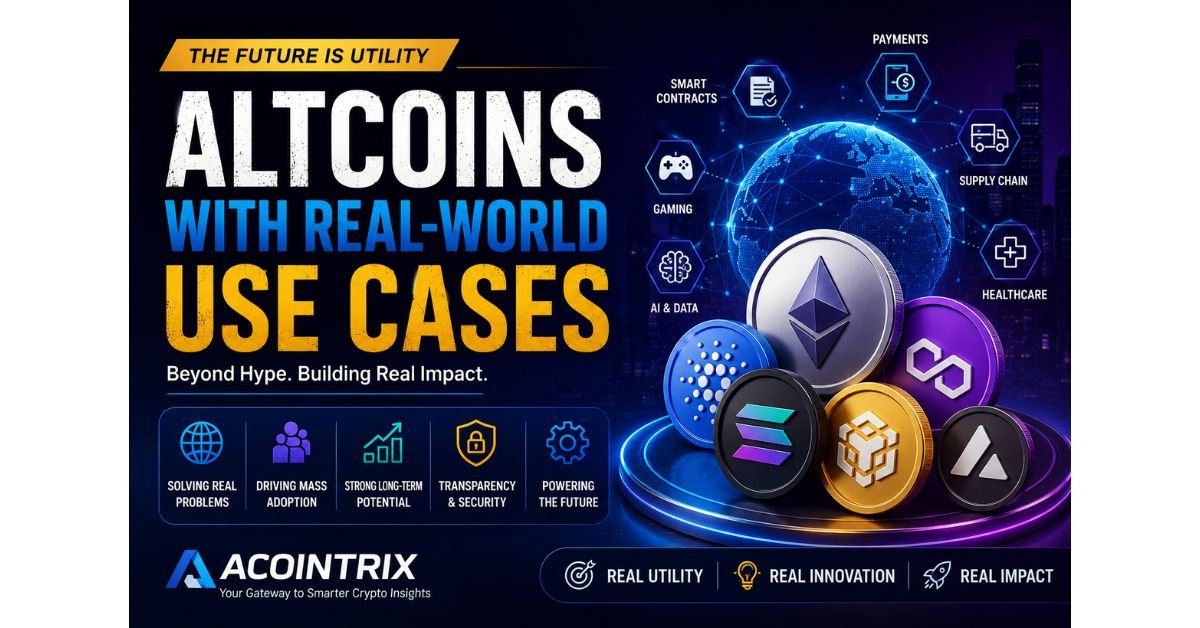
Today, the cryptocurrency landscape is evolving beyond speculation. The most promising altcoins are solving real-world problems, powering decentralized applications, improving payment systems, enhancing supply chains, and enabling entirely new digital economies.
The future of crypto belongs to projects that deliver measurable utility—not just market hype.
Introduction
Bitcoin introduced the world to decentralized money, but altcoins have expanded blockchain technology into industries ranging from finance and healthcare to gaming and artificial intelligence.
As blockchain adoption accelerates globally, investors and businesses are increasingly focusing on altcoins with genuine real-world applications. These projects offer practical solutions that improve efficiency, reduce costs, increase transparency, and create new opportunities for innovation.
Understanding which altcoins possess sustainable utility can help investors identify projects with long-term growth potential while avoiding purely speculative assets.
This guide explores the leading categories of utility-driven altcoins, their practical applications, benefits, risks, and future outlook.
What Are Altcoins With Real-World Use Cases?
Altcoins are cryptocurrencies other than Bitcoin.
Altcoins with real-world use cases are blockchain projects designed to solve specific problems or improve existing systems through decentralized technology.
Unlike speculative tokens that rely primarily on market sentiment, utility-focused altcoins provide tangible value through products, services, or infrastructure used by businesses, developers, governments, or consumers.
Examples include:
- Cross-border payment networks
- Smart contract platforms
- Supply chain tracking systems
- Decentralized finance applications
- Gaming ecosystems
- Artificial intelligence marketplaces
- Identity verification systems
The stronger the utility, the greater the potential for long-term adoption.
Key Points
1. Utility drives sustainable crypto adoption.
2. Real-world demand creates stronger ecosystems.
3. Enterprise partnerships enhance credibility.
4. Blockchain technology is expanding beyond finance.
5. Utility-focused projects often show greater long-term resilience.
6. Practical applications attract institutional interest.
7. Adoption matters more than speculation.
Features of Utility-Focused Altcoins
1. Problem-Solving Capability
Addresses real business or consumer challenges.
2. Blockchain Infrastructure
Provides decentralized network functionality.
3. Smart Contract Integration
Automates transactions and processes.
4. Transparency
Improves trust through verifiable records.
5. Security
Reduces risks associated with centralized systems.
6. Global Accessibility
Enables borderless participation.
7. Scalability
Supports growing user demand.
Benefits of Altcoins With Real-World Use Cases
Increased Adoption Potential
Practical utility attracts users and businesses.
Long-Term Sustainability
Projects solving real problems tend to survive market cycles.
Enterprise Partnerships
Utility-driven projects often collaborate with established organizations.
Revenue Generation
Many ecosystems generate ongoing network activity.
Technological Innovation
Drives blockchain advancement.
Diversification Opportunities
Expands investment exposure beyond Bitcoin.
Quick Insights Table
| Category | Real-World Application |
| Payments | Fast global transactions |
| Smart Contracts | Automated agreements |
| Supply Chain | Product tracking |
| Healthcare | Secure medical records |
| Gaming | Digital ownership |
| AI Networks | Decentralized computation |
| Identity | Verification systems |
| DeFi | Financial services |
Small Case Study
Blockchain in Supply Chain Management
A global logistics company struggles with tracking products across multiple suppliers.
Using blockchain infrastructure powered by utility-focused crypto networks:
- Shipment records become transparent.
- Fraud risks decline.
- Verification improves.
- Delays are reduced.
Result:
Improved operational efficiency and customer trust.
This demonstrates how blockchain utility extends far beyond trading.
Major Categories of Utility Altcoins
Smart contract platforms allow developers to create decentralized applications.
Use Cases:
- Decentralized Finance
- NFT Platforms
- Gaming Ecosystems
- Enterprise Solutions
These platforms form the foundation of Web3 innovation.
Payment-Focused Altcoins
Traditional international payments often involve:
- High fees
- Long settlement times
- Currency conversion challenges
Blockchain payment networks can process transactions significantly faster while reducing costs.
Industries benefiting include:
- E-commerce
- Freelancing
- Remittances
- International trade
Supply Chain Altcoins
Blockchain enables product verification throughout manufacturing and distribution.
Benefits:
- Authenticity tracking
- Counterfeit prevention
- Regulatory compliance
- Inventory visibility
Gaming and Metaverse Altcoins
Gaming ecosystems increasingly use blockchain technology for:
- In-game assets
- Virtual land ownership
- Player rewards
- Digital economies
This creates new monetization opportunities for players and developers.
AI-Powered Blockchain Projects
Artificial intelligence and blockchain are beginning to converge.
Applications include:
- Decentralized AI marketplaces
- Data sharing networks
- Machine learning infrastructure
- Autonomous digital services
This category is expected to grow significantly in the coming years.
Real Example / Case Study
Cross-Border Business Payments
A technology company regularly pays international contractors.
Traditional Method:
- Processing delays
- Banking fees
- Currency conversion costs
Blockchain-Based Payment Network:
- Faster settlement
- Lower transaction fees
- Global accessibility
- Improved efficiency
Outcome:
Reduced operational costs and improved payment speed.
This highlights how utility-focused crypto solutions can solve real business challenges.
Current Trends
Institutional Adoption
Large organizations continue exploring blockchain infrastructure.
Tokenization
Real-world assets are increasingly moving on-chain.
AI Integration
Artificial intelligence and blockchain convergence are accelerating.
Enterprise Blockchain Solutions
Businesses seek efficiency improvements through decentralized systems.
Cross-Border Payment Innovation
Demand for faster international payments continues to grow.
Common Mistakes Investors Make
Following Hype Alone
Popularity does not equal utility.
Ignoring Adoption Metrics
Technology without users rarely succeeds.
Overlooking Competition
Many projects solve similar problems.
Neglecting Tokenomics
Economic design affects sustainability.
Lack of Research
Always evaluate fundamentals.
Pro Tips
Study actual use cases.
Analyze ecosystem growth.
Evaluate developer activity.
Monitor partnerships.
Understand token utility.
Focus on adoption trends.
Diversify risk.
Think long term.
Expert Quotes
“Utility is becoming the defining factor for long-term cryptocurrency success.”
— Blockchain Industry Analysts
“The strongest crypto projects solve real-world problems rather than creating speculative narratives.”
— Digital Asset Researchers
“Adoption remains the most important metric for evaluating blockchain value.”
— Web3 Technology Experts
Risks Associated With Utility Altcoins
Regulatory Uncertainty
Changing regulations may impact projects.
Technology Risks
Security vulnerabilities can occur.
Market Volatility
Cryptocurrency prices remain highly volatile.
Competition
Numerous projects compete for adoption.
Adoption Challenges
Technology adoption takes time.
Responsible Investing Considerations
Before investing:
- Conduct independent research.
- Understand project fundamentals.
- Evaluate risks.
- Diversify investments.
- Avoid emotional decisions.
- Invest according to risk tolerance.
Responsible investing helps manage uncertainty while participating in innovation.
Why Utility Matters More Than Hype
Historically, technologies that solve meaningful problems create lasting value.
Utility-driven altcoins:
- Generate real demand.
- Attract users.
- Build ecosystems.
- Encourage partnerships.
- Improve sustainability.
As blockchain matures, utility is becoming a primary driver of success.
Future Outlook
The next phase of cryptocurrency growth will likely be driven by real-world utility rather than speculation.
Emerging opportunities include:
- Decentralized AI
- Tokenized assets
- Enterprise blockchain solutions
- Web3 infrastructure
- Digital identity systems
- Global payment networks
Projects delivering measurable value are expected to play an increasingly important role in the digital economy.
Conclusion
Altcoins with real-world use cases represent the evolution of cryptocurrency from speculative assets into practical technological solutions.
As blockchain technology continues to mature, projects that improve efficiency, reduce costs, increase transparency, and enable innovation are likely to attract greater adoption and long-term interest.
Whether in payments, supply chains, gaming, healthcare, AI, or decentralized finance, utility-focused altcoins are shaping the future of digital transformation.
For investors, understanding utility may be one of the most important factors when evaluating opportunities in the rapidly evolving cryptocurrency market.
FAQ Section
What are utility altcoins?
Utility altcoins are cryptocurrencies designed to provide practical functionality within a blockchain ecosystem.
Why are real-world use cases important?
They create adoption, demand, and long-term sustainability.
Are utility altcoins safer investments?
No investment is risk-free, but projects with strong utility may have stronger long-term fundamentals.
Which industries use blockchain technology?
Finance, healthcare, logistics, gaming, AI, identity management, and many others.
Can utility altcoins replace traditional systems?
Some may complement or improve existing systems rather than fully replacing them.
What should investors evaluate first?
The problem being solved and the level of adoption.