

Introduction
What if a digital asset created in 2009 could influence global finance, challenge traditional banking systems, and become a recognized reserve asset for institutions worldwide?
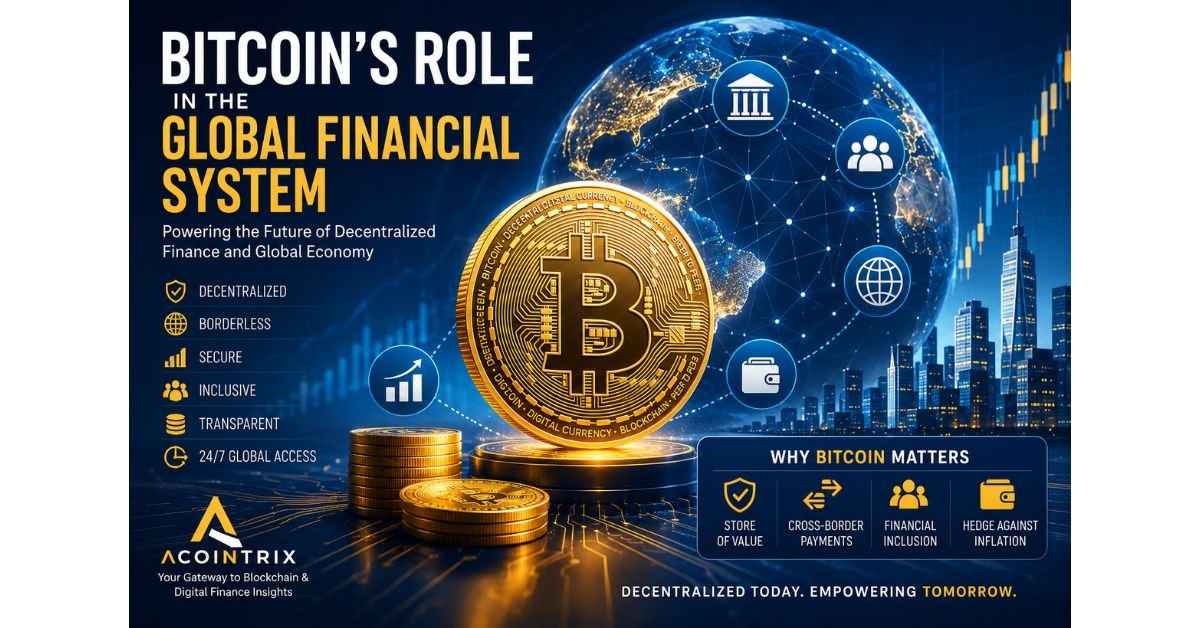
Bitcoin has evolved far beyond being a niche cryptocurrency. Today, governments, corporations, institutional investors, and millions of individuals view Bitcoin as an important component of the modern financial ecosystem. As financial systems become increasingly digital, Bitcoin continues to gain attention as a decentralized, borderless, and scarce digital asset.
The rise of Bitcoin is not just a technological story—it is a financial revolution that is reshaping how people store value, transfer money, and participate in the global economy.
In this comprehensive guide, we explore Bitcoin’s Role in the Global Financial System, its meaning, features, benefits, risks, real-world use cases, future trends, and the key factors driving its growing adoption.
Understanding Bitcoin’s Role in the Global Financial System is essential for investors, businesses, and policymakers navigating the future of digital finance
What Is Bitcoin?
Bitcoin is a decentralized digital currency that operates on blockchain technology without requiring a central authority such as a government or bank.
Created by the pseudonymous developer Satoshi Nakamoto, Bitcoin enables peer-to-peer transactions across the globe while maintaining transparency and security through cryptographic verification.
Unlike traditional currencies, Bitcoin has a fixed supply of 21 million coins, making it scarce and resistant to inflation caused by excessive money printing.
The concept of Bitcoin’s Role in the Global Financial System extends beyond cryptocurrency trading and includes global payments, wealth preservation, and financial innovation.
Meaning of Bitcoin’s Role in the Global Financial System
Bitcoin’s role in the global financial system refers to its growing influence as:
- A store of value
- A digital investment asset
- A cross-border payment solution
- A hedge against currency depreciation
- An alternative financial network
- A financial inclusion tool
- A reserve asset for institutions
As digital transformation accelerates, Bitcoin is increasingly being considered alongside traditional financial instruments such as stocks, bonds, commodities, and currencies.
Growing institutional participation, ETF adoption, and global awareness have strengthened Bitcoin’s position within financial markets. Recent research suggests Bitcoin is becoming more integrated with traditional finance while institutional adoption continues to expand.
Key Points at a Glance
Quick Insights
✔ Decentralized and borderless digital asset
✔ Limited supply of 21 million BTC
✔ Operates 24/7 globally
✔ Used for investment and wealth preservation
✔ Enables international transfers
✔ Supports financial inclusion
✔ Increasing institutional adoption
✔ Growing integration with traditional finance
✔ Considered by many as digital gold
✔ Continues to influence future financial innovation
Visual Introduction
Traditional Finance vs Bitcoin
| Feature | Traditional Finance | Bitcoin |
|---|---|---|
| Control | Centralized | Decentralized |
| Operating Hours | Limited | 24/7 |
| Cross-Border Transfers | Slow | Faster |
| Supply | Expandable | Fixed |
| Accessibility | Bank Required | Internet Access |
| Transparency | Limited | Public Blockchain |
| Settlement | Intermediaries | Peer-to-Peer |
11 Success Factors Behind Bitcoin’s Role in the Global Financial System
1. Digital Store of Value
Bitcoin is frequently compared to gold because of its scarcity.
With only 21 million coins available, many investors use Bitcoin as a long-term store of value.
As inflation concerns rise globally, Bitcoin continues attracting investors seeking alternative assets.
2. Borderless Financial Transactions
Traditional international transfers can be expensive and time-consuming.
Bitcoin allows users to send value across borders without relying on multiple intermediaries.
This capability makes Bitcoin especially useful for global commerce and remittances.
3. Financial Inclusion
Billions of people remain underbanked worldwide.
Bitcoin enables access to financial services using only a smartphone and internet connection.
This opens opportunities for individuals who cannot access traditional banking systems.
4. Institutional Adoption
One of the biggest developments in recent years has been institutional involvement.
Asset managers, corporations, and investment funds increasingly view Bitcoin as part of diversified portfolios. Institutional adoption and Bitcoin ETFs have contributed to growing liquidity and stronger integration with traditional financial markets.
5. Hedge Against Currency Depreciation
In regions experiencing high inflation, Bitcoin has emerged as an alternative means of preserving purchasing power.
Research indicates Bitcoin may function more effectively as a hedge against long-term currency debasement than short-term inflation.
6. Enhanced Transparency
Every Bitcoin transaction is recorded on a public blockchain.
This creates an immutable and transparent ledger that can be verified by anyone.
7. Reduced Dependence on Central Authorities
Bitcoin operates independently of governments and central banks.
This decentralization is one of its most distinctive characteristics.
8. Portfolio Diversification
Many investors use Bitcoin to diversify investment portfolios.
Its unique market behavior provides an alternative asset class alongside stocks, bonds, and commodities.
9. Innovation in Financial Technology
Bitcoin paved the way for blockchain innovation, decentralized finance, and digital asset ecosystems.
The technology behind Bitcoin continues to influence financial infrastructure globally.
10. Global Liquidity Network
Bitcoin operates continuously without geographical restrictions.
This creates a global liquidity network accessible to participants worldwide.
11. Foundation for Future Digital Finance
Bitcoin has become a catalyst for broader digital finance initiatives, including tokenization, digital payments, and emerging financial technologies. Experts increasingly view digital assets as part of the evolving architecture of global finance.
Features of Bitcoin’s Role in the Global Financial System
Core Features
- Decentralized network
- Fixed supply
- Blockchain technology
- Global accessibility
- High transparency
- Strong security
- Peer-to-peer transactions
- 24/7 operation
- Borderless transfers
- Immutable transaction records
Benefits of Bitcoin in the Global Financial System
Economic Benefits
Wealth Preservation
Limited supply helps protect against excessive monetary expansion.
Faster Transactions
Global transfers can occur without multiple banking intermediaries.
Financial Accessibility
People can participate in financial networks without traditional bank accounts.
Investment Opportunities
Bitcoin provides exposure to a rapidly growing digital asset class.
Transparency
Public blockchain verification increases accountability.
Innovation
Encourages technological advancement across financial services.
Quick Insights Table
| Area | Impact of Bitcoin |
|---|---|
| Banking | Alternative financial access |
| Payments | Faster cross-border transfers |
| Investment | New asset class |
| Technology | Blockchain innovation |
| Inclusion | Banking the unbanked |
| Commerce | Global digital payments |
| Wealth Storage | Digital store of value |
| Finance | Decentralized alternatives |
Small Case Study
Cross-Border Remittances
A worker employed abroad wants to send money home.
Traditional transfer services may charge high fees and require multiple intermediaries.
Using Bitcoin, value can be transferred globally with fewer intermediaries, potentially reducing costs and increasing accessibility.
This demonstrates how Bitcoin can contribute to financial efficiency on a global scale.
Deep Explanation: Why Bitcoin Matters Globally
The global financial system relies heavily on centralized institutions.
While these institutions provide stability, they can also introduce friction, delays, and barriers.
Bitcoin introduces a decentralized alternative that offers:
- Open participation
- Global accessibility
- Reduced dependence on intermediaries
- Increased financial sovereignty
As digital transformation continues, Bitcoin serves as a complementary layer to existing financial systems rather than necessarily replacing them.
Recent adoption trends show a growing divide where some regions lead in usage while others build institutional infrastructure, highlighting Bitcoin’s expanding role across multiple segments of finance.
Real Example
Corporate Treasury Adoption
Several companies have added Bitcoin to their treasury strategies as a long-term reserve asset.
This reflects increasing confidence in Bitcoin’s potential role as a strategic financial asset.
The trend has encouraged broader institutional participation and increased public awareness of digital assets.
Risks of Bitcoin
Despite its advantages, Bitcoin carries important risks.
| Risk | Explanation |
|---|---|
| Volatility | Prices can fluctuate significantly |
| Regulation | Rules vary across countries |
| Security | Improper storage may lead to losses |
| Market Sentiment | Prices influenced by investor behavior |
| Technology Risk | Requires technical understanding |
| Liquidity Events | Market shocks can impact valuations |
Research also highlights risks associated with leveraged markets, custodial solutions, tokenized products, and operational complexities surrounding Bitcoin-related financial products.
Responsible Bitcoin Usage
To use Bitcoin responsibly:
- Learn blockchain fundamentals.
- Use secure wallets.
- Enable two-factor authentication.
- Diversify investments.
- Avoid emotional trading.
- Follow regulatory guidelines.
- Invest only what you can afford to risk.
Why Bitcoin Is Important Today
Global Digitization
Financial systems are becoming increasingly digital.
Economic Uncertainty
Many investors seek alternative assets.
Financial Freedom
Users gain greater control over their assets.
Technological Advancement
Blockchain innovation continues to accelerate.
Institutional Confidence
Large organizations increasingly participate in digital asset markets.
Common Mistakes to Avoid
- Investing without research
- Ignoring security practices
- Following hype-driven decisions
- Overleveraging positions
- Neglecting portfolio diversification
- Failing to understand volatility
Pro Tips for Investors
✅ Focus on long-term fundamentals
✅ Use secure hardware wallets
✅ Stay informed about regulations
✅ Diversify holdings
✅ Understand market cycles
✅ Follow risk management principles
Expert Quotes
Satoshi Nakamoto
“If you don’t believe me or don’t get it, I don’t have time to try to convince you, sorry.”
Michael Saylor
“Bitcoin is digital property and the strongest asset for preserving capital over time.”
Cathie Wood
“Bitcoin represents a new global monetary system powered by technology.”
Step-by-Step Guide: Understanding Bitcoin’s Global Role
Step 1
Learn what Bitcoin is.
Step 2
Understand blockchain technology.
Step 3
Study global financial systems.
Step 4
Analyze adoption trends.
Step 5
Explore institutional involvement.
Step 6
Evaluate risks and opportunities.
Step 7
Follow long-term developments.
Future Outlook
The future of Bitcoin appears increasingly connected to the evolution of global finance.
Key trends include:
- Institutional expansion
- Digital asset regulation
- Cross-border payment innovation
- Financial tokenization
- Blockchain infrastructure growth
- Increased adoption in emerging markets
- Integration with traditional financial services
Research suggests digital currencies, stablecoins, and tokenized financial assets will play an increasingly important role in the future architecture of global finance, with Bitcoin remaining a major component of this transformation.
FAQ Section
Is Bitcoin part of the global financial system?
Yes. Bitcoin increasingly influences investment markets, payment systems, and financial innovation worldwide.
Why is Bitcoin considered digital gold?
Its fixed supply and scarcity make it comparable to gold as a store of value.
Can Bitcoin replace traditional banks?
Bitcoin provides an alternative financial network but currently complements rather than completely replaces traditional banking.
What are the biggest benefits of Bitcoin?
Accessibility, transparency, decentralization, and global transfer capabilities.
What are the biggest risks?
Volatility, regulatory uncertainty, and security challenges.
Is institutional adoption increasing?
Yes. Institutional participation has grown significantly through investment products, custody solutions, and portfolio allocations.
Conclusion
Bitcoin has evolved from an experimental digital currency into a globally recognized financial asset. Its role in the global financial system continues to expand through institutional adoption, technological innovation, financial inclusion, and cross-border utility.
While challenges such as volatility and regulation remain, Bitcoin has already established itself as a major force within modern finance. As digital transformation accelerates, Bitcoin is likely to remain at the center of conversations about the future of money, investment, and global economic connectivity.
For investors, businesses, and policymakers alike, understanding Bitcoin’s Role in the Global Financial System is no longer optional—it is essential.
Ready to stay ahead in the world of cryptocurrency and blockchain innovation?
Visit Acointrix for expert crypto insights, market analysis, blockchain education, investment strategies, and the latest trends shaping the future of digital finance.
Stay informed. Stay secure. Stay ahead with Acointrix.