

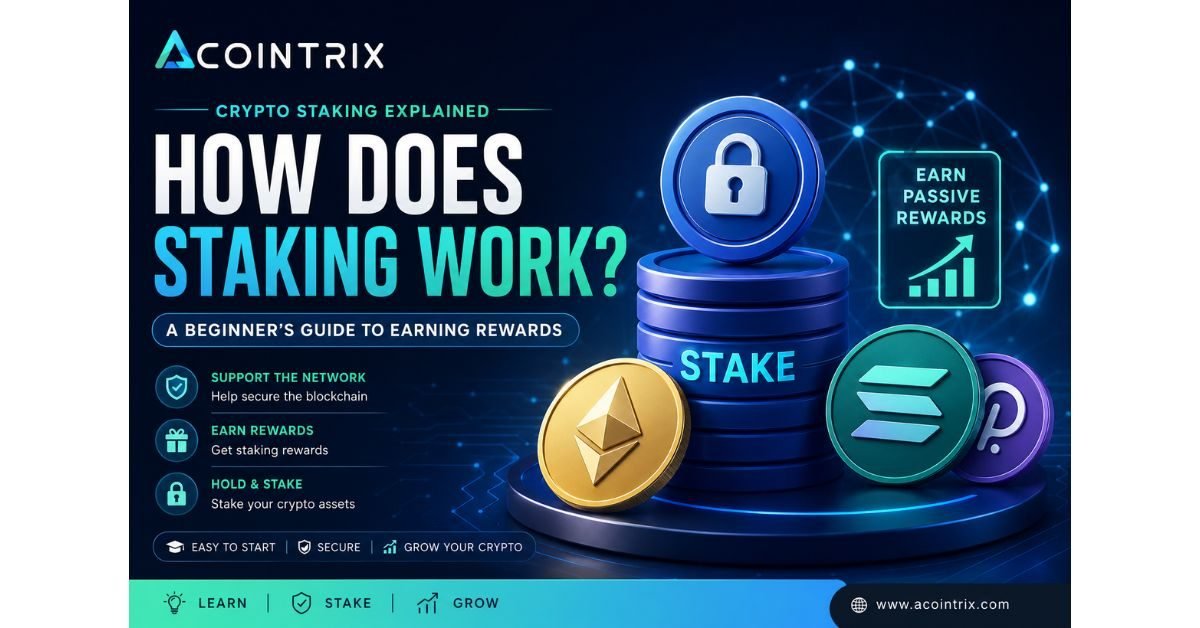
Introduction
Cryptocurrency has changed the way people think about money, investing, and financial technology. While many crypto users simply buy and hold digital assets, another method allows investors to potentially earn rewards from participating in blockchain networks: crypto staking.
But what exactly is staking?
How does it work?
Where do staking rewards come from?
And is staking actually worth it?
Crypto staking can appear complicated at first, especially for beginners. In reality, the basic idea is relatively straightforward: users commit certain cryptocurrencies to support the operation and security of a Proof-of-Stake (PoS) blockchain and may receive rewards in return.
However, staking isn’t simply a guaranteed way to make passive income. Rewards can vary, assets can lose value, and different staking mechanisms come with different conditions and risks.
In this guide, we’ll explain crypto staking from the ground up, including how staking works, its features, benefits, risks, examples, common mistakes, and responsible strategies for beginners.
What Is Crypto Staking?
Crypto staking is the process of committing cryptocurrency to support a blockchain network that uses a Proof-of-Stake consensus mechanism. In return, participants may receive staking rewards.
Think of staking as participating in the operation and security of a blockchain rather than simply holding a cryptocurrency in your wallet.
In Proof-of-Work systems, such as Bitcoin, miners use computational power to help validate transactions.
Proof-of-Stake networks use a different approach.
Instead of relying primarily on mining hardware, these networks use validators and staked cryptocurrency to help maintain network security and validate transactions.
A person who stakes cryptocurrency may therefore contribute to the blockchain while potentially earning additional tokens as rewards.
Simple Example
Imagine you own 1,000 units of a cryptocurrency.
Instead of leaving them idle, you stake them through a supported staking mechanism.
Suppose the network offers an illustrative annual reward rate of 5%.
If the rate remained constant and there were no fees or other changes, you might earn approximately:
1,000 × 5% = 50 tokens
However, this does not mean you are guaranteed to make money.
The cryptocurrency’s market price can rise or fall, staking rates can change, and fees or lock-up conditions can affect your actual return.
How Does Crypto Staking Work?
The process can be broken down into several steps.
Step 1: Choose a Proof-of-Stake Cryptocurrency
First, users need an asset that operates on a Proof-of-Stake or related consensus mechanism.
Not every cryptocurrency supports staking.
Step 2: Acquire the Cryptocurrency
The user obtains the relevant cryptocurrency through an exchange, wallet, or another supported method.
Step 3: Select a Staking Method
Depending on the blockchain, users may be able to stake through:
- Direct validator staking
- A cryptocurrency exchange
- A staking pool
- Liquid staking protocols
- Wallet-based staking
Step 4: Commit or Delegate Assets
The cryptocurrency is either deposited with a staking service or delegated to a validator.
The exact process differs between blockchains.
Step 5: Validators Participate in Network Consensus
Validators use staked assets as part of the blockchain’s consensus mechanism.
They help process transactions and maintain network integrity.
Step 6: Rewards Are Distributed
When the network successfully processes blocks and meets its consensus requirements, eligible participants may receive rewards.
Step 7: Unstaking
Depending on the network, users may later withdraw or unstake their assets.
Some networks have an unbonding period, meaning users cannot immediately access their funds after requesting withdrawal.
Visual Introduction: The Crypto Staking Process
Your Crypto → Stake/Delegate → Validator → Blockchain Network → Network Participation → Rewards
This simple flow explains the basic concept behind Proof-of-Stake participation.
However, the exact mechanics vary significantly from one blockchain to another.
Key Features of Crypto Staking
1. Proof-of-Stake Participation
Staking is primarily associated with Proof-of-Stake and related consensus systems.
2. Potential Rewards
Participants may receive additional cryptocurrency as compensation for contributing to the network.
3. Network Security
Staked assets can help make attacks against a blockchain more difficult and expensive.
4. Validator-Based System
Many staking systems rely on validators to propose and validate blocks.
5. Delegation
Some networks allow users to delegate their assets to validators instead of operating validator infrastructure themselves.
6. Different Lock-Up Conditions
Some staking programs allow flexible withdrawals, while others require users to wait before accessing their assets.
7. Variable Reward Rates
Staking yields aren’t necessarily fixed forever. Reward rates can change according to network conditions and protocol rules.
Benefits of Crypto Staking
1. Potential Passive Rewards
One of the biggest attractions of staking is the possibility of earning additional tokens while holding an asset.
2. Supports Blockchain Security
Staking isn’t only about earning rewards. Stakers can contribute to the security and operation of decentralized networks.
3. Alternative to Simply Holding
Instead of keeping eligible tokens completely idle, users can potentially put them to work within the network.
4. Lower Energy Requirements Than Mining
Proof-of-Stake systems generally don’t require the same type of energy-intensive mining infrastructure associated with Proof-of-Work networks.
5. Accessibility
Some staking services allow users to participate without running their own validator infrastructure.
6. Long-Term Participation
Investors who already intend to hold a particular asset for an extended period may consider staking as part of their broader strategy.
Quick Insights: Crypto Staking at a Glance
| Factor | Explanation |
|---|---|
| What is staking? | Participating in a PoS blockchain by committing or delegating crypto |
| Main purpose | Help secure and operate the blockchain |
| Potential benefit | Earn additional cryptocurrency rewards |
| Main participants | Stakers, validators and delegators |
| Reward source | Blockchain protocol emissions and/or transaction-related rewards |
| Main risk | Crypto price volatility and protocol/service risks |
| Withdrawal | Depends on the blockchain or platform |
| Guaranteed profit? | No |
| Suitable for everyone? | No; users should understand the risks first |
Why Do People Stake Cryptocurrency?
People may stake crypto for several different reasons.
Earning Additional Tokens
The most obvious reason is the potential to receive additional cryptocurrency.
Supporting a Blockchain
Some investors want to contribute directly to the networks they use or believe in.
Long-Term Strategy
Someone planning to hold an eligible asset for years may consider staking rather than simply keeping the asset inactive.
Participation in Decentralized Networks
Staking allows users to become participants in blockchain ecosystems rather than merely market participants.
How Are Staking Rewards Generated?
This is one of the most important concepts beginners should understand.
Staking rewards do not simply appear from nowhere.
Depending on the blockchain, rewards may come from mechanisms such as:
- New token issuance
- Transaction fees
- Protocol incentives
- Validator rewards
- Other network-defined reward mechanisms
The exact reward structure varies by blockchain.
Therefore, seeing a staking percentage on a platform does not necessarily mean that percentage will remain unchanged.
Crypto Staking Risks
Staking can offer potential rewards, but it also carries meaningful risks.
1. Cryptocurrency Price Risk
This is perhaps the biggest risk.
Imagine you stake crypto worth ₹100,000 and earn 5% in tokens.
Your reward may look attractive.
But if the cryptocurrency’s market value falls significantly, the overall value of your holdings could still decline.
Staking rewards do not protect you from market losses.
2. Lock-Up and Unbonding Risk
Some blockchain networks require users to wait before their assets become available after unstaking.
This can become a problem during sudden market movements.
3. Validator Risk
When delegating assets to a validator, poor validator performance may affect rewards.
Some networks can also impose penalties for certain validator behaviors.
4. Platform Risk
If you stake through a centralized exchange or third-party service, you also take on counterparty and platform risks.
5. Smart Contract Risk
Certain staking and liquid-staking systems rely on smart contracts.
A vulnerability or exploit could potentially result in financial losses.
6. Reward Rate Changes
A displayed annual percentage yield isn’t necessarily permanent.
Network conditions, token issuance, participation levels, and protocol changes can influence rewards.
7. Liquidity Risk
If your assets are locked, you may not be able to sell them immediately when market conditions change.
Responsible Crypto Staking: What Should Beginners Do?
Responsible staking starts with understanding what you’re actually participating in.
Before staking, ask:
What blockchain am I staking on?
Who controls the validator or platform?
How are rewards calculated?
Can I unstake immediately?
Are there fees?
What happens if the validator performs poorly?
Is the staking service custodial or non-custodial?
What smart contracts are involved?
Don’t stake simply because you see a high APY.
A very high advertised yield can come with significantly higher risks.
Step-by-Step Guide: How to Stake Crypto
Step 1: Research the Asset
Understand the cryptocurrency and its underlying blockchain.
Step 2: Confirm Staking Support
Check whether the asset actually supports staking and what type of staking mechanism it uses.
Step 3: Understand the Reward Model
Don’t focus only on the percentage.
Understand how rewards are calculated and distributed.
Step 4: Check Lock-Up Rules
Find out whether your assets can be unstaked immediately or whether an unbonding period applies.
Step 5: Evaluate Validators or Platforms
Look at:
- Validator history
- Fees
- Performance
- Reputation
- Security practices
Step 6: Start Small
Beginners should consider starting with an amount they can afford to lose rather than committing their entire portfolio.
Step 7: Monitor Your Position
Keep track of:
- Reward changes
- Validator performance
- Network updates
- Fees
- Token price
- Unstaking requirements
Small Case Study: How Staking Can Work
Consider a hypothetical investor named Rahul.
Rahul owns crypto worth ₹200,000.
He decides to stake the eligible portion through a supported validator.
Suppose the network’s reward rate is approximately 6% annually.
If the rate remained constant and ignoring fees, taxes, compounding and price changes, Rahul might receive rewards equivalent to approximately:
₹200,000 × 6% = ₹12,000
However, there is an important distinction.
If the cryptocurrency’s market value falls by 20%, Rahul’s total investment value could decline despite receiving staking rewards.
This illustrates why staking yield and investment return are not the same thing.
Real-World Staking Example
A well-known example of Proof-of-Stake adoption is Ethereum, which transitioned from Proof-of-Work to Proof-of-Stake in September 2022.
Ethereum staking allows participants to contribute to network security through validators and staking mechanisms.
However, Ethereum staking has technical requirements and different participation options. Users should understand validator responsibilities, staking infrastructure, withdrawal rules, and associated risks before participating.
The lesson for beginners is simple:
Staking isn’t just about earning rewards; it’s about understanding the blockchain mechanism behind those rewards.
Crypto Staking vs Crypto Mining
| Feature | Staking | Mining |
|---|---|---|
| Consensus model | Proof-of-Stake | Proof-of-Work |
| Main resource | Staked crypto | Computing power |
| Hardware requirements | Usually lower | Often significant |
| Energy requirements | Generally lower | Generally higher |
| Rewards | Staking rewards | Mining rewards |
| Main participants | Validators/delegators | Miners |
| Common risk | Market, validator, protocol risks | Hardware, energy, market risks |
Common Mistakes Beginners Make
Mistake 1: Chasing the Highest APY
A high yield doesn’t automatically mean a better investment.
Mistake 2: Ignoring Lock-Up Periods
Some users discover too late that they cannot immediately access their assets.
Mistake 3: Forgetting Token Price Risk
Receiving more tokens doesn’t guarantee higher portfolio value.
Mistake 4: Choosing Validators Without Research
Validator performance and fees can matter.
Mistake 5: Staking Everything
Concentrating your entire crypto portfolio in one staking strategy can increase risk.
Mistake 6: Ignoring Fees
Fees can reduce the actual reward you receive.
Mistake 7: Trusting Guaranteed-Return Claims
Legitimate staking mechanisms don’t eliminate market risk.
Pro Tips for Safer Crypto Staking
Tip 1: Understand the blockchain before staking.
Tip 2: Don’t judge an opportunity solely by APY.
Tip 3: Research validators carefully.
Tip 4: Keep some liquidity outside locked staking positions.
Tip 5: Use reputable wallets and platforms.
Tip 6: Understand smart-contract risks before using DeFi staking protocols.
Tip 7: Track your actual returns instead of relying on advertised percentages.
Tip 8: Keep records of transactions and rewards for accounting and tax purposes.
Crypto Staking Trends to Watch
The staking ecosystem continues to evolve alongside blockchain technology.
Several developments are worth watching:
Liquid Staking
Liquid staking allows users to potentially maintain liquidity while their underlying assets participate in staking.
Staking Infrastructure
Improved validator infrastructure may make participation easier for users and institutions.
Institutional Participation
As blockchain infrastructure matures, professional and institutional participants may play a larger role in staking ecosystems.
Restaking
Restaking introduces additional ways to use staked assets within blockchain infrastructure, although it also introduces additional complexity and risks.
Greater Regulatory Attention
Crypto staking may receive increasing attention from regulators around the world, making it important for users to understand the rules applicable to their jurisdiction.
Expert Insight
“Staking should be understood as participation in a blockchain’s consensus mechanism—not simply as a high-yield savings account.”
This distinction is critical.
A crypto staking reward is fundamentally different from interest on a traditional bank deposit. The underlying asset remains exposed to cryptocurrency market volatility and the specific risks of the network or platform being used.
Frequently Asked Questions
What is crypto staking in simple words?
Crypto staking means committing or delegating eligible cryptocurrency to help support a Proof-of-Stake blockchain while potentially receiving rewards.
Is crypto staking profitable?
It can generate additional token rewards, but profitability isn’t guaranteed. Cryptocurrency prices, fees, reward rates and other risks can affect the final outcome.
Is staking the same as mining?
No. Mining generally uses computational work in Proof-of-Work systems, while staking uses cryptocurrency participation in Proof-of-Stake systems.
Can I lose money while staking?
Yes. The cryptocurrency’s market price can fall, and users can also face validator, platform, smart-contract, liquidity or protocol risks.
Is staking safe for beginners?
It can be accessible to beginners, but users should understand the specific asset, platform, validator, withdrawal rules and risks before committing funds.
Can I unstake my crypto anytime?
Not always. Some networks and platforms impose unbonding or withdrawal periods.
Does staking guarantee returns?
No. Staking rewards aren’t the same as guaranteed investment returns.
Is staking better than simply holding crypto?
There isn’t a universal answer. Staking may provide additional token rewards, but it can introduce lock-up, validator and platform risks that don’t necessarily apply to simply holding an asset.
Future Outlook for Crypto Staking
Crypto staking is likely to remain an important component of the blockchain ecosystem as Proof-of-Stake networks continue to develop.
Future innovation may focus on:
- Better staking accessibility
- More efficient validator infrastructure
- Improved liquid-staking solutions
- Greater institutional participation
- New staking-based blockchain applications
- Enhanced security mechanisms
- More sophisticated risk-management tools
At the same time, regulation and security will remain important considerations.
The future of staking won’t simply depend on how high the rewards are. It will also depend on security, decentralization, usability, liquidity and long-term blockchain adoption.
Conclusion
Crypto staking is a way for cryptocurrency holders to participate in Proof-of-Stake blockchain networks while potentially earning additional rewards.
The concept is relatively simple, but successful staking requires more than selecting the highest advertised APY.
Investors should understand:
- How the blockchain works
- Where rewards come from
- Validator responsibilities
- Lock-up and unbonding periods
- Platform and smart-contract risks
- Cryptocurrency price volatility
- Fees and tax considerations
The most important principle is this:
Don’t stake crypto simply because the reward percentage looks attractive. Understand the asset, understand the network, understand the risks, and then make an informed decision.