
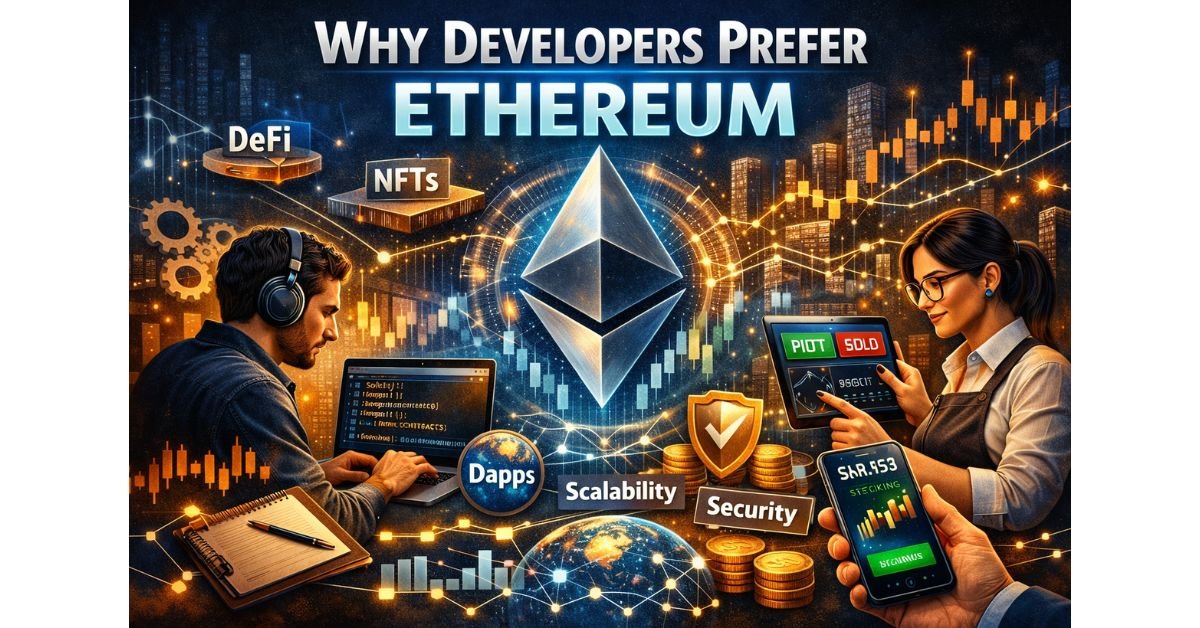
A futuristic blockchain network glowing with interconnected nodes, developers coding smart contracts, and decentralized applications running across global servers—symbolizing the Ethereum ecosystem powering Web3 innovation.
The decentralized landscape moves at breakneck speed, yet one powerhouse continually dominates the developer mindshare: Ethereum. While alternative Layer 1 chains promise lightning-fast speeds or zero transaction fees, the global developer ecosystem keeps returning to the network that started it all.
For digital assets and platforms like acointrix.com, understanding the mechanics of this preference is not just an academic exercise—it is the baseline for predicting where market liquidity, application security, and Web3 innovation will flow next.
This comprehensive strategic guide breaks down exactly why developers prefer Ethereum, how its ecosystem drives engineering success, and what this means for the future of decentralized applications (dApps)
In this article, we explain why developers prefer Ethereum in modern blockchain development.
Ethereum
A futuristic blockchain network glowing with interconnected nodes, developers coding smart contracts, and decentralized applications running across global servers—symbolizing the Ethereum ecosystem powering Web3 innovation.
Why Developers Prefer Ethereum
In the evolving world of blockchain technology, one platform consistently stands out among developers—Ethereum.
While many blockchains exist today, Ethereum remains the most widely adopted ecosystem for building decentralized applications (dApps), smart contracts, and Web3 solutions. Developers prefer Ethereum not just because it was first, but because it has evolved into a powerful, flexible, and highly secure development environment.
From startups building DeFi platforms to global enterprises experimenting with tokenization, Ethereum has become the backbone of decentralized innovation.
This blog explores the success reasons behind why developers prefer Ethereum, including its features, benefits, risks, real-world use cases, trends, and future outlook.
What is Ethereum?
Ethereum is a decentralized blockchain platform that enables developers to build and deploy smart contracts and decentralized applications without relying on centralized control.
Unlike traditional applications hosted on servers, Ethereum apps run on a global network of computers, making them transparent, secure, and resistant to censorship.
In simple terms:
Ethereum is a programmable blockchain that allows developers to create “apps without middlemen.”
Key Points of Ethereum
- Open-source blockchain platform
- Supports smart contracts
- Powers decentralized applications (dApps)
- Native cryptocurrency: Ether (ETH)
- Highly secure and globally distributed network
- Backbone of DeFi, NFTs, and Web3 ecosystems
Core Features of Ethereum That Attract Developers
1. Smart Contracts
Self-executing agreements coded on blockchain without intermediaries.
2. Ethereum Virtual Machine (EVM)
A powerful runtime environment that executes smart contract code consistently across all nodes.
3. Decentralization
No central authority controls the network.
4. High Developer Adoption
Largest blockchain developer community globally.
5. dApp Ecosystem
Thousands of decentralized applications already live.
6. Interoperability
Supports integration with other blockchains and Layer 2 solutions.
Benefits: Why Developers Prefer Ethereum
1. Strong Ecosystem Support
Ethereum has the largest developer ecosystem, tools, and libraries.
2. Security and Trust
Battle-tested network with high-level cryptographic security.
3. Flexibility
Supports multiple programming languages like Solidity.
4. Innovation Hub
Home to DeFi, NFTs, DAOs, and Web3 innovations.
5. High Liquidity and Adoption
ETH is widely used across exchanges and platforms.
6. Continuous Upgrades
Ethereum constantly evolves (e.g., Ethereum 2.0 upgrades).
Quick Insights Table
| Feature | Description | Developer Advantage |
|---|---|---|
| Smart Contracts | Automated code execution | Removes intermediaries |
| EVM | Execution engine | Consistent deployment |
| Security | Cryptographic validation | Safe application environment |
| Community | Global developer base | Faster learning & support |
| Scalability | Layer 2 solutions | Lower transaction cost |
| Ecosystem | DeFi, NFT, Web3 | Real-world applications |
Small Case Study: DeFi Growth on Ethereum
A decentralized finance platform built on Ethereum allowed users to lend and borrow crypto without banks.
Result:
- Reduced transaction friction
- Global access without KYC barriers
- Increased financial inclusion
- Millions of users onboarded
This demonstrates how Ethereum empowers developers to build real-world financial solutions.
Why Ethereum Dominates Development
Ethereum’s dominance comes from its ability to combine programmability with decentralization.
Developers are not just building applications—they are building trustless systems. This means users don’t need to trust a company; they trust the code itself.
The introduction of EVM standardized blockchain development, allowing developers to reuse tools and frameworks across multiple projects.
Real Example / Case Study
A global NFT marketplace built on Ethereum enabled artists to sell digital art directly to buyers.
Impact:
- Eliminated middlemen
- Provided royalty mechanisms
- Enabled global digital ownership
- Created new income streams for creators
Ethereum became the foundation for this digital economy transformation.
Current Trends in Ethereum Development
- Growth of Layer 2 scaling solutions
- Rise of DeFi ecosystems
- Expansion of NFT marketplaces
- Institutional blockchain adoption
- Increased focus on sustainability and energy efficiency
Common Mistakes Developers Make
- Ignoring gas fee optimization
- Poor smart contract security audits
- Not testing on testnets
- Overcomplicating contract logic
- Lack of upgrade planning
Pro Tips for Developers
- Always audit smart contracts before deployment
- Use Layer 2 networks for scalability
- Optimize gas usage in every function
- Keep contracts modular and simple
- Stay updated with Ethereum Improvement Proposals (EIPs)
Benefits of Building on Ethereum
When an engineering team chooses its blockchain stack, they weigh long-term ecosystem viability against short-term execution costs. Ethereum consistently wins on three distinct fronts:
Unmatched Security and Economic Decoupling
Following its monumental transition to Proof-of-Stake (PoS) via “The Merge,” Ethereum secured its status as the most economically secure smart contract platform on earth. Millions of ETH are staked across thousands of independent global validators. Hacking or reversing a transaction on Ethereum requires overriding an economic moat worth tens of billions of dollars, providing enterprise-grade security that newer chains cannot match.
Composability (The “Money Legos” Effect)
In Web3 development, composability means that distinct applications can interact and build upon one another seamlessly. Because major decentralized finance (DeFi) primitives like Uniswap, Aave, and MakerDAO live natively on Ethereum, a new developer can integrate these existing protocols into a brand-new application via simple smart contract calls. This eliminates the need to build liquidity pools or collateral systems from scratch.
Massive Developer Liquidity and Talent Pool
Because Ethereum pioneered smart contract development, it possesses the largest documentation libraries, development frameworks (like Foundry and Hardhat), and active developer communities globally. If an enterprise encounters a bug or an optimization issue, the solution is highly likely already documented within the Ethereum community.
Step-by-Step Guide: How Developers Start on Ethereum
- Learn the Solidity programming language
- Install development tools like Hardhat or Truffle
- Create a smart contract
- Test on Ethereum testnet
- Deploy on mainnet
- Build front-end integration
- Launch decentralized application
Risk Factors of Ethereum Development
- High gas fees during congestion
- Smart contract vulnerabilities
- Scalability limitations (partially solved by Layer 2)
- Regulatory uncertainty in some countries
- Complexity for beginners
Responsible Development Section
Developers must ensure:
- Secure coding practices
- Transparent token usage
- Ethical DeFi applications
- Avoidance of exploit-prone contracts
- User data protection in dApps
Why Developers Prefer Ethereum in Web3 Ecosystem
Ethereum wins because it is:
- Most adopted
- Most secure
- Most developer-friendly
- Continuously evolving
- Backed by a massive global community
Other blockchains may offer speed, but Ethereum offers trust, stability, and ecosystem maturity.
Expert Quote
“Ethereum is not just a blockchain; it is a global decentralized computer that enables developers to build the next internet.” – Blockchain Industry Analyst
7 Reasons Why Developers Prefer Ethereum: Success Guide
Global Adoption & Liquidity: ETH is widely used and accepted, making it easier for developers to build applications that can scale globally and integrate with real markets.
Smart Contracts Automation: Ethereum allows developers to build self-executing smart contracts that remove intermediaries, reduce costs, and increase efficiency.
Largest Developer Ecosystem: Ethereum has the biggest global community of blockchain developers, providing strong support, tools, and continuous innovation.
Ethereum Virtual Machine (EVM): The EVM ensures that smart contracts run consistently across all nodes, making applications reliable and predictable.
Strong Use Cases in Web3: Developers prefer Ethereum because it powers real-world applications like DeFi platforms, NFTs, and decentralized apps (dApps).
High Security & Decentralization: Ethereum’s decentralized network and cryptographic security make it a trusted platform for financial and enterprise solutions.
Continuous Upgrades & Scalability: With Layer 2 solutions and ongoing upgrades, Ethereum is improving speed, reducing fees, and solving scalability challenges.
Future Outlook of Ethereum
Ethereum’s future is focused on:
- Full scalability through Layer 2 adoption
- Lower gas fees
- Mass enterprise adoption
- Web3 infrastructure dominance
- Integration with AI and IoT systems
Ethereum is positioned to remain the foundation of decentralized innovation for years to come.
Conclusion: Why Developers Prefer Ethereum (Final Success Insight)
Developers prefer Ethereum because it provides a secure, and scalable environment for building decentralized applications.
Its strong ecosystem, global adoption, and continuous innovation make it the most reliable blockchain platform for developers entering the Web3 world.
Despite challenges like gas fees and scalability limitations, Ethereum continues to evolve—making it the success-driven choice for modern blockchain development.
FAQ Section
1. Why is Ethereum popular among developers?
Because of its smart contracts, large ecosystem, and strong security.
2. What language is used for Ethereum development?
Solidity is the primary programming language.
3. Is Ethereum better than other blockchains?
Ethereum is not always the fastest, but it is the most trusted and widely used blockchain for developers due to its strong ecosystem and security.
4. What are dApps?
It depends, but Ethereum leads in adoption and developer support.
Decentralized applications that run on blockchain networks.
5. What is Ethereum used for?
DeFi, NFTs, gaming, identity systems, and Web3 applications.