
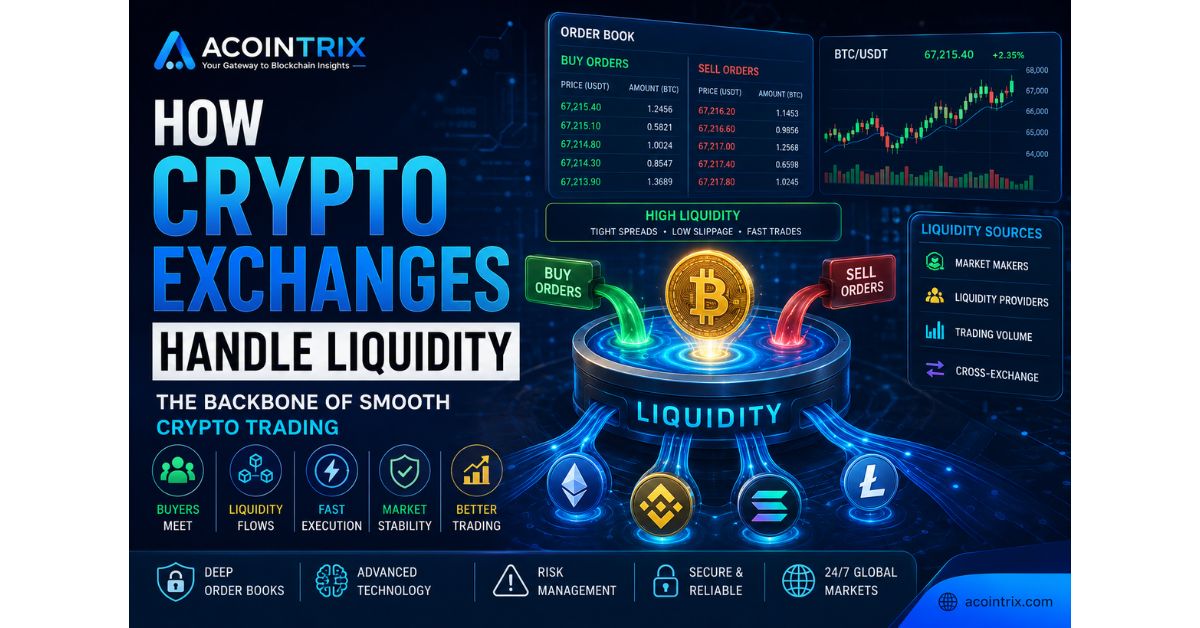
Have you ever wondered how crypto exchanges process millions of dollars in trades within seconds without crashing prices instantly?
Behind every successful crypto trade lies one powerful mechanism: Liquidity.
Without liquidity, crypto markets would become slow, volatile, and nearly impossible to trade efficiently. Whether you’re buying Bitcoin, trading altcoins, or swapping tokens on a decentralised exchange, liquidity is what keeps the crypto ecosystem alive.
In this guide, we’ll explore how crypto exchanges handle liquidity, why it matters, the risks involved, and how leading exchanges maintain smooth trading experiences for millions of users worldwide.
Introduction
The cryptocurrency market operates 24/7, processing billions of dollars in transactions every day. Unlike traditional stock markets that rely on centralised institutions and market hours, crypto exchanges must continuously manage buy and sell activity across global markets.
This is where liquidity becomes essential.
Liquidity determines:
-
- How easily traders can buy or sell assets
-
- How stable prices remain during trades
-
- How fast transactions execute
-
- How reliable does a trading platform feel
A highly liquid crypto exchange allows users to trade large amounts without significantly affecting market prices. On the other hand, poor liquidity often causes slippage, price manipulation, and delayed executions.
As the crypto industry evolves in 2026, liquidity management has become one of the most important competitive advantages for exchanges.
What is Liquidity in Crypto?
Liquidity refers to how quickly and efficiently a cryptocurrency asset can be bought or sold without causing major price fluctuations.
In simple terms:
Higher liquidity = Easier and faster trading
For example:
-
- Bitcoin usually has very high liquidity because millions of traders buy and sell it daily.
-
- Smaller altcoins may have lower liquidity due to limited trading activity.
Crypto exchanges use multiple systems and strategies to ensure sufficient liquidity across trading pairs.
Key Points
Liquidity enables smooth crypto trading.
Exchanges use market makers and liquidity providers.
High liquidity reduces slippage.
Low liquidity increases volatility.
Both centralised and decentralised exchanges depend heavily on liquidity systems.
Advanced algorithms now optimise liquidity management automatically.
Visual Introduction
| High Liquidity | Low Liquidity |
| Faster trades | Slow execution |
| Stable pricing | High volatility |
| Lower slippage | Bigger price swings |
| Better user experience | Poor trading conditions |
| Strong investor confidence | Increased market risk |
Features of Crypto Exchange Liquidity Systems
1. Order Books
Centralised exchanges use order books to match buyers and sellers.
Includes:
-
- Buy orders (bids)
-
- Sell orders (asks)
-
- Market depth
A deep order book indicates strong liquidity.
2. Market Makers
Market makers continuously place buy and sell orders to maintain active trading.
Their role:
-
- Reduce the spread between bid and ask prices
-
- Improve market stability
-
- Increase trade efficiency
Large exchanges often partner with professional liquidity firms.
3. Liquidity Pools
Decentralised exchanges (DEXs) use liquidity pools instead of traditional order books.
Users deposit crypto assets into pools, enabling automated trading through smart contracts.
Popular DEX models rely heavily on:
-
- Automated Market Makers (AMMs)
-
- Yield farming incentives
-
- Token rewards
4. Cross-Exchange Liquidity
Many exchanges aggregate liquidity from multiple platforms.
This helps:
-
- Improve pricing
-
- Increase market depth
-
- Execute large trades efficiently
5. Algorithmic Liquidity Management
AI-driven systems now monitor:
-
- Trading volume
-
- Market volatility
-
- User behavior
-
- Price movement
These systems adjust liquidity dynamically to improve exchange performance.
Benefits of Strong Liquidity
Faster Trade Execution
Orders are filled quickly without delays.
Reduced Slippage
Users get prices close to expected values.
Better Market Stability
Liquidity helps reduce extreme price swings.
Higher User Trust
Traders prefer exchanges with smooth execution.
Increased Institutional Participation
Institutions require deep liquidity for large transactions.
Small Case Study
Example: Bitcoin Trading During Market Volatility
During major Bitcoin price movements, leading exchanges like Binance and Coinbase handled billions in trading volume because of their strong liquidity infrastructure.
Result:
-
- Faster order execution
-
- Lower slippage
-
- Stable market operations
Smaller exchanges with weaker liquidity experienced:
-
- Price gaps
-
- Delayed withdrawals
-
- Wider spreads
Key Learning:
Liquidity directly affects exchange reliability during high-volume events.
How Centralised Exchanges Handle Liquidity
Centralised exchanges (CEXs) like Binance, Kraken, and Coinbase use sophisticated systems to maintain liquidity.
Main Liquidity Sources
Market Makers
Professional firms provide continuous buy/sell activity.
Internal User Activity
Large user bases naturally generate trading volume.
Liquidity Aggregation
Some exchanges connect to external exchanges for deeper liquidity.
Incentive Programs
Reduced trading fees encourage higher activity.
How Decentralised Exchanges Handle Liquidity
Decentralised exchanges operate differently.
Instead of order books, DEXs rely on:
-
- Smart contracts
-
- Liquidity pools
-
- Automated pricing formulas
Example Process
-
- Users deposit tokens into pools.
-
- Traders swap assets against the pool.
-
- Liquidity providers earn transaction fees.
Popular DEX platforms reward providers with:
-
- Yield farming rewards
-
- Governance tokens
-
- Trading fee shares
Risks Associated with Liquidity
1. Liquidity Crises
Sudden market panic can reduce liquidity rapidly.
2. Slippage
Large orders may execute at worse prices.
3. Market Manipulation
Low-liquidity markets are easier to manipulate.
4. Impermanent Loss
DEX liquidity providers may face temporary losses.
5. Flash Crashes
Poor liquidity can trigger rapid price collapses.
Responsibilities of Crypto Exchanges
Crypto exchanges have a responsibility to:
-
- Maintain fair trading conditions
-
- Prevent market manipulation
-
- Protect user funds
-
- Ensure transparent pricing
-
- Monitor suspicious trading activity
Strong liquidity management is essential for maintaining trust and regulatory compliance.
Why Liquidity Matters in Crypto
Supports Mass Adoption
Smooth trading encourages mainstream adoption.
Enables Institutional Trading
Large investors require deep markets.
Improves Market Confidence
Stable trading conditions attract more users.
Reduces Volatility
Healthy liquidity creates balanced markets.
Strengthens Exchange Reputation
Reliable execution improves brand trust.
Real Example / Case Study
Binance Liquidity Leadership
Binance became one of the world’s largest exchanges partly because of its aggressive liquidity strategy.
Their approach included:
-
- Partnering with market makers
-
- Listing high-demand assets
-
- Offering low trading fees
-
- Building massive global trading volume
Outcome:
-
- Strong market depth
-
- Lower spreads
-
- Faster execution
-
- Higher user retention
This demonstrates how liquidity can directly influence exchange growth.
Crypto Liquidity Trends in 2026
AI-Powered Liquidity Engines
Exchanges increasingly use AI for automated liquidity optimisation.
Cross-Chain Liquidity
Platforms now connect liquidity across multiple blockchains.
Institutional Market Makers
Traditional financial firms are entering crypto liquidity markets.
DeFi Liquidity Expansion
Decentralised liquidity pools continue growing rapidly.
Regulatory Oversight
Governments increasingly monitor exchange liquidity practices.
Common Mistakes Traders Make
Ignoring Market Depth
Traders often overlook order book strength.
Trading Illiquid Tokens
Low-liquidity assets carry higher risk.
Using Large Market Orders
This increases slippage significantly.
Ignoring Exchange Reputation
Weak exchanges may struggle during volatility.
Chasing Hype Coins
Many hype tokens lack sustainable liquidity.
Pro Tips for Crypto Traders
Check Trading Volume
Higher volume usually means better liquidity.
Review Order Books
Analyse bid and ask depth before trading.
Use Limit Orders
Reduce slippage risks.
Choose Reputable Exchanges
Large exchanges generally provide better liquidity.
Diversify Trading Platforms
Avoid relying on one exchange alone.
Step-by-Step Guide: How Exchanges Maintain Liquidity
Step 1: Attract Traders
Large user bases generate organic volume.
Step 2: Partner with Market Makers
Professional firms provide active buy/sell orders.
Step 3: Offer Incentives
Reduced fees increase trading participation.
Step 4: Integrate Liquidity Aggregators
Combine liquidity from multiple markets.
Step 5: Use AI Monitoring
Track volatility and adjust liquidity dynamically.
Step 6: Maintain Security & Stability
Reliable infrastructure builds long-term trust.
Expert Quotes
“Liquidity is the foundation of every successful financial market.”
“Crypto exchanges survive not just through users, but through strong liquidity systems.”
“Without liquidity, even the best trading platform struggles to retain traders.”
Future Outlook
The future of crypto trading will heavily depend on advanced liquidity systems.
In the coming years:
-
- AI-driven market making will expand
-
- Institutional liquidity will increase
-
- Cross-chain liquidity networks will dominate
-
- DeFi and CeFi liquidity models may merge
-
- Regulation will shape liquidity transparency standards
Exchanges that master liquidity management will likely lead the next phase of crypto adoption.
Conclusion
Liquidity is one of the most important components of the cryptocurrency ecosystem.
Without proper liquidity:
-
- Trades become inefficient
-
- Volatility increases
-
- User trust declines
Crypto exchanges invest heavily in liquidity management because it directly impacts user experience, market stability, and long-term growth.
As crypto adoption continues expanding globally, exchanges with deeper liquidity, stronger infrastructure, and smarter market systems will dominate the future of digital asset trading.
For traders and investors, understanding liquidity is no longer optional — it is essential for navigating crypto markets safely and effectively.