
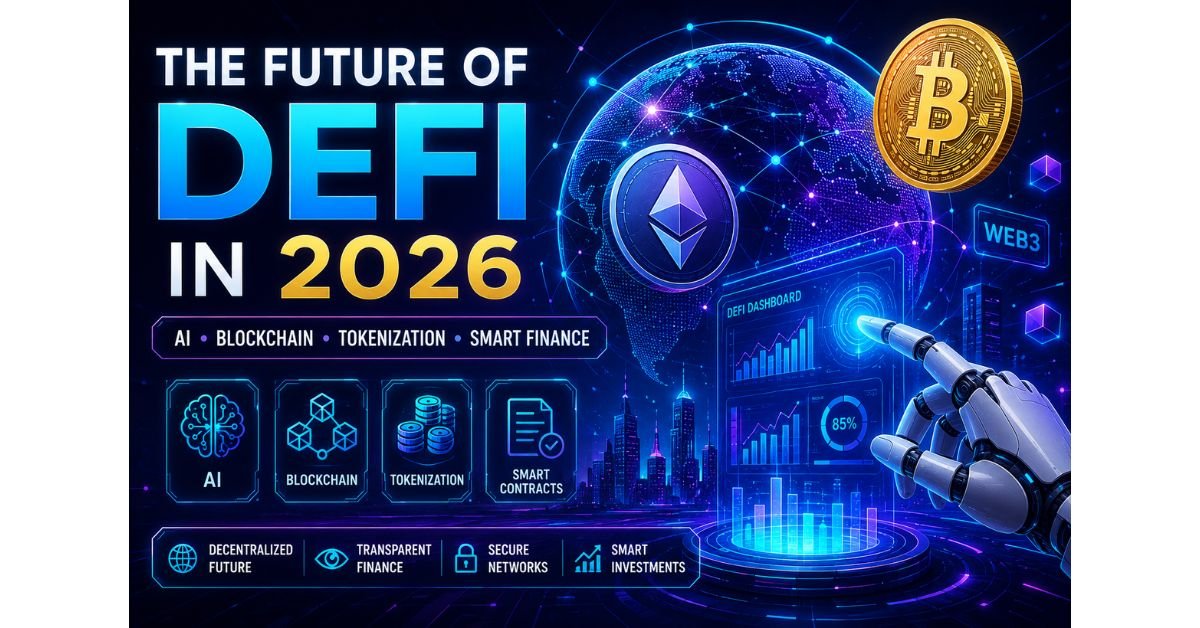
In 2026, DeFi has matured into a regulated, institutional-grade ecosystem with $92B+ in total value locked, stricter compliance under frameworks like MiCA, and growing integration of real-world assets. For investors, this means more stability, but also higher compliance costs and reduced anonymity.
“DeFi in 2026 Is No Longer Experimental — It’s Becoming the Future of Global Finance.”
From decentralized lending and AI-powered smart contracts to tokenized real-world assets and institutional adoption, Decentralized Finance (DeFi) is rapidly transforming the financial ecosystem in 2026.
Introduction
The financial world is evolving faster than ever before, and Decentralized Finance (DeFi) stands at the center of this digital revolution. What started as an experimental blockchain movement has now become one of the most disruptive innovations in modern finance.
In 2026, DeFi is no longer just about crypto trading or yield farming. It is transforming banking, lending, insurance, payments, asset management, and even global financial accessibility. Governments, institutions, startups, and retail investors are actively participating in this rapidly growing ecosystem.
With advancements in blockchain scalability, AI integration, tokenized assets, and regulatory clarity, the future of DeFi looks more promising — and more competitive — than ever.
In this detailed guide, we explore:
- What DeFi means in 2026
- Key changes shaping the future
- Major features and benefits
- Emerging trends
- Risks and responsibilities
- Real-world examples
- Expert insights
- Future opportunities for investors and businesses
If you want to understand where decentralized finance is heading, this guide will help you stay ahead of the curve.
Meaning: What Is DeFi?
Decentralized Finance (DeFi) refers to a blockchain-based financial ecosystem that allows users to access financial services without traditional intermediaries like banks or financial institutions.
DeFi platforms use smart contracts on blockchain networks to automate financial operations securely and transparently.
Common DeFi Services Include:
- Lending and borrowing
- Decentralized exchanges (DEXs)
- Staking
- Yield farming
- Crypto insurance
- Asset management
- Cross-border payments
Unlike traditional finance, DeFi gives users full control over their funds through decentralized applications (dApps) and crypto wallets.
Traditional Finance vs DeFi in 2026
| Traditional Finance | DeFi in 2026 |
|---|
| Banks control transactions | Users control assets |
| Slow international transfers | Instant global transactions |
| Limited banking access | Open financial access |
| High intermediary fees | Lower transaction costs |
| Manual approvals | Automated smart contracts |
| Limited transparency | Transparent blockchain records |
Key Points About DeFi in 2026
- Institutional adoption is accelerating
- AI integration is improving automation
- Real-world asset tokenization is growing
- Cross-chain interoperability is expanding
- Regulatory frameworks are becoming clearer
- Security infrastructure is improving
- DeFi user adoption is increasing globally
Why DeFi Matters in 2026
The future of finance is becoming decentralized because users demand:
- Faster financial services
- Lower fees
- Greater transparency
- Financial inclusion
- Global accessibility
- Full ownership of assets
DeFi solves many limitations of traditional banking systems, especially for unbanked populations and global digital economies.
Features of DeFi in 2026
1. Smart Contract Automation
Smart contracts automatically execute transactions without human intervention.
Features:
- Transparent
- Secure
- Fast execution
- Reduced operational costs
AI-powered smart contracts are becoming smarter and more efficient in 2026.
2. Cross-Chain Compatibility
Modern DeFi platforms now support multiple blockchains.
Benefits:
- Better liquidity
- Faster transfers
- Lower gas fees
- Improved scalability
Cross-chain ecosystems are eliminating blockchain silos.
3. Tokenized Real-World Assets (RWA)
One of the biggest DeFi trends in 2026 is tokenizing real-world assets such as:
- Real estate
- Stocks
- Gold
- Bonds
- Commodities
This bridges traditional finance with blockchain technology.
4. AI Integration
Artificial Intelligence is revolutionizing DeFi platforms through:
- Risk analysis
- Fraud detection
- Automated trading
- Smart investment strategies
- Personalized finance solutions
AI + DeFi is becoming one of the strongest crypto narratives of 2026.
5. Institutional DeFi Participation
Banks and financial institutions are entering the DeFi ecosystem through:
- Tokenized assets
- Blockchain settlements
- Stablecoin payments
- Institutional lending protocols
This is increasing credibility and mainstream adoption.
Benefits of DeFi in 2026
Financial Inclusion
Millions of people without bank accounts can now access financial services using only a smartphone and internet connection.
Faster Transactions
Blockchain technology enables near-instant global transactions without traditional banking delays.
Lower Costs
DeFi reduces:
- Banking fees
- Transfer fees
- Administrative costs
- Currency conversion expenses
Transparency
All blockchain transactions are publicly verifiable, improving trust and reducing corruption risks.
User Ownership
Users maintain control of their assets instead of relying on centralized institutions.
Quick Insights Table
| Aspect | DeFi in 2026 |
| Market Growth | Rapid expansion |
| Main Trend | AI + Tokenization |
| Institutional Adoption | Increasing |
| Security | Improving significantly |
| Regulations | Becoming clearer |
| Cross-Chain Support | Expanding |
| User Growth | Mainstream adoption |
| Biggest Opportunity | Tokenized assets |
Small Case Study
How DeFi Helped Small Businesses Access Global Capital
A small startup in Southeast Asia struggled to obtain loans from traditional banks due to strict requirements and slow approval systems.
Using a DeFi lending platform:
- The company tokenized assets
- Accessed decentralized liquidity pools
- Secured funding globally
- Reduced borrowing costs
Within months, the business expanded operations without depending on traditional financial institutions.
This demonstrates how DeFi is democratizing financial access globally.
What’s Changing in DeFi in 2026
1. Regulatory Clarity
Governments are introducing structured frameworks for:
- Stablecoins
- DeFi taxation
- AML compliance
- Investor protection
Regulations are reducing uncertainty while attracting institutional investors.
2. Better Scalability
Layer-2 networks and advanced blockchain technologies are solving scalability issues.
Benefits include:
- Faster transactions
- Lower fees
- Better user experience
- Improved adoption
3. Enhanced Security
Security remains a top priority.
Modern DeFi platforms now implement:
- Smart contract audits
- AI threat detection
- Multi-signature wallets
- Insurance protocols
4. User-Friendly Interfaces
DeFi applications are becoming easier for beginners.
Platforms now offer:
- Simplified dashboards
- Mobile integration
- AI assistance
- Better onboarding systems
This is helping mainstream adoption.
Real Example / Case Study
Ethereum’s Role in the Future of DeFi
Ethereum continues dominating the DeFi ecosystem in 2026 due to:
- Large developer community
- Strong smart contract infrastructure
- Layer-2 scaling solutions
- Institutional trust
Many DeFi innovations are still being built on Ethereum despite rising competition from newer blockchains.
Top DeFi Trends in 2026
AI-Driven DeFi
AI algorithms are improving:
- Automated investing
- Risk management
- Fraud prevention
Real-World Asset Tokenization
Physical assets are entering blockchain ecosystems rapidly.
Institutional DeFi
Traditional financial institutions are embracing blockchain finance.
DeFi + CBDC Integration
Central Bank Digital Currencies may integrate with DeFi systems in future financial ecosystems.
Sustainable DeFi
Green blockchain solutions and energy-efficient systems are becoming more important.
Common Mistakes in DeFi Investing
1. Ignoring Security Risks
Users often neglect wallet security and fall victim to scams.
2. Chasing Unrealistic Returns
Extremely high APY projects can carry major risks.
3. Not Understanding Smart Contracts
Investing without understanding protocols can lead to financial losses.
4. Lack of Diversification
Relying on a single DeFi platform increases exposure to risk.
Risks of DeFi in 2026
Despite its advantages, DeFi still carries significant risks.
Smart Contract Vulnerabilities
Coding errors can lead to major exploits.
Regulatory Uncertainty
Some countries still lack clear crypto regulations.
Market Volatility
Cryptocurrency price fluctuations impact DeFi investments heavily.
Cybersecurity Threats
Hackers continue targeting DeFi platforms and wallets.
Responsibilities of DeFi Users
Responsible DeFi participation includes:
- Researching platforms carefully
- Using secure wallets
- Understanding risks
- Following regulations
- Diversifying investments
- Avoiding scams
Education remains essential for long-term success.
Pro Tips for DeFi Investors
- Use hardware wallets for large holdings
- Choose audited DeFi protocols
- Diversify investments
- Monitor gas fees
- Follow market trends regularly
- Stay updated on regulations
- Start with small investments
Step-by-Step Guide to Getting Started With DeFi
Step 1: Create a Crypto Wallet
Popular options include MetaMask and Trust Wallet.
Step 2: Buy Cryptocurrency
Purchase assets like ETH or stablecoins through regulated exchanges.
Step 3: Connect to a DeFi Platform
Use decentralized applications safely.
Step 4: Start Small
Begin with low-risk DeFi activities like staking.
Step 5: Learn Risk Management
Understand liquidity, volatility, and protocol risks before scaling investments.
Expert Quotes
“DeFi is evolving from experimental finance into a foundational layer of the global digital economy.”
— Blockchain Industry Analyst
“Tokenized real-world assets could become one of the largest financial innovations of this decade.”
— Web3 Investment Researcher
Points Recap
- DeFi is transforming global finance
- AI integration is accelerating innovation
- Institutional adoption is increasing
- Tokenized assets are becoming mainstream
- Security and regulations are improving
- Risks still exist and require caution
Future Outlook
The future of DeFi in 2026 and beyond looks highly promising.
Expected developments include:
- Mainstream financial adoption
- AI-powered financial ecosystems
- Tokenized global assets
- Advanced blockchain interoperability
- Better security infrastructure
- Stronger regulatory frameworks
DeFi could eventually become a core pillar of the global financial system.
Conclusion
The future of DeFi in 2026 represents one of the biggest transformations in modern finance. What once seemed like a niche blockchain experiment is now becoming a powerful global financial ecosystem driven by decentralization, transparency, automation, and innovation.
With AI integration, institutional participation, tokenized real-world assets, and evolving regulations, DeFi is creating new opportunities for businesses, investors, and everyday users worldwide.
However, success in DeFi requires education, security awareness, and responsible investing. As the industry matures, those who understand its potential early may gain significant advantages in the digital economy of the future.
The next generation of finance is not just digital — it is decentralized.
FAQ Section
What is DeFi in simple words?
DeFi is a blockchain-based financial system that allows people to access banking-like services without traditional banks.
Is DeFi safe in 2026?
DeFi is becoming safer due to audits and improved security, but risks like hacks and scams still exist.
Why is DeFi growing rapidly?
DeFi offers faster transactions, lower fees, transparency, and financial accessibility globally.
What are the biggest DeFi trends in 2026?
AI integration, tokenized assets, institutional adoption, and cross-chain interoperability are major trends.
Can beginners invest in DeFi?
Yes, but beginners should start slowly, research platforms carefully, and understand risks before investing heavily.